Add your promotional text...
A Balanced Diet for Your Plants: The Science of Soil Amendments
Source & Further Information: The findings and concepts discussed in this article are largely based on the research presented in the following scientific paper: Ayamba BE, Abaidoo RC, Opoku A, Ewusi-Mensah N. Mechanisms for nutrient interactions from organic amendments and mineral fertilizer inputs under cropping systems: a review. PeerJ. 2023 Apr 4;11:e15135. doi: 10.7717/peerj.15135. PMID: 37033729; PMCID: PMC10081454. We encourage readers interested in the detailed methodology and complete results to consult the original publication.
1/26/20263 min read
Introduction: The Challenge of Tired Soil
For anyone who grows plants, from a farmer managing vast fields to a gardener tending a small plot, there's a common challenge: declining soil fertility. Over time, crops pull nutrients from the soil, leading to smaller yields and weaker plants. For years, the go-to solution has been to replenish these nutrients. But what's the best way to do it?
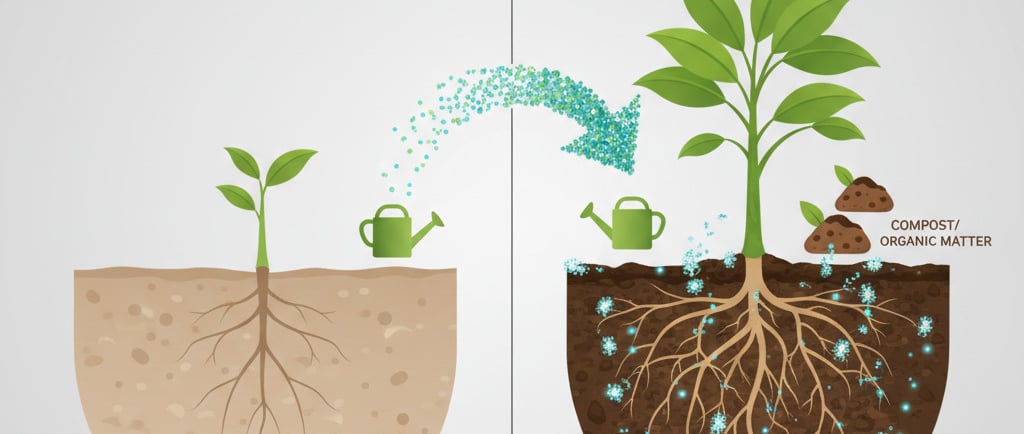
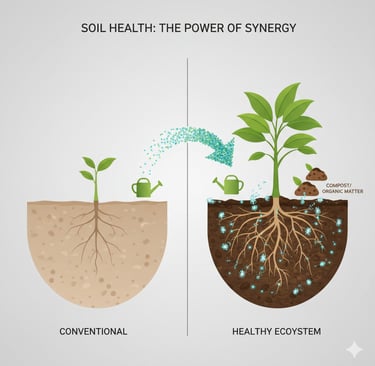
While chemical fertilizers provide a quick hit of specific nutrients, and organic amendments like compost or manure build soil health over time, researchers have found that the real magic often happens when you combine them. Using both together can lead to surprisingly large increases in crop yields, far more than either could achieve alone. But why? This "1 + 1 = 3" effect isn't just a happy accident. Scientists have identified several key mechanisms that explain how this powerful partnership works.
1. Perfect Timing is Everything (Nutrient Synchrony)
Imagine a plant as a growing child; its appetite changes as it gets older. A young seedling needs just a little food, but a plant entering its rapid growth phase (like maize before tasselling) or producing fruit becomes incredibly hungry.
Mineral fertilizers are like a quick snack – they release nutrients rapidly, which is great for hungry plants but can be wasteful if the plant isn't ready to use them all. Excess nutrients can wash away or be lost.
Organic amendments (like compost) are like a slow-cooker meal – they break down slowly, releasing nutrients over a longer period.
By combining the two, you achieve Nutrient Synchrony. The mineral fertilizer provides the immediate nutrients the plant needs for a growth spurt, while the organic matter continues to release a steady supply of food over the weeks and months, ensuring the plant is fed throughout its entire life cycle. This "right nutrient at the right time" approach dramatically improves efficiency and reduces waste.
2. Waking Up the Soil's Workforce (The Priming Effect)
Soil is teeming with a microscopic workforce of bacteria and fungi. These microbes are responsible for breaking down complex soil organic matter into the simple nutrients that plants can absorb. Sometimes, this workforce can become a bit sleepy.
When you add fresh, easily-degradable organic matter (like compost), it acts like a jolt of caffeine for these microbes. This is called the Priming Effect. The sudden influx of an easy food source stimulates the microbes into a frenzy of activity. As they multiply and work, they don't just consume the fresh material; they also start breaking down the older, more stable organic matter that was already in the soil, releasing a hidden reserve of nutrients for your plants. It's a short-term but powerful boost that unlocks the soil's existing fertility.
3. Building a Better Foundation (General Soil Fertility Improvement)
Think of soil as a plant's home. It's not just a pantry for nutrients; it also needs good structure, the right pH, and the ability to hold onto water and nutrients.
Mineral fertilizers are great at stocking the pantry with specific items (like Nitrogen, Phosphorus, Potassium).
Organic amendments are the architects and builders. They improve the physical structure of the soil, help it hold more water, buffer the pH, and increase its ability to hold onto nutrients (a property called cation exchange capacity).
When you combine them, the organic matter improves the "home" so the plant can make much better use of the "food" supplied by the mineral fertilizer. For example, by improving the soil's ability to hold onto nutrients, the organic matter prevents the quick-release mineral fertilizer from simply washing away, making it available to the plant for longer.
4. Providing a Complete & Balanced Diet (Balanced Nutrient Ratios)
Plants, like us, need a balanced diet. They require a wide range of nutrients, from the big three (Nitrogen, Phosphorus, Potassium - NPK) to secondary nutrients (Calcium, Magnesium) and a host of micronutrients (like Zinc, Iron, Boron).
Mineral fertilizers are often high in just a few key nutrients (NPK).
Organic amendments typically contain a much wider, more diverse range of micronutrients.
Applying only a high-nitrogen fertilizer can actually cause problems. For instance, too much of one nutrient can block the plant's ability to absorb another—a phenomenon known as antagonism. High nitrogen can decrease potassium availability, and high phosphorus can inhibit zinc uptake.
By combining organic matter with mineral fertilizer, you provide a more complete nutritional profile. You're not just giving the plant a single-vitamin pill; you're serving it a full, balanced meal with all the essential vitamins and minerals it needs to reach its full genetic potential. This balanced approach prevents deficiencies and ensures all nutrients can work together effectively.
Conclusion: A Smarter Way to Feed Our Soil
Understanding these four mechanisms shows us that combining organic and mineral inputs isn't just about adding more food; it's about creating a smarter, more efficient system. By timing nutrient release, stimulating microbial life, improving soil structure, and providing a balanced diet, this integrated approach helps us grow healthier, more productive crops. This knowledge is vital for promoting sustainable agriculture and ensuring food security for a growing world.