Add your promotional text...
A Nano-Boost for Your Brew: How Tiny Zinc Particles Supercharge Tea Plants
Source & Further Information: The findings and concepts discussed in this article are largely based on the research presented in the following scientific paper: Chen H, Song Y, Wang Y, Wang H, Ding Z, Fan K. Zno nanoparticles: improving photosynthesis, shoot development, and phyllosphere microbiome composition in tea plants. J Nanobiotechnology. 2024;22(1):389. Published 2024 Jul 2. doi:10.1186/s12951-024-02667-2. We encourage readers interested in the detailed methodology and complete results to consult the original publication.
9/15/20252 min read
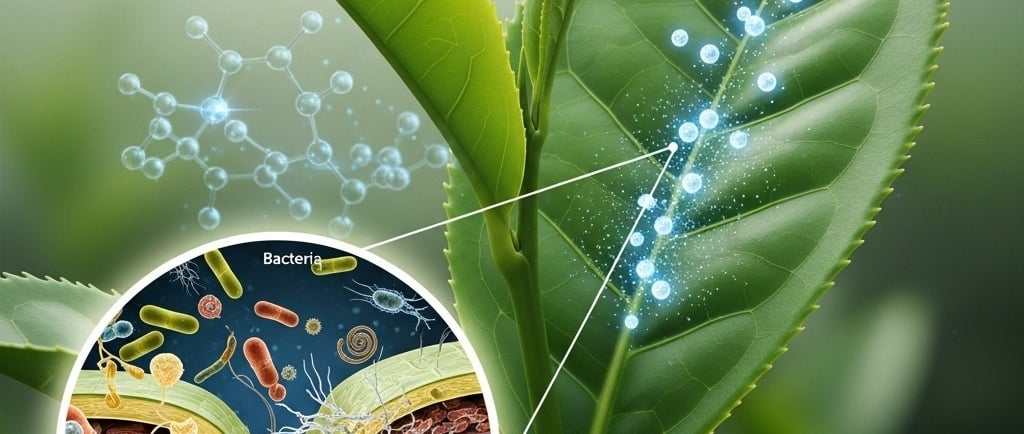
Imagine giving your favorite tea plant a vitamin shot so tiny it's invisible, yet powerful enough to make it healthier, grow faster, and even fight off bad germs. That's the revolutionary promise of nanotechnology in agriculture. A recent study delved into how zinc oxide nanoparticles (ZnO NPs)—particles thousands of times smaller than a human hair—can create a supercharged environment for tea plants, the source of one of the world's most beloved beverages. Researchers explored how this nano-boost affects the plant's energy production, growth, and the microscopic world of microbes living on its leaves.
Fueling the Growth Engine
Photosynthesis is the solar-powered engine of any plant, converting sunlight into the sugars needed for growth. For tea plants, a more efficient engine means more energy, which leads to more new shoots—the very parts harvested to make high-quality tea.
This study found that spraying tea leaves with a solution of ZnO NPs kicked this engine into high gear. Treated plants showed a significant increase in their net photosynthetic rate. They were essentially "breathing in" more CO2 and using it more efficiently. This was backed up by several key findings:
More Chlorophyll: The plants produced more chlorophyll, the green pigment essential for capturing sunlight.
Better Light Use: Key indicators showed the plant's internal machinery for using light energy (photosystem II) was working more effectively.
More Photosynthetic Products: Advanced analysis revealed that the leaves accumulated more sugars, like sucrose. This is the direct, usable fuel created by photosynthesis.
This energy boost had a direct, visible effect: the tea plants sprouted more new shoots. The study also found that ZnO NPs increased the levels of auxin, a key plant hormone that acts as a powerful signal for bud development and growth. More fuel and a stronger "grow" signal resulted in healthier, more productive plants.
A Shift in the Leaf's Ecosystem
Every leaf is home to a bustling, invisible city of microorganisms known as the phyllosphere. This community of bacteria and fungi—some living on the surface (epiphytes) and some inside the leaf tissue (endophytes)—plays a huge role in the plant's health, much like our gut microbiome does for us. They can help with nutrient absorption, produce beneficial hormones, and even protect against disease.
The researchers hypothesized that since ZnO NPs have antimicrobial properties, they would likely shake up this microbial city. Their findings were striking:
A New Community: The application of ZnO NPs significantly changed the composition of both the surface and internal microbial communities. Different types of bacteria and fungi became dominant compared to the untreated plants.
Beneficial Microbes Favored: Interestingly, this wasn't a random wipeout. The new dominant species included well-known beneficial bacteria like Bacillus, which is known to promote plant growth and photosynthesis.
Pathogens Suppressed: Functional analysis revealed that the abundance of microbes associated with "plant pathogen" functions was significantly reduced in the treated plants. The ZnO NPs appeared to act like a selective "bouncer," discouraging potential troublemakers while allowing beneficial residents to thrive.
A Tiny Particle with a Big Impact
This study paints a comprehensive picture of how zinc oxide nanoparticles can act as a powerful biostimulant for tea plants. By directly enhancing the machinery of photosynthesis and boosting growth hormones, they promote the development of more valuable new shoots. Simultaneously, they reshape the leaf's microbiome into a healthier, more protective community. These findings provide strong evidence for the potential of nanotechnology to create more sustainable and productive agricultural practices, helping us grow healthier crops for a healthier world.