Add your promotional text...
Beyond Chemicals: The Microbial Revolution in Your Soil
Source & Further Information: The findings and concepts discussed in this article are largely based on the research presented in the following scientific paper: Kumar S, Diksha, Sindhu SS, Kumar R. Biofertilizers: An ecofriendly technology for nutrient recycling and environmental sustainability. Curr Res Microb Sci. 2021 Dec 20;3:100094. doi: 10.1016/j.crmicr.2021.100094. PMID: 35024641; PMCID: PMC8724949. We encourage readers interested in the detailed methodology and complete results to consult the original publication.
12/24/20253 min read
The Problem with Our Modern Fields
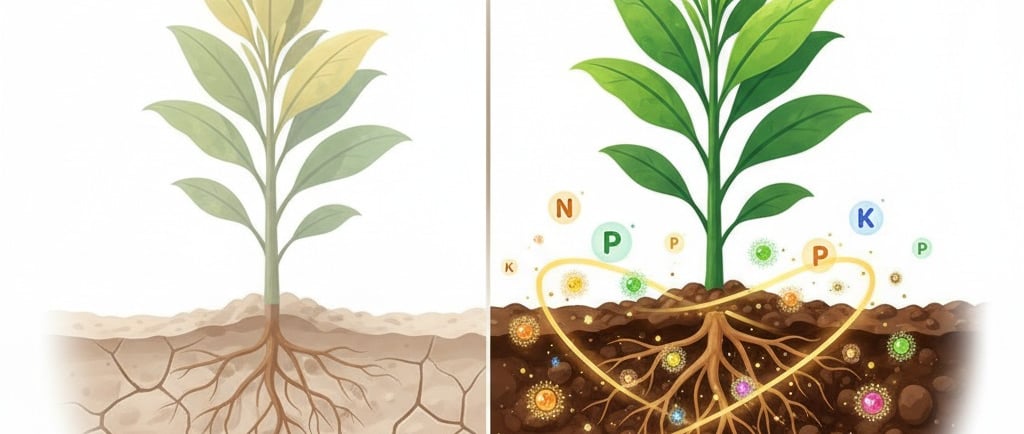
Feeding a growing planet is one of humanity's greatest challenges. For decades, our primary solution has been to use chemical fertilizers and pesticides to boost crop production. While this has helped increase yields, it's come at a steep cost. The overuse of these agrochemicals is degrading our farmlands, polluting our water, and even posing risks to public health. Our soil—the very foundation of agriculture—is losing its vitality, its natural balance of nutrients, and its rich biological life.
Think of it like this: we've been giving our fields a diet of "fast food" instead of nourishing, whole foods. The result is soil that's less resilient and an environment under strain. But what if there was a better, more natural way? A powerful, eco-friendly solution is already living right under our feet: beneficial microbes. Harnessing these tiny allies in what are called biofertilizers is emerging as a game-changing technology for sustainable agriculture.
The Root Zone Buffet: Where Plants and Microbes Meet
To understand biofertilizers, you first need to know about the rhizosphere. This is the bustling, microscopic world of soil immediately surrounding a plant's roots. It's not just dirt; it's a vibrant ecosystem. Plants cleverly release a significant portion of the sugars they make from photosynthesis—up to 50% in some cases!—out through their roots. This sugary cocktail of "root exudates" acts like a dinner bell, attracting a huge and diverse community of bacteria, fungi, and other microorganisms.
In this busy "root zone buffet," a fascinating partnership forms. The plant provides food (sugars), and in return, many of these microbes provide essential services. Scientists are now learning how to identify the most helpful of these microbes and apply them to crops to improve health and yield.
How Do Biofertilizers Actually Work? The Microbial Toolkit
Beneficial microbes, often called Plant Growth-Promoting Rhizobacteria (PGPR), help plants in two main ways: directly and indirectly.
Direct Mechanisms: The Growth Boosters
Unlocking Nutrients: A lot of the nutrients in soil (like phosphorus and potassium) are "locked up" in forms that plants can't use. Certain microbes act like tiny miners or chefs, producing acids and enzymes that break down these complex compounds and "unlock" the nutrients, making them available for the plant roots to absorb.
Fixing Nitrogen from the Air: Nitrogen is essential for plant growth, but plants can't get it from the air. Some brilliant bacteria (like Rhizobium in legumes or free-living Azotobacter) can capture atmospheric nitrogen and convert it into a usable form for the plant—a natural, self-sustaining fertilizer factory!
Producing Plant Hormones: These microbes also produce their own versions of plant hormones like auxins and gibberellins. These hormones act as powerful growth stimulants, encouraging stronger, longer, and more branched root systems, which in turn makes the plant better at finding water and nutrients.
Indirect Mechanisms: The Plant Protectors
Starving Out Pathogens (Siderophores): Iron is another vital nutrient that both plants and harmful pathogens need. Beneficial microbes are masters at producing special molecules called siderophores that are extremely good at scavenging iron from the soil. By grabbing all the available iron, they effectively starve out competing harmful fungi and bacteria.
Acting as Microbial Bodyguards: Many beneficial microbes produce natural antibiotics or enzymes (like chitinases) that directly attack and inhibit the growth of disease-causing pathogens in the soil. They act like a tiny security force protecting the plant's roots.
"Vaccinating" the Plant (Induced Systemic Resistance): The mere presence of beneficial microbes can put a plant's own immune system on high alert. This process, called Induced Systemic Resistance (ISR), "primes" the plant to respond faster and more strongly if it's attacked by a real pathogen later. It's like a natural vaccination that boosts the plant's overall resilience.
The Future is Microscopic
The journey from a lab discovery to a successful product on a farmer's field isn't always simple. Scientists are working hard on better ways to formulate these biofertilizers—creating stable liquid versions, microencapsulating them for protection, or even creating "biofilms" where different microbes work together.
The goal is to create robust, effective biofertilizers that can reduce our reliance on chemical inputs. By embracing these eco-friendly technologies, we can work towards a future of "climate-smart" agriculture—restoring soil fertility, protecting our environment, and sustainably feeding the world.