Add your promotional text...
Beyond Cuttings: The High-Tech Future of Cannabis Cultivation
Source & Further Information: The findings and concepts discussed in this article are largely based on the research presented in the following scientific paper: Adhikary D, Kulkarni M, El-Mezawy A, Mobini S, Elhiti M, Gjuric R, Ray A, Polowick P, Slaski JJ, Jones MP, Bhowmik P. Medical Cannabis and Industrial Hemp Tissue Culture: Present Status and Future Potential. Front Plant Sci. 2021 Mar 3;12:627240. doi: 10.3389/fpls.2021.627240. PMID: 33747008; PMCID: PMC7968383. We encourage readers interested in the detailed methodology and complete results to consult the original publication.
11/26/20253 min read
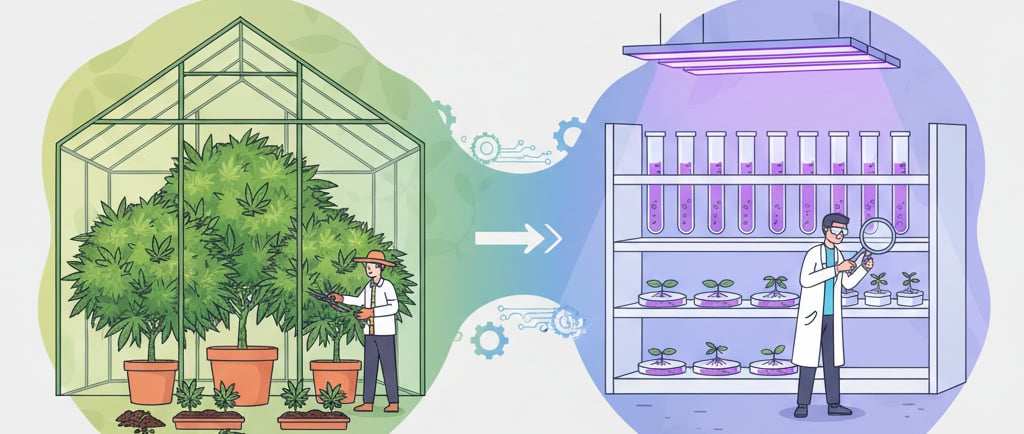
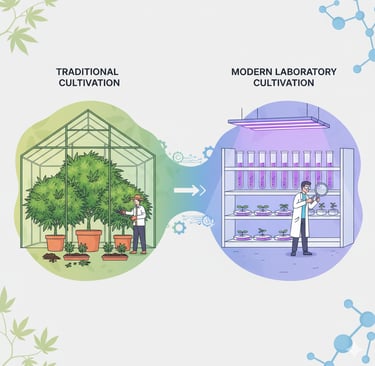
For thousands of years, cannabis has been intertwined with human history, serving as a source of fiber, food, and medicine. But despite its long history, this multi-billion-dollar industry is still grappling with a fundamental challenge: how to grow consistent, clean, and high-quality plants at a massive scale. The traditional method of taking cuttings from "mother plants" has its limits. Now, scientists and modern cultivators are turning to advanced lab techniques, broadly known as tissue culture, to unlock the full potential of this valuable crop.
The Problem with Traditional Cannabis Cloning
If you want a cannabis plant that’s genetically identical to its parent—a crucial requirement for producing medical products with precise cannabinoid levels (like THC and CBD)—you can't just plant a seed, which creates genetic variation. The go-to method has been "cloning" by taking stem cuttings.
While this works, it comes with serious drawbacks:
Space & Vigor: Maintaining large "mother plants" to take cuttings from requires a huge amount of space, sometimes up to 25% of a cultivation facility. Over time, these plants can lose their vigor.
Disease Risk: Mother plants are susceptible to pests and diseases, like the notorious Hop Latent Viroid, which can be unknowingly passed to every single cutting, potentially ruining an entire crop.
Low Multiplication Rate: It's a slow, manual process that isn't cost-effective for the massive scale the modern industry demands.
The Solution: Clean, Consistent Clones from the Lab
Enter in vitro micropropagation, or tissue culture. This is the science of growing plants in a sterile, lab-controlled environment using tiny pieces of plant tissue (explants). For crops like potatoes, strawberries, and bananas, this has been the standard for decades, ensuring farmers get disease-free, genetically identical starting material.
For cannabis, this approach offers game-changing advantages:
Disease-Free Plants: By starting cultures from clean, tested tissue, you can produce millions of clones guaranteed to be free of viruses, fungi, and other pathogens.
Genetic Purity: Every plant is a true-to-type copy of the elite original, ensuring consistency in growth, cannabinoid profiles, and therapeutic effects.
Massive Scale: A small lab can produce exponentially more plants than a traditional cloning room, saving huge amounts of space and ultimately reducing production costs.
Despite these benefits, cannabis has been notoriously difficult to work with in tissue culture. Many achievements have been kept as trade secrets by competitive companies. However, recent research is breaking down these barriers, optimizing protocols for rooting and growth to make this technology more accessible and reliable.
Beyond Cloning: The Future of Cannabis Breeding is in the Lab
Tissue culture is more than just a better way to clone; it's the foundation for a whole suite of advanced biotechnologies that can accelerate cannabis breeding and create novel varieties. Here are some of the exciting frontiers:
Genetic Transformation & Gene Editing (CRISPR):
Want to create a hemp variety that produces more of a rare, medically interesting cannabinoid, or "knock out" the gene that produces THC? Genetic transformation is the key. While early attempts were difficult, new tools like CRISPR-Cas9 offer a precise way to edit a plant's DNA. This is much faster than traditional breeding and can create targeted improvements. Since gene-edited plants don't always contain foreign DNA, they face fewer regulatory hurdles than traditional GMOs in some regions.Cleaning Up Plants (Meristem Culture):
The very tip of a growing plant shoot (the apical meristem) is often free of viruses, even if the rest of the plant is infected. Scientists can carefully dissect this tiny piece of tissue and grow it into a completely new, virus-free plant, effectively "laundering" valuable genetics to create clean stock material.Synthetic Seeds & Long-Term Storage:
Imagine a tiny, encapsulated plant bud that can be stored, transported, and germinated like a regular seed, but grows into a genetically identical clone. This "synthetic seed" technology is a major goal. Furthermore, cryopreservation—storing plant material in liquid nitrogen at -196°C—offers a way to preserve valuable cannabis genetics for decades without the risk of disease or genetic drift that comes from maintaining live mother plants.
The Challenges and the Path Forward
While the potential is enormous, there are still hurdles. Cannabis can be "recalcitrant" (stubborn) in tissue culture, and a protocol that works for one strain may not work for another. The risk of somaclonal variation—small genetic mutations that can occur during the culture process—must also be carefully managed to ensure clones remain true-to-type.
Despite these challenges, the cannabis industry is rapidly adopting these scientific approaches. From reducing production costs with high-throughput micropropagation to developing new medical and industrial varieties through gene editing, tissue culture is the key to unlocking a more sustainable, consistent, and innovative future for both high-THC cannabis and industrial hemp.