Add your promotional text...
Beyond N-P-K: Listening to the Biochemical Buzz of Fertile Grasslands
Source & Further Information: The findings and concepts discussed in this article are largely based on the research presented in the following scientific paper: Wang L, Hamel C, Lu P, Wang J, Sun D, Wang Y, Lee SJ, Gan GY. Using enzyme activities as an indicator of soil fertility in grassland - an academic dilemma. Front Plant Sci. 2023 Jul 7;14:1175946. doi: 10.3389/fpls.2023.1175946. PMID: 37484467; PMCID: PMC10360189. We encourage readers interested in the detailed methodology and complete results to consult the original publication.
12/5/20254 min read
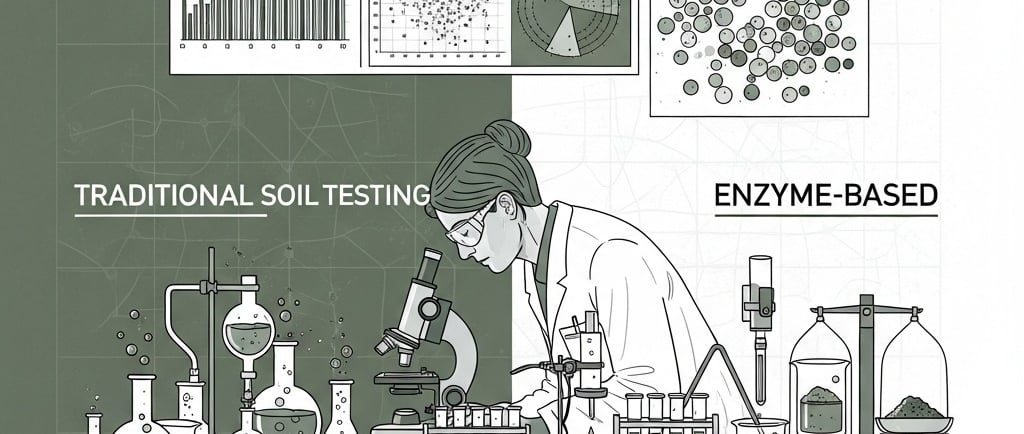
How do we know if soil is truly fertile? For decades, the answer has involved scooping up dirt, sending it to a lab, and running a battery of slow, expensive tests for things like carbon, nitrogen, and phosphorus. This process is crucial for managing our vast and vital grasslands, which conserve biodiversity and support global food systems. But what if there was a faster, cheaper, and more dynamic way to take the pulse of the soil? Researchers are debating a fascinating alternative: listening to the buzz of biochemical activity by measuring soil enzymes.
What is Soil Fertility, Really?
Before we dive into enzymes, it's worth remembering that "soil fertility" is more than just a chemical nutrient count. It’s the soil's overall ability to support healthy plant life. This means having the right physical structure, a balanced chemical environment, and a thriving community of biological organisms all working together to provide plants with water, air, stability, and of course, essential nutrients. Measuring this complex web of properties has traditionally been a laborious process.
The Enzyme Proposition: A Biological Shortcut?
This brings us to the exciting idea at the heart of the scientific debate. Could measuring the activity of soil enzymes—the tiny protein catalysts that drive almost all biochemical reactions in the soil—give us a reliable shortcut to understanding soil fertility?
The logic is compelling. Soil is teeming with enzymes released by microbes and plant roots. These enzymes are the tireless workers that:
Break down dead organic matter (like fallen leaves and old roots).
Cycle vital nutrients like carbon (C), nitrogen (N), and phosphorus (P).
Convert these nutrients into forms that plants can actually absorb.
In short, enzyme activity is the engine of soil life. Proponents of this new method argue two main points:
Enzyme activity is a sensitive early-warning system. It can change much more quickly in response to disturbances (like grazing, fertilization, or drought) than the total amount of carbon or nitrogen, giving us a real-time indicator of soil health.
Testing for enzymes is relatively fast, easy, and cheap compared to traditional, multi-parameter soil chemistry tests.
The Dilemma: Why Isn't Everyone Doing It?
If it sounds too good to be true, that’s because there are significant hurdles—what the paper calls an "academic dilemma." While promising, using enzymes as a direct proxy for fertility has several major problems:
Wildly Variable Results: In some studies, enzyme activity in degraded soils can swing dramatically—from just 16% to a whopping 260% of the activity in healthy soil. Such a wide range makes it incredibly difficult to create a reliable "fertility score."
Weak or Unknown Connections: The link between some enzymes and specific fertility properties can be weak or even nonexistent in certain conditions.
Extreme Sensitivity: Enzyme activity can be heavily influenced by short-term environmental changes like a sudden temperature spike or a brief dry spell. This "hyper-sensitivity" might reflect the weather of the day rather than the soil's stable, long-term fertility.
Contradictory Effects of Farming: Here’s a major paradox: adding nitrogen or phosphate fertilizer clearly makes soil more fertile for crops, but it often suppresses the activity of the very enzymes (like urease and phosphatase) that cycle those nutrients naturally. So, a highly fertile, fertilized field might show lower enzyme activity, leading to a completely backward interpretation.
How Enzymes Work: A Quick Biochemistry Refresher
To understand the debate, it helps to know what enzymes do. Think of an enzyme as a tiny molecular machine with a specific shape (an "active site"). It grabs onto a specific molecule (its "substrate"), performs a chemical reaction (like breaking it down), and releases the new products. For example, the enzyme urease grabs urea (a nitrogen compound) and breaks it down to release ammonia, a form of nitrogen that plants can use.
In grasslands, enzymes like β-glucosidase help release carbon to fuel soil life, while phosphatase frees up phosphorus. Each enzyme has a specific job in the grand scheme of nutrient cycling, and their combined activity reflects the overall metabolic pulse of the soil ecosystem.
The Impact of How We Manage Grasslands
Real-world studies show just how complex these enzyme responses are. How we manage grasslands—through grazing, fertilizing, mowing, or converting them to cropland—has a profound and often inconsistent impact on soil life and enzyme activity.
Grazing: Heavy grazing often reduces microbial biomass and enzyme activity. Yet, in some ecosystems, moderate grazing has been shown to increase nutrient availability and the activity of certain enzymes. There is no one-size-fits-all answer.
Fertilizer: Adding nitrogen can be a double-edged sword. While it boosts plant growth, it can suppress the natural microbial community and the enzymes involved in the nitrogen cycle.
Mowing: Removing plant biomass through mowing can starve the soil of fresh carbon input, leading to a decline in microbial life and enzyme production.
Land Conversion: Turning grassland into cropland almost always leads to a loss of soil organic matter and a major shift in the microbial community and its enzymatic activity.
These complex interactions show that simply measuring one or two enzymes might not tell the whole story of soil fertility, as management practices can dramatically alter the relationship between biochemical activity and nutrient availability.
The Path Forward: Can the Dilemma Be Solved?
So, are soil enzymes a dead end as a fertility indicator? Not necessarily, but the scientific community agrees that we're not ready for a simple "enzyme dipstick" for soil health just yet. To make this approach reliable, researchers suggest we need:
Standardization: Everyone needs to use the same standardized methods for sampling soil and measuring enzyme activity so results can be compared across different studies and ecosystems.
Systematic Research: We need more long-term studies across many different soil types and climates to identify which specific enzymes (or combination of enzymes) are the most reliable indicators for specific fertility traits.
Better Data & Models: Building large, standardized datasets will be crucial for calibrating enzyme tests and creating models that can accurately interpret what the results mean for overall soil fertility.
Conclusion: A Promising but Unfinished Tool
Soil enzymes offer a tantalizing glimpse into the real-time biochemical health of our grasslands. They are sensitive, cost-effective, and provide timely information. However, their very sensitivity to short-term changes and complex reactions to management practices means they are not yet a reliable standalone indicator of long-term soil fertility. For now, the old-school, labor-intensive methods remain the gold standard. But with more focused research and standardization, the hum of enzymatic activity might one day become a key part of how we quickly and effectively monitor the health of our planet’s vital grassland soils.