Add your promotional text...
Beyond Sprays: Integrated Disease Management for Greenhouse Cannabis
Source & Further Information: The findings and concepts discussed in this article are largely based on the research presented in the following scientific paper: Buirs L, Punja ZK. Integrated Management of Pathogens and Microbes in Cannabis sativa L. (Cannabis) under Greenhouse Conditions. Plants (Basel). 2024 Mar 10;13(6):786. doi: 10.3390/plants13060786. PMID: 38592798; PMCID: PMC10974757. We encourage readers interested in the detailed methodology and complete results to consult the original publication.
2/20/20264 min read
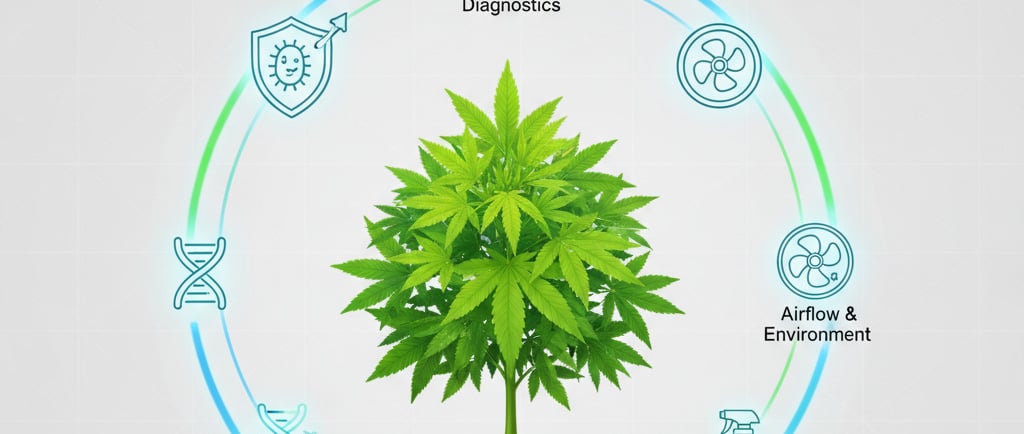
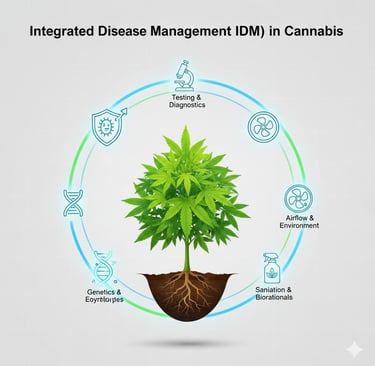
As cannabis cultivation moves into modern greenhouses, growers are facing an old agricultural challenge: a rise in diseases that can devastate crop quality and yield. From root rots to the dreaded bud mold, a host of pathogens are thriving in these environments. So, what’s a modern grower to do, especially when traditional chemical fungicides are off the table?
The answer lies in a smart, multi-layered strategy called Integrated Disease Management (IDM).
What is Integrated Disease Management (IDM)?
Think of IDM as building a fortress, not just fighting battles. Instead of relying on a single "magic bullet" spray, IDM combines multiple tactics—prevention, monitoring, and control—to create a resilient growing system that keeps pathogens in check. It’s a proactive approach that’s been successful in agriculture for decades, and it’s perfectly suited for cannabis.
The challenge? The cannabis industry faces unique hurdles. There are no registered synthetic fungicides, disease-resistant cultivars are still rare, and even the optimal growing conditions aren't fully standardized. This makes a well-designed IDM program not just a good idea, but an absolute necessity.
Let's break down the key enemies and the tools in your IDM arsenal.
Meet the Main Culprits: Key Cannabis Diseases
Several pathogens are notorious in greenhouse cannabis cultivation:
Root Rots (Fusarium & Pythium): These soil-borne fungi attack the roots, causing browning, poor growth, yellowing leaves, and plant decline. They thrive in overly wet conditions.
Bud Rot (Botrytis cinerea): The bane of the flowering stage, this fuzzy grey mold infects dense buds, turning them mushy and unusable. It loves high humidity and poor airflow.
Powdery Mildew: Appears as a white, dusty coating on leaves, stealing nutrients from the plant and reducing its photosynthetic ability.
Hop Latent Viroid (HLVd): The Silent Killer. This is one of the most significant modern threats. A viroid (simpler than a virus), HLVd often shows no obvious symptoms on mother plants but causes "stunt disease" in the cuttings taken from them. Infected plants show weak rooting, strange branching, stunted growth, and significantly reduced yield and potency. It's a stealthy threat that can spread throughout an operation before it's even noticed.
The IDM Toolkit: Your Lines of Defense
An effective IDM plan combines several strategies across the entire life cycle of the plant.
Start Clean, Stay Clean (Biosecurity & Sanitation): This is your foundation.
Quarantine: Any new plants brought into your facility must be isolated for 3-4 weeks, monitored, and tested for pathogens like HLVd before being introduced to your main crop.
Sanitation: Regularly and thoroughly clean all surfaces, tools, pots, and irrigation lines with reduced-risk sanitizers (like hydrogen peroxide-based products).
Smart Genetics (Tolerant Genotypes): While highly resistant cultivars are rare, significant variation exists. Some genotypes show natural tolerance to powdery mildew or bud rot. Selecting and cultivating these more robust plants is a powerful, built-in defense.
Know Your Enemy (Testing & Monitoring): You can't fight what you can't see.
Scouting: Regularly inspect your plants for any signs of disease.
Testing: Use lab services (PCR tests) to routinely test stock plants for hidden threats like Fusarium, Pythium, and especially HLVd. Early detection is critical for eradication.
Control the Climate (Environmental Management): Pathogens thrive in specific conditions. By managing your greenhouse climate, you can make it inhospitable for them. This includes controlling temperature, optimizing airflow with fans, and, most importantly, managing relative humidity, especially during the flowering stage to combat bud rot.
Fight Fire with Fungi (Biological Controls): Since synthetic fungicides aren't an option, growers can use beneficial microbes as a shield.
Biocontrol Agents: Products containing beneficial fungi like Trichoderma or Gliocladium can be applied to the roots as a drench. These microbes colonize the root zone, protecting the plant from root rot pathogens.
Biorational Products: These are reduced-risk products, often derived from natural sources (like plant extracts or minerals), that can suppress diseases like powdery mildew when applied preventatively.
IDM in Action: A Plant's Life Cycle
Your IDM strategy must adapt as the plant grows:
Stock (Mother) Plants: This is the most critical stage. The health of your entire crop begins here. The #1 priority is keeping these plants pathogen-free, especially from the silent HLVd. Rigorous testing, culling infected plants, and strict sanitation are non-negotiable.
Propagation (Cuttings): Cuttings are vulnerable. This is the perfect time to apply a preventative drench of a biological control agent to protect the developing roots from damping-off caused by Fusarium. High humidity here means you must watch for early signs of mold.
Vegetative Growth: As plants grow, continue monitoring for powdery mildew and signs of root stress. This is also a stage where UV-C light treatments have shown potential for suppressing mildew.
Flowering: The high-stakes stage. Plant biomass increases, raising humidity. This is prime time for bud rot (Botrytis). Your main weapons here are environmental control—crank up the airflow and keep humidity in check. Preventative sprays of certain biocontrols have also shown promise in reducing both bud rot and powdery mildew on flowers.
Post-Harvest: The battle isn't over. Molds can still develop during drying and curing. Proper sanitation of drying rooms and equipment is crucial, as is maintaining the right environment to reduce moisture content quickly but effectively.
The Future is High-Tech and Biological
The world of cannabis IDM is rapidly evolving. Researchers are exploring:
Endophytes: Beneficial microbes that live inside the plant, potentially boosting its defenses from within.
Tissue Culture: Growing plants from tiny sterile samples to create a source of guaranteed pathogen-free mother plants, effectively "rebooting" the genetic line to eliminate viruses and viroids like HLVd.
AI & Infrared (IR) Scouting: Using cameras and AI to automatically detect signs of plant stress, sometimes even before they are visible to the human eye.
By combining these robust, multi-layered strategies, growers can build a resilient system that protects their crop, improves quality, and ensures a successful harvest without relying on harsh chemicals.