Add your promotional text...
Cannabis, THC, and CBD: What Does the Science Actually Say About Athletic Performance?
Source & Further Information: The findings and concepts discussed in this article are largely based on the research presented in the following scientific paper: Burr JF, Cheung CP, Kasper AM, Gillham SH, Close GL. Cannabis and Athletic Performance. Sports Med. 2021;51(Suppl 1):75-87. doi:10.1007/s40279-021-01505-x. We encourage readers interested in the detailed methodology and complete results to consult the original publication.
9/19/20254 min read
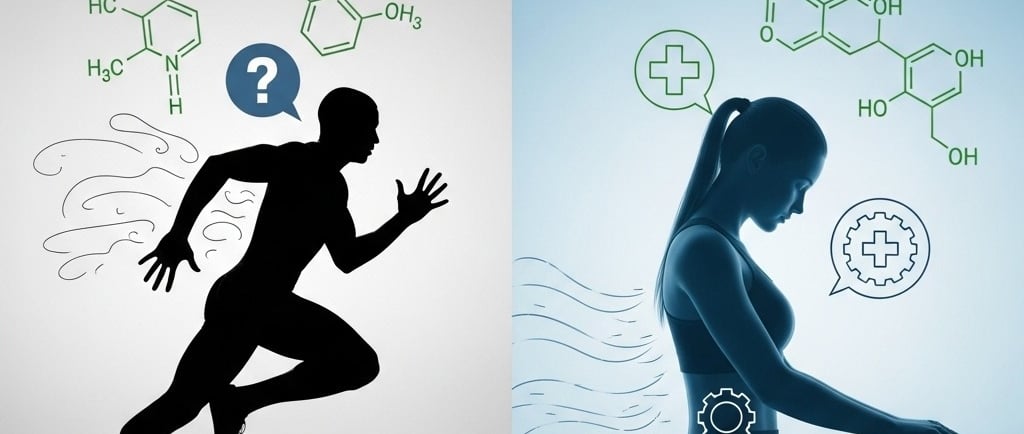
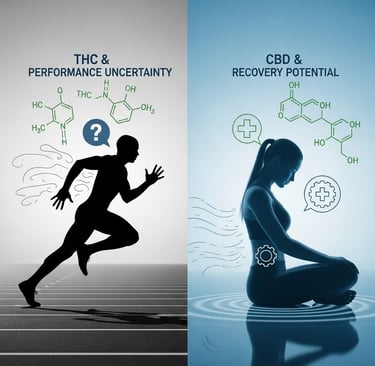
The Hazy State of Cannabis in Sports
From locker rooms to ultra-marathon trails, the conversation around cannabis is getting louder. With laws relaxing and products like THC and CBD becoming mainstream, a growing number of athletes are looking to cannabis for a competitive edge or a recovery boost. In fact, a recent analysis suggests nearly one in four athletes have used some form of cannabis in the past year.
But does it actually work? Despite its widespread use and ancient history, the hard scientific evidence remains surprisingly thin and often contradictory. Athletes are caught in a vacuum, relying on anecdotes and marketing claims while navigating complex anti-doping rules. This review breaks down what we actually know—and what we don't—about cannabis, THC, and CBD in the context of athletic performance and recovery.
The Main Players: THC vs. CBD
It's crucial to separate the two most famous compounds in cannabis:
THC (delta-9-tetrahydrocannabinol): This is the psychoactive component that causes the "high." It interacts with the body's natural endocannabinoid system, affecting everything from mood to cardiovascular function. It is prohibited in-competition by the World Anti-Doping Agency (WADA).
CBD (cannabidiol): This compound is non-psychoactive. It's most often studied for its potential therapeutic effects on things like pain, anxiety, and inflammation. CBD was removed from the WADA prohibited list in 2018, leading to a surge in its popularity among athletes.
The Big Question: Does Cannabis or THC Improve Performance?
For decades, the debate has raged: does smoking cannabis or consuming THC make you a better athlete? When we critically examine the existing research, a clear and disappointing picture emerges.
The Evidence is Old and Flawed. The bulk of the relevant studies on THC and exercise were conducted 35-45 years ago. This is a huge problem for two reasons: today's cannabis is often 6 to 10 times more potent, and our methods for measuring athletic performance are vastly more sophisticated now.
The Wrong Subjects. Many foundational studies that concluded cannabis harms performance were conducted on patients with severe heart disease or COPD. These individuals could barely handle a few minutes of very light exercise. Using this data to predict effects on a healthy, professional cyclist is, frankly, absurd.
The Wrong Tests. One of the most-cited studies in healthy people used a flawed test. It measured work capacity based on heart rate. Since THC is well-known to increase heart rate, the test was rigged from the start—of course the calculated "work capacity" would look lower! It's like measuring a car's fuel efficiency while forcing it to rev its engine in neutral. Other studies only looked at low-intensity exercise and didn't measure maximal performance at all.
The One "Good" Study? The single study that actually tested healthy participants to exhaustion did find a small decrease in performance—participants gave up about one minute earlier on an incremental test. However, the study's methods were ambiguous, and the practical significance of this small change is debatable. At maximal effort, key physiological measures like aerobic fitness (V̇O2max) and heart rate were no different between the cannabis and placebo groups.
The Takeaway on THC & Performance: Based on the current, low-quality evidence, there is no compelling proof that cannabis or THC offers any performance benefit in strength or aerobic activities. In fact, the evidence leans towards either no effect or a small negative effect. Furthermore, THC is known to affect cardiovascular function (like increasing heart rate at rest) and potentially impair motor control and decision-making, posing clear risks.
A Different Story: Can CBD Aid in Recovery?
While THC seems to be a dead end for performance, athletes are increasingly turning to CBD for help with the grind of training and competition. Here, the science is more promising, but still in its infancy for athletic populations.
Sleep and Anxiety: Good sleep is critical for recovery. CBD has shown promise for improving sleep and reducing anxiety in clinical populations (like those with PTSD), but these effects haven't been confirmed in well-designed studies on healthy, elite athletes who might be struggling with pre-competition jitters or disrupted travel schedules.
Pain and Inflammation: Many athletes use CBD to manage pain, hoping to avoid the side effects of common NSAIDs (like ibuprofen). However, the evidence is mixed. In a study of elite rugby players, 80% used CBD for pain, but only 14% felt it had a beneficial effect. The dose seems to matter, but the effective dose for athletic recovery is unknown.
Concussion / Brain Injury: There's exciting preclinical (animal study) evidence suggesting CBD might have neuroprotective properties that could help with the consequences of mild traumatic brain injuries (mTBI), a major concern in contact sports. But this is a huge leap from animal models to human athletes, and much more research is needed.
The Bottom Line & Major Knowledge Gaps
The world of cannabis and sports is filled with more questions than answers.
For THC/Cannabis & Performance: The evidence is sparse, outdated, and of low quality. We desperately need modern, well-controlled studies on actual athletes using relevant performance tests to understand the true effects.
For CBD & Recovery: There is some potential for benefits in sleep, pain, and neuroprotection, but the research in athletic populations is almost non-existent. We don't know the effective doses, timing, or long-term effects.
A Word of Caution: Athletes considering CBD must be extremely careful. The CBD market is poorly regulated, and many products contain undeclared THC (which could lead to a doping violation) or other prohibited cannabinoids.
Ultimately, while the conversation is evolving, evidence-based decision-making is key. For now, the science suggests THC is more likely to be a risk than a reward for performance, while CBD remains a promising but unproven tool for recovery.