Add your promotional text...
Farming's Footprint: Simple Ways to Store More Carbon and Emit Less
Source & Further Information: The findings and concepts discussed in this article are largely based on the research presented in the following scientific paper: Ozlu, E., Arriaga, F. J., Bilen, S., Gozukara, G., & Babur, E. (2022). Carbon Footprint Management by Agricultural Practices. Biology (Basel), 11(10), 1453. https://doi.org/10.3390/biology11101453. We encourage readers interested in the detailed methodology and complete results to consult the original publication.
11/7/20254 min read
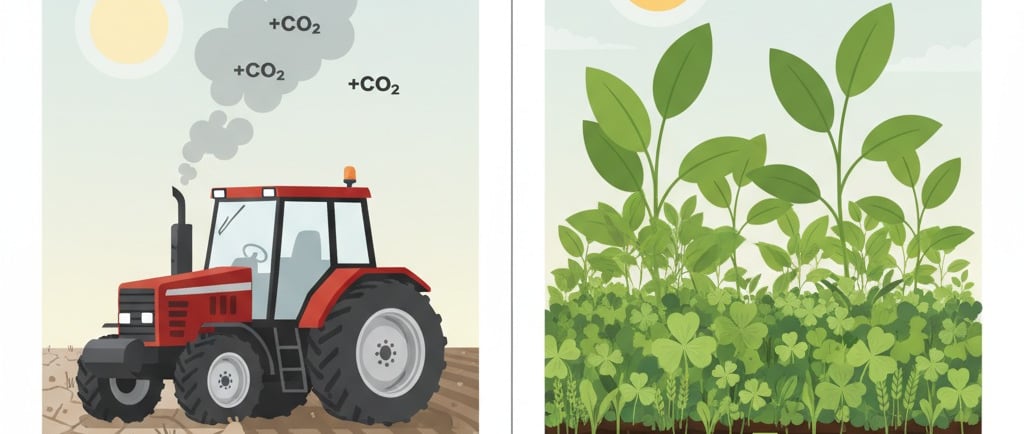
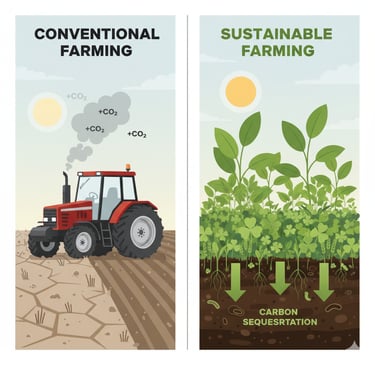
When we think about climate change, we often picture smokestacks and tailpipes. But did you know that agriculture plays a huge role, contributing nearly a fifth of total greenhouse gas (GHG) emissions? From the fuel tractors burn to the fertilizers used, farming leaves what's called a "carbon footprint." The good news? Farmers are on the front lines of a powerful solution. By focusing on the health of our soil, we can dramatically reduce these emissions and even turn our fields into giant carbon sponges. Let's break down the science of farming's carbon footprint and explore the practical steps that make a real difference.
What is a Carbon Footprint in Farming?
Simply put, a carbon footprint is the total amount of greenhouse gases—like carbon dioxide (CO2), methane (CH4), and nitrous oxide (N2O)—released by an activity. In farming, this includes everything from the energy used to make fertilizers and run machinery to the natural emissions that come from the soil itself.
Why does this matter? Healthy soil is a massive natural storage tank for carbon. When soil is degraded, this stored carbon can be released into the atmosphere as CO2. Furthermore, certain farming practices can increase the release of potent greenhouse gases like methane (often from livestock and rice paddies) and nitrous oxide (a major emission from nitrogen fertilizers). The goal of climate-friendly farming is to flip this equation: emit less and store more.
The #1 Enemy of Soil Carbon: Tillage
For generations, tilling—plowing and turning over the soil—has been standard practice to prepare fields for planting. But from a carbon perspective, intensive tillage can be destructive.
How it works: Tilling breaks apart soil aggregates, the small clumps that protect organic matter. This suddenly exposes vast amounts of stored carbon to oxygen and hungry microbes, which rapidly "burn" it off as CO2 gas. It's like fanning the embers of a fire.
The Solution: The best practice is "no-till" farming, where seeds are planted directly into the residue of the previous crop. If that's not possible, minimizing the frequency and depth of tillage can make a huge difference. Tilling soil when it's at the right moisture level—not too wet, not too dry—can also help reduce damage.
Healthy Soil: The Ultimate Carbon Sink
The core message from countless studies is clear: healthy soil has a lower carbon footprint. But what does "healthy soil" actually mean?
Good Structure: Healthy soil is full of stable aggregates, creating a sponge-like structure with plenty of pore space for air and water. This structure is more resistant to erosion and compaction.
Rich in Organic Carbon: This is the key. Building up soil organic carbon (SOC) in stable forms (like humus) is the single most effective way to practice sustainable, carbon-friendly farming.
Full of Life: It's a thriving habitat for the billions of microorganisms that drive nutrient cycles and help build that stable structure.
Healthy soils are a win-win: they are more fertile and resilient for farmers, and they act as powerful carbon sinks, pulling CO2 out of the atmosphere.
Smart Farming Practices for a Lighter Footprint
Beyond just reducing tillage, several other practices can significantly lower agriculture's carbon footprint:
Diversify Your Crops: Planting the same crop year after year (monoculture) can deplete specific nutrients and degrade soil structure. Diverse cropping systems, including crop rotations and cover crops, are much better for soil health, microbial diversity, and building organic carbon.
Manage Fertilizers Wisely: Chemical fertilizers, especially nitrogen-based ones, are a major source of nitrous oxide (N2O), a greenhouse gas nearly 300 times more potent than CO2.
Organic Amendments: Using manure and compost is a fantastic way to build long-term soil carbon and fertility. Studies show that manure application is far more effective at increasing stable carbon stocks than chemical fertilizers alone.
Biochar: This charcoal-like material, made from pyrolyzed biomass, is incredibly stable and can lock away carbon in the soil for centuries. It also improves soil fertility and water retention.
Keep the Soil Covered: Leaving crop residues on the field protects the soil from erosion, helps retain moisture, and provides a slow-release source of organic matter. Cover crops planted between main growing seasons serve the same purpose, keeping the soil ecosystem alive and active.
Minimize Machinery Operations: Every pass a tractor makes uses fuel (direct emissions) and risks compacting the soil. Soil compaction damages structure, reduces air and water infiltration, and can lead to conditions that produce more greenhouse gases.
Looking at the Big Picture: Land Use Matters
How we use land has a massive impact on its carbon footprint. Converting forests or wetlands to cropland releases huge amounts of stored carbon. For example, when a forest is cleared for agriculture, 30-35% of the carbon in the topsoil can be lost within the first 30 years. Wetlands are also critical ecosystems that store vast amounts of carbon; draining them for farming can result in large CO2 and N2O emissions. Protecting these natural carbon sinks is a vital part of managing our global carbon budget.
The Path Forward: A Win-Win for Farms and Climate
Managing agriculture's carbon footprint isn't about sacrificing productivity; it's about embracing smarter, more sustainable practices. By focusing on building healthy, carbon-rich soils through reduced tillage, diverse cropping, and organic amendments, farmers can make their operations more resilient to challenges like drought and erosion. These same practices simultaneously pull carbon out of the atmosphere and reduce harmful greenhouse gas emissions, making agriculture a powerful part of the climate change solution.