Add your promotional text...
Feeding Plants with a Feather-Light Sponge Made from Nature
Source & Further Information: The findings and concepts discussed in this article are largely based on the research presented in the following scientific paper: Abdul Khalil HPS, Jha K, Yahya EB, Panchal S, Patel N, Garai A, Kumari S, Jameel M. Insights into the Potential of Biopolymeric Aerogels as an Advanced Soil-Fertilizer Delivery Systems. Gels. 2023 Aug 17;9(8):666. doi: 10.3390/gels9080666. PMID: 37623121; PMCID: PMC10453695. We encourage readers interested in the detailed methodology and complete results to consult the original publication.
12/10/20253 min read
The Fertilizer Dilemma: Too Much of a Good Thing
Fertilizers are one of modern agriculture's greatest triumphs. By supplying essential nutrients like nitrogen, phosphorus, and potassium, they have dramatically boosted crop yields, allowing us to feed a rapidly growing global population. With nearly 10 billion people expected by 2050, the demand for efficient farming—and thus, fertilizer—is only going up.
But there's a serious downside. When we overuse or misuse conventional fertilizers, the excess nutrients don't just disappear. They wash away into rivers and lakes, causing massive algae blooms that choke aquatic life (a process called eutrophication). They can degrade soil health over time, and the production and use of synthetic fertilizers even contribute to greenhouse gas emissions.
For years, scientists have been searching for a "Goldilocks" solution: a way to give plants the exact amount of nutrients they need, right when they need them, with nothing left over to harm the environment. This is where a remarkable, futuristic material comes into play: aerogels.
Meet the Eco-Friendly Aerogel: A Sponge Like No Other
Imagine a solid material that's over 90% air. That's an aerogel. They are incredibly lightweight, highly porous structures, like a microscopic sponge. While traditional aerogels can be synthetic, scientists are now creating them from biopolymers—natural, renewable materials derived from plants (like cellulose from wood pulp), animals (like chitosan from shrimp shells), or seaweed (alginates).
These "biopolymeric aerogels" are amazing. They are biodegradable, environmentally friendly, and possess a massive internal surface area. Think of a single gram of this material having the surface area of a tennis court packed inside! This unique structure, previously explored for advanced applications like drug delivery and aerospace insulation, makes them a perfect candidate for a smarter fertilizer system.
How a Smart Sponge Can Transform Farming
So, how can this lightweight, natural sponge help solve the fertilizer problem? It all comes down to three key superpowers:
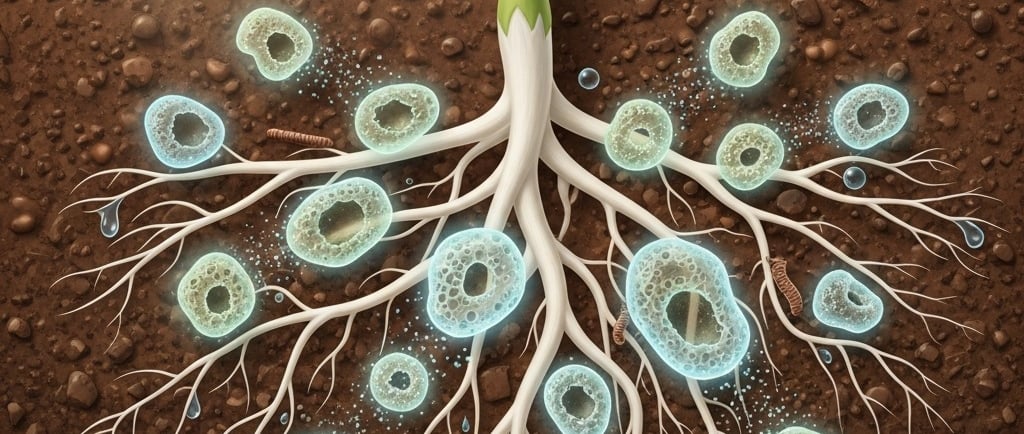
1. The Perfect Slow-Release System: The aerogel's porous structure is ideal for trapping, or "encapsulating," fertilizer. When these nutrient-loaded aerogels are mixed into the soil, they don't dump their entire payload at once. Instead, as the soil gets moist, the fertilizer gradually and steadily diffuses out over an extended period. This provides a constant, gentle food supply that matches the plant's needs, dramatically reducing waste and runoff.
2. A Built-in Water Reservoir: Beyond holding fertilizer, these aerogels are fantastic at absorbing and retaining water. When mixed into soil, they act like tiny reservoirs, holding onto moisture and releasing it during dry spells. This can help maintain optimal soil moisture, improve a plant's resilience to drought, and even reduce the need for frequent irrigation.
3. A Boost for Soil Health: Biopolymer aerogels can also improve the physical structure of the soil. They help bind soil particles together, reduce compaction, and improve porosity. This allows for better air circulation and easier root penetration, leading to healthier root systems and more efficient nutrient uptake by the plants. And because they're made from natural biopolymers, they biodegrade over time, becoming part of the soil without leaving harmful residues.
The Road Ahead: From Lab to Field
Researchers have already shown incredible promise with aerogels made from various biopolymers like cellulose, alginate, chitosan, and starch. Studies demonstrate their ability to hold large quantities of fertilizer and release it in a controlled manner over weeks or even months, compared to hours for conventional fertilizers.
Of course, there are still challenges to overcome. Making these aerogels cost-effective and scalable for widespread agricultural use is a major focus. More long-term field trials are needed to understand their performance in different climates, soil types, and with various crops. However, the potential is undeniable. Biopolymer aerogels represent an exciting frontier in sustainable agriculture, offering a way to improve crop yields while protecting our precious soil and water ecosystems.