Add your promotional text...
Feeding Plants with Rocks? Meet the Microbes That Make It Possible
Source & Further Information: The findings and concepts discussed in this article are largely based on the research presented in the following scientific paper: Ribeiro IDA, Volpiano CG, Vargas LK, Granada CE, Lisboa BB, Passaglia LMP. Use of Mineral Weathering Bacteria to Enhance Nutrient Availability in Crops: A Review. Front Plant Sci. 2020 Dec 11;11:590774. doi: 10.3389/fpls.2020.590774. PMID: 33362817; PMCID: PMC7759553. We encourage readers interested in the detailed methodology and complete results to consult the original publication.
11/24/20254 min read
The Fertilizer Dilemma: Feeding the World Without Harming It
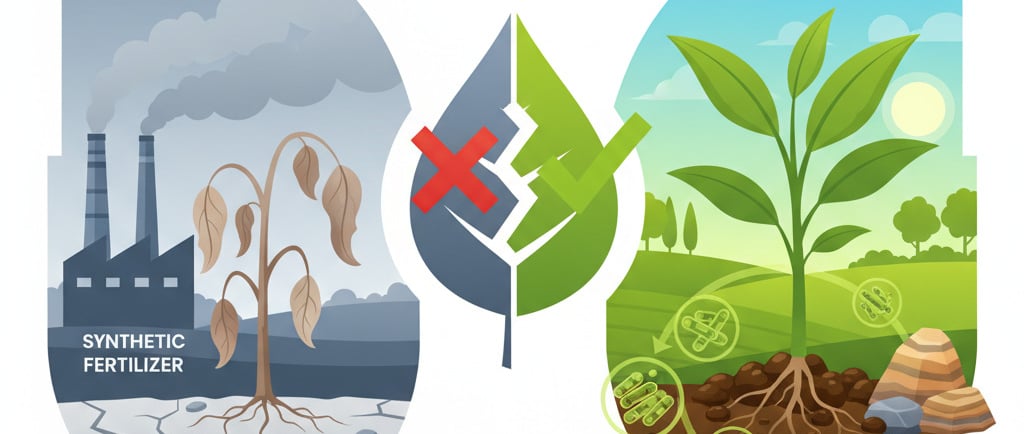
For over half a century, modern agriculture has performed a miracle, dramatically increasing food production thanks to the "Green Revolution." A key ingredient in this success story? Massive amounts of synthetic fertilizers. These high-powered nutrients have boosted crop yields worldwide, but this progress has come at a steep environmental cost.
Excess fertilizers run off our fields, polluting rivers and oceans, leading to harmful algae blooms that create "dead zones" in the water. Furthermore, the manufacturing and use of these fertilizers are a major source of greenhouse gas emissions, directly contributing to climate change. We're caught in a cycle: climate change creates more extreme weather like droughts and heatwaves, which in turn makes farming harder, increasing our reliance on these very inputs.
The challenge is clear: how do we continue to feed a growing population while reducing the environmental footprint of agriculture? One of the most exciting answers might be lying right under our feet, in the form of tiny microbes and abundant rocks.
"Rocks for Crops": A Natural, Low-Cost Alternative
What if instead of relying on expensive, imported, and industrially produced fertilizers, farmers could use locally sourced rock powders? This concept, sometimes called "agrogeology" or "Rocks for Crops," is a promising path towards more sustainable farming. Finely crushed rocks, such as rock phosphate or silicate rocks, are rich in many of the essential nutrients plants need, like phosphorus (P), potassium (K), calcium, and magnesium.
This approach has huge benefits:
Low Cost & Local: It reduces dependency on volatile international fertilizer markets, empowering local communities and farmers, especially in developing nations.
Sustainable: Rock powders release their nutrients slowly, drastically reducing the risk of nutrient runoff and pollution.
Soil Health: Many rock powders, especially silicates, can help improve soil structure, increase its ability to hold nutrients (cation exchange capacity), and even correct acidity in weathered tropical soils.
Climate Friendly: The natural chemical weathering of silicate rocks actually captures CO2 from the atmosphere, helping to mitigate climate change and even reduce ocean acidification.
There's just one major hurdle: these rocks release their nutrients very slowly. The minerals are locked up in a crystalline structure that dissolves at a snail's pace, often too slow for the demands of modern crops. So, how can we speed things up? The answer, once again, is bacteria.
Meet the "Weathering Bacteria": Nature's Tiny Miners
Just as pioneer organisms like lichens can slowly break down bare rock to create the first hints of soil, specific bacteria in the soil are experts at "weathering" or dissolving minerals. These microscopic miners have a toolkit of clever chemical strategies to unlock the nutrients trapped inside rocks.
They can:
Produce Acids: Bacteria release various organic acids (like gluconic and citric acid) as byproducts of their metabolism. These acids lower the pH in the immediate vicinity of a mineral particle, helping it dissolve.
Release "Chelators": They secrete special molecules, like siderophores, that are incredibly good at grabbing onto and "chelating" (binding with) mineral ions like iron, pulling them out of the rock's structure and making them available.
Perform Redox Reactions: Some bacteria can change the chemical state of elements like iron in a mineral, destabilizing its structure and causing it to break down.
When these bacteria live in the rhizosphere—the bustling microbial ecosystem right around plant roots—a powerful partnership forms. Plants release sugars and other compounds from their roots, feeding the bacteria. In return, the bacteria get to work weathering soil minerals and any added rock powders, releasing a steady stream of nutrients that the plant can then easily absorb.
A Powerful Combination: Inoculants and Rock Powders
The real breakthrough comes when we combine these two ideas: applying low-cost rock powders to fields and inoculating the soil or seeds with highly efficient strains of these weathering bacteria. Studies have shown this one-two punch can significantly boost crop growth and yield.
For Phosphorus (P): Bacteria known as Phosphate-Solubilizing Bacteria (PSB) are particularly effective. When added alongside rock phosphate, they can dramatically increase the availability of this crucial nutrient, enhancing everything from root development to grain production in crops like wheat, rice, and legumes.
For Potassium (K): Similarly, Potassium-Solubilizing Bacteria (KSB) can break down K-rich silicate minerals (like feldspar and mica), which make up over 98% of the potassium in soil but are normally unavailable to plants. Combining KSB with silicate rock powders can lead to impressive increases in potassium uptake and crop yields.
Multi-Nutrient Benefits: Silicate rocks often contain a cocktail of other beneficial elements. Weathering bacteria can release not just potassium, but also calcium, magnesium, and even silicon (Si). Silicon, while not always considered essential, is increasingly recognized for its role in strengthening plants and boosting their resistance to stresses like pests, diseases, and drought.
The Road Ahead: Challenges and a Sustainable Future
While the promise is immense, bringing this technology to every farm isn't a simple plug-and-play solution. A bacterial strain that works wonders in the lab might struggle in a real field due to competition from native microbes, different soil types, or varying climate conditions.
The future of this research lies in finding the right "matchmaking" – pairing the best bacterial strains with specific crops, soil types, and rock fertilizers. Scientists are exploring advanced techniques like improved inoculant formulations (such as encapsulating bacteria to protect them) and even genetic engineering to enhance the weathering abilities of these microbes.
By combining the use of sustainable, local rock resources with the power of beneficial bacteria, we can create a more resilient and environmentally friendly agricultural system. It’s a strategy that can help improve soil fertility, increase food security, reduce our reliance on synthetic fertilizers, and actively contribute to mitigating climate change—all by working smarter with nature's own tiny, powerful miners.