Add your promotional text...
Fixing Our Farms From the Ground Up with Beneficial Microbes
Source & Further Information: The findings and concepts discussed in this article are largely based on the research presented in the following scientific paper: Maitra S, Brestic M, Bhadra P, Shankar T, Praharaj S, Palai JB, Shah MMR, Barek V, Ondrisik P, Skalický M, Hossain A. Bioinoculants-Natural Biological Resources for Sustainable Plant Production. Microorganisms. 2021 Dec 27;10(1):51. doi: 10.3390/microorganisms10010051. PMID: 35056500; PMCID: PMC8780112. We encourage readers interested in the detailed methodology and complete results to consult the original publication.
1/7/20263 min read
The Hidden Cost of Our Food
For the past sixty years, global agriculture has performed a miracle, tripling farm output to feed a booming population. This success was largely driven by the "Green Revolution"—a wave of innovation that introduced high-yielding crop varieties, massive irrigation projects, and, most notably, a heavy reliance on chemical fertilizers and pesticides. While this chemical-intensive approach delivered impressive yields, we've come to realize it came with a steep, hidden cost.
The very foundation of our food system—the soil—is showing signs of strain. The side effects of this industrial approach are now clear: degraded soil health, loss of biodiversity, depletion of water resources, and an agroecosystem thrown out of balance. Chemical fertilizers can pollute groundwater, release potent greenhouse gases like nitrous oxide, and harm the natural microbial communities that are essential for a healthy soil food web. In our race for productivity, we've created a high-energy, fossil-fuel-dependent system that threatens its own long-term sustainability.
As we face the dual challenges of feeding a future population of over 10 billion and tackling climate change, it's clear we need a smarter path forward.
The Solution Beneath Our Feet: Bioinoculants
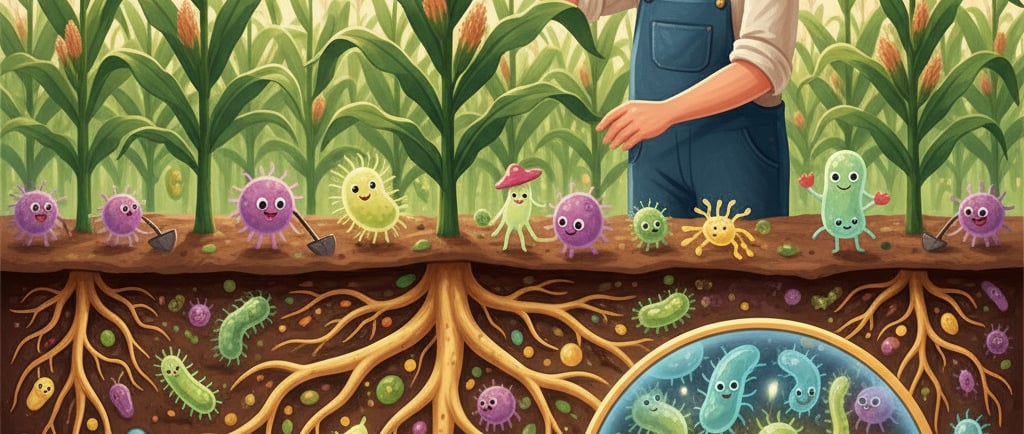
Fortunately, a powerful, eco-friendly solution already exists, working tirelessly in the soil. Meet bioinoculants: carefully selected formulations of living microorganisms—like beneficial bacteria and fungi—that can be introduced to soil or plants to boost their health and productivity.
Think of them as a natural, living toolkit for farming. Instead of overwhelming the system with synthetic chemicals, bioinoculants work with nature. They are comprised of living cells that, in a favorable environment, multiply and perform a host of beneficial tasks. This isn't a new concept—farmers have known about the power of crop rotation with legumes for centuries—but modern science is unlocking the full potential of these microscopic allies.
What Can These Tiny Helpers Do? The Three Main Roles of Bioinoculants
Bioinoculants are multitasking powerhouses. Their benefits can be grouped into three main categories:
1. The Nutrient Providers:
Plants are hungry for nutrients like nitrogen (N), phosphorus (P), and potassium (K). While chemical fertilizers provide these in a concentrated dose, bioinoculants help plants access them naturally and more efficiently.
Nitrogen Fixers: Our atmosphere is nearly 80% nitrogen, but plants can't use it directly. Certain bacteria (like Rhizobium in legumes or free-living Azotobacter) are natural "nitrogen-fixing" factories. They capture atmospheric nitrogen and convert it into a form plants can absorb, providing a free, sustainable source of this vital nutrient.
Phosphate & Potassium Solubilizers: Soil often contains vast reserves of phosphorus and potassium that are "locked up" in mineral forms plants can't use. Specific microbes (Phosphate-Solubilizing Bacteria or PSB, and Potassium-Solubilizing Bacteria or KSB) release acids and enzymes that "unlock" these nutrients, making them available for plant uptake.
Micronutrient Mobilizers: These microbes also help with the uptake of essential micronutrients like iron and zinc, often by producing "siderophores"—special molecules that bind to iron and ferry it to the plant roots.
2. The Bodyguards (Pest & Pathogen Control):
Every year, a significant portion of global crops are lost to pests and diseases. Instead of broad-spectrum chemical pesticides that can harm beneficial organisms, bioinoculants offer a targeted defense.
Competition: Beneficial microbes colonize the area around roots (the rhizosphere), taking up space and nutrients, effectively crowding out harmful pathogens.
Producing Antibiotics: Many microbes, particularly actinobacteria, produce natural antibiotic compounds that directly suppress or kill disease-causing fungi and bacteria.
Strengthening Plant Defenses: The presence of certain bioinoculants can trigger a plant's own immune-like response (known as Induced Systemic Resistance), making it more resilient to future attacks.
3. The Stress Managers (Abiotic Stress Tolerance):
As we've discussed with drought, plants also face stress from salinity (salty soil), heat, and heavy metal contamination. Bioinoculants are incredible stress-management coaches.
They help plants manage internal stress hormones.
They produce protective compounds that shield plant cells from damage.
Some can even help plants tolerate or "detoxify" soil contaminated with heavy metals.
The Shift to "Green Agriculture"
These multifaceted benefits are at the heart of a paradigm shift towards "Green Agriculture"—a way of farming that aims to be productive and profitable while enhancing, not degrading, our natural resources. It's about building a healthier agroecosystem from the ground up. By integrating bioinoculants, we can reduce our reliance on synthetic chemicals, improve soil health for the long term, and create a more resilient and sustainable food system.
The future of agriculture isn't about choosing between high yields and a healthy planet. It's about leveraging the incredible power of nature's own technology—the unseen workforce of beneficial microbes—to achieve both.