Add your promotional text...
From Bacteria to Banana Peels: A Guide to Eco-Friendly Biofertilizers
Source & Further Information: The findings and concepts discussed in this article are largely based on the research presented in the following scientific paper: Ammar EE, Rady HA, Khattab AM, et al. A comprehensive overview of eco-friendly bio-fertilizers extracted from living organisms. Environ Sci Pollut Res Int. 2023;30(53):113119-113137. doi:10.1007/s11356-023-30260-x. We encourage readers interested in the detailed methodology and complete results to consult the original publication.
10/1/20254 min read

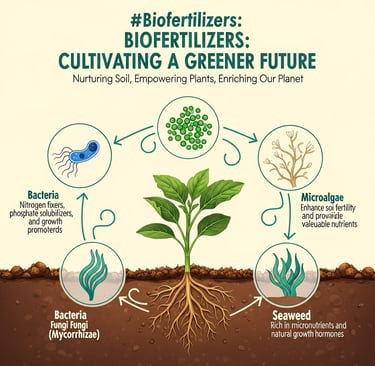
Imagine a farm that doesn't rely on harsh chemical fertilizers. Instead, it harnesses the power of living organisms—from microscopic bacteria to humble plant waste—to enrich the soil, boost crop yields, and protect our environment. This isn't science fiction; it's the growing field of biofertilization, a cornerstone of sustainable agriculture that promises healthier food, healthier soil, and a healthier planet. As our world population climbs towards 10 billion, the need for safe, sustainable food production has never been more critical. Let's explore the incredible world of these eco-friendly "living" fertilizers.
The Problem with Our Current Approach
For decades, modern agriculture has leaned heavily on synthetic chemical fertilizers. While they can boost crop yields in the short term, this convenience comes at a steep price. The overuse of these inorganic fertilizers has led to contaminated water supplies, damaged soil ecosystems, and even the accumulation of heavy metals in our food chain. This chemical-heavy approach not only harms the environment but has been linked to serious human health issues. It's clear that to feed our future, we need a smarter, more natural way to grow.
What Are Biofertilizers?
Enter biofertilizers. In simple terms, a biofertilizer is a substance containing living microorganisms or natural organic matter which, when applied to soil or plants, helps to enrich the soil and promote plant growth. Unlike chemical fertilizers that simply dump nutrients into the soil, biofertilizers work with nature. They can:
Fix nitrogen from the atmosphere, making it available to plants.
Unlock nutrients like phosphorus and potassium that are already in the soil but in a form plants can't use.
Produce plant growth hormones to stimulate stronger roots and healthier plants.
Improve soil structure and its ability to hold water.
The best part? They are biodegradable, leave no harmful residues, and can actually help heal and maintain the long-term health of our soil.
A Tour of Nature's Fertilizers: From Microbes to Plants
Biofertilizers aren't a single product but a diverse category of natural solutions derived from a wide range of living things. Let's look at some of the key players.
1. The Bacterial Powerhouses
Bacteria are the unseen champions of soil fertility. Many species, particularly those living around plant roots (rhizobacteria), have been used as biofertilizers for over a century. They help plants in three main ways: producing nutrients, mobilizing existing soil compounds, and protecting plants from stress and disease.
Nitrogen-Fixers: Bacteria like Azotobacter and Rhizobium have the amazing ability to pull nitrogen gas from the air and convert it into a form that plants can use as food. Cyanobacteria (once called blue-green algae) are another incredibly productive group that can both photosynthesize and fix nitrogen, contributing significantly to nutrient cycling.
Phosphate Solubilizers: A huge amount of phosphorus in the soil is locked up in an insoluble form. Bacteria like Bacillus megaterium and Pseudomonas fluorescens produce acids that dissolve these phosphate compounds, making this crucial nutrient available for plant uptake.
Other Mineral Mobilizers: Some bacteria, known as silicate bacteria, can even help break down rock minerals over time, releasing important nutrients like potassium.
2. The Algal Advantage
Algae, from microscopic single-celled organisms to large seaweeds, are another promising and sustainable source for biofertilizers.
Microalgae: Tiny photosynthetic powerhouses like Chlorella and Spirulina can be cultivated and applied to soil. They enrich it with organic matter, produce growth hormones, and enhance nutrient consumption by plants, making them an excellent renewable alternative to chemical inputs.
Macroalgae (Seaweed): For centuries, coastal communities have used seaweed to fertilize their fields. Modern seaweed extracts, often from brown algae like Ascophyllum nodosum (Kelp), are packed with effective nutrients and growth stimulants. Applied as a powder mixed into soil or a liquid foliar spray, seaweed can boost seed germination, increase crop yield, and enhance a plant's resistance to environmental stress.
3. The Fungal Network
Fungi are essential decomposers and recyclers in any healthy ecosystem, and their role as biofertilizers is vital.
Mycorrhizal Fungi: This is a superstar group. Mycorrhizae form a symbiotic partnership with the roots of most plants, creating a vast underground network of fungal threads (hyphae). This network acts as an extension of the plant's own root system, dramatically increasing its ability to absorb water and nutrients, especially phosphorus, potassium, and zinc. Fungi like Glomus species are key players in this process, essentially trading nutrients with the plant in exchange for sugars.
Other Helpful Fungi: Other soil fungi, like species of Aspergillus, Penicillium, and Trichoderma, are excellent at solubilizing locked-up phosphorus by producing organic acids that lower the soil's pH.
4. Using Plants to Feed Plants
The concept of using plants to fertilize other plants is a cornerstone of sustainable farming.
Plant Residues & Biochar: Common agricultural waste products that would otherwise be thrown away can be turned into valuable soil amendments. Banana peels, spent coffee grounds, and pomegranate peels are rich in potassium, nitrogen, and other micronutrients. When composted or converted into a stable, carbon-rich substance called "biochar" through a process called pyrolysis, they can dramatically improve soil quality, water retention, and nutrient content.
Cover & Intercropping: Planting certain crops, particularly legumes like peas, beans, and grass pea, can replenish soil nitrogen naturally. These plants work with symbiotic Rhizobium bacteria in their root nodules to fix atmospheric nitrogen. Planting them between main crop cycles (as cover crops) or alongside them (intercropping) reduces the need for nitrogen fertilizers, improves soil organic matter, and can even disrupt weed and disease cycles.
The Future is Biological
The evidence is clear: biofertilizers offer a powerful, eco-friendly, and sustainable path forward for agriculture. By harnessing the natural abilities of bacteria, algae, fungi, and plants, we can increase crop yields, improve soil health, and reduce our reliance on harmful chemical inputs. This approach not only mitigates environmental pollution but also contributes to producing healthier food and a more resilient food system. As technology advances, we can expect to see even more innovative biofertilizer solutions, helping farmers around the world grow more with less, in harmony with nature.