Add your promotional text...
Halobacteria: Nature's Biofertilizer for a Hotter, Saltier Planet
Source & Further Information: The findings and concepts discussed in this article are largely based on the research presented in the following scientific paper: Masmoudi F, Alsafran M, Jabri HA, Hosseini H, Trigui M, Sayadi S, Tounsi S, Saadaoui I. Halobacteria-Based Biofertilizers: A Promising Alternative for Enhancing Soil Fertility and Crop Productivity under Biotic and Abiotic Stresses-A Review. Microorganisms. 2023 May 9;11(5):1248. doi: 10.3390/microorganisms11051248. PMID: 37317222; PMCID: PMC10222427. We encourage readers interested in the detailed methodology and complete results to consult the original publication.
1/19/20263 min read

The Squeeze on Modern Farming
Imagine trying to feed a world of nearly 10 billion people by 2050. That’s the challenge we face, and it requires a staggering 70% increase in food production. Yet, the very methods we've used to boost yields—intensive farming, heavy machinery, and overuse of chemical fertilizers and pesticides—are taking a toll. Soils are becoming degraded, salty, and less fertile. We're using up freshwater at an alarming rate, often irrigating with lower-quality, saltier water, which only makes the problem worse.
Simply put, we need to produce more food with less land and fewer resources, all while protecting our environment. Traditional solutions are hitting their limits. This critical situation has sent scientists searching for smarter, more sustainable tools. One of the most promising solutions comes from an unexpected place: the world's saltiest environments.
Meet the Halobacteria: The Salt-Loving Superheroes
"Halobacteria" are a group of microorganisms that don't just tolerate salty conditions—they thrive in them. Found in saline soils, salt lakes, and around salt-loving plants (halophytes), these bacteria have evolved incredible survival skills. Scientists have discovered that these hardy microbes, specifically a group called Plant-Growth-Promoting Halobacteria (PGPH), can be powerful biofertilizers.
Unlike many beneficial microbes that struggle in harsh conditions, PGPH are built for stress. They can be applied to crops to help them withstand a double-whammy of challenges: abiotic stresses (like drought and high salinity) and biotic stresses (like attacks from harmful fungi and bacteria). They offer a natural, eco-friendly way to boost crop resilience, improve soil health, and reduce our reliance on chemical inputs.
The Challenges Facing Our Fields
Before we see how halobacteria help, let's look at the main villains they fight:
Soil Salinization: A creeping disaster for farmland. High salt levels, caused by natural processes but accelerated by poor irrigation and land use, make it harder for plants to absorb water (creating a "physiological drought"). Toxic ions like sodium and chloride can also directly poison plants and degrade soil structure. Salinization is a leading cause of desertification, claiming millions of hectares of farmland globally each year.
Phytopathogenic Diseases: Harmful fungi, bacteria, and viruses are a constant threat, causing billions of dollars in crop losses annually. Fungi are particularly devastating, attacking plants both above and below ground. They can rot roots, blight leaves, and even produce toxins that are dangerous to humans and animals.
When a plant is hit with both high salt and a fungal attack at the same time, its chances of survival plummet. This is where conventional pesticides and fertilizers often fall short.
How Halobacteria Lend a Helping Hand
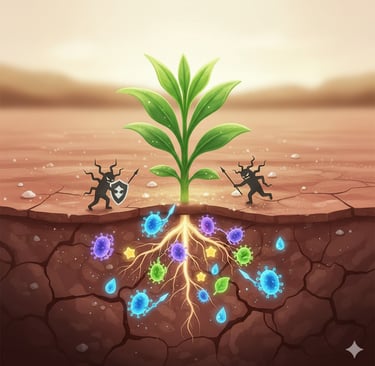
These salt-loving microbes use a wide array of mechanisms to protect and promote plant growth. Think of them as a multi-talented support crew for the plant.
Direct Growth Promotion: They act like mini-fertilizer factories, "fixing" atmospheric nitrogen and unlocking phosphorus and other key nutrients in the soil, making them available to the plant. They also produce plant hormones like auxin, which encourages a bigger, stronger root system better able to find water and nutrients.
Indirect Protection (Biocontrol): They are fierce defenders. PGPH can produce natural antibiotic compounds that inhibit harmful pathogens. They also produce enzymes that can break down the cell walls of fungi. By rapidly colonizing the area around the roots, they outcompete harmful microbes for space and food, effectively shielding the plant.
Stress Management: Halobacteria are masters of survival. They produce and accumulate special molecules (osmolytes like amino acids and sugars) to balance their internal water pressure in salty conditions. They can pass these benefits on to the plant, helping it maintain hydration. They also produce enzymes (like ACC deaminase) that lower the plant's stress hormone levels, preventing it from panicking and aging prematurely.
Building a Protective Barrier: Many PGPH create a slimy layer of exopolysaccharides (EPS). This biofilm helps retain moisture around roots, binds toxic salt ions to prevent them from harming the plant, and improves soil structure by clumping particles together.
The Power to Heal the Land: Soil Remediation
The benefits of PGPH go beyond just helping a single plant. They are incredible soil healers. Studies have shown they can:
Improve Soil Fertility: Increase the content of nitrogen, phosphorus, and potassium, and improve soil pH and structure.
Remediate Contamination: Some halobacteria are amazing bioremediators. They can break down petroleum hydrocarbons in oil-contaminated soils and detoxify heavy metals like lead, cadmium, and mercury by either absorbing them or converting them into less toxic forms.
Challenges and the Road Ahead
Despite their immense promise, using halobacteria as a widespread agricultural solution isn't a simple plug-and-play. A strain that works wonders in a lab might be less effective in a real field with its unique climate, soil type, and native microbial community.
The key to unlocking their full potential lies in more field research. We need to find the best native strains for specific regions, understand the optimal application methods (seed coating, soil drench), and learn how they interact with other sustainable practices like crop rotation and reduced tillage.
Even with these challenges, halotolerant bacteria represent a frontier of hope for sustainable agriculture. By harnessing these tiny, salt-loving powerhouses, we can develop a more resilient food system, restore degraded lands, and help feed our world in a way that works with nature, not against it.