Add your promotional text...
Healing the Land: A Look at the Cutting-Edge Science of Soil Regeneration
Source & Further Information: The findings and concepts discussed in this article are largely based on the research presented in the following scientific paper: Das S, Dutta S, Roy Choudhury M, Garai S, Mukherjee S, Sengupta S, Jana S, Dey S, Dhar A, Dutta S, Awasthi A. Regenerating rural soil and ecosystems: A 15-year systematic review of emerging methods and technologies. Sci Total Environ. 2025 Jun 18;990:179926. doi: 10.1016/j.scitotenv.2025.179926. Epub ahead of print. PMID: 40554157. We encourage readers interested in the detailed methodology and complete results to consult the original publication.
1/2/20263 min read
The Silent Crisis Beneath Our Feet
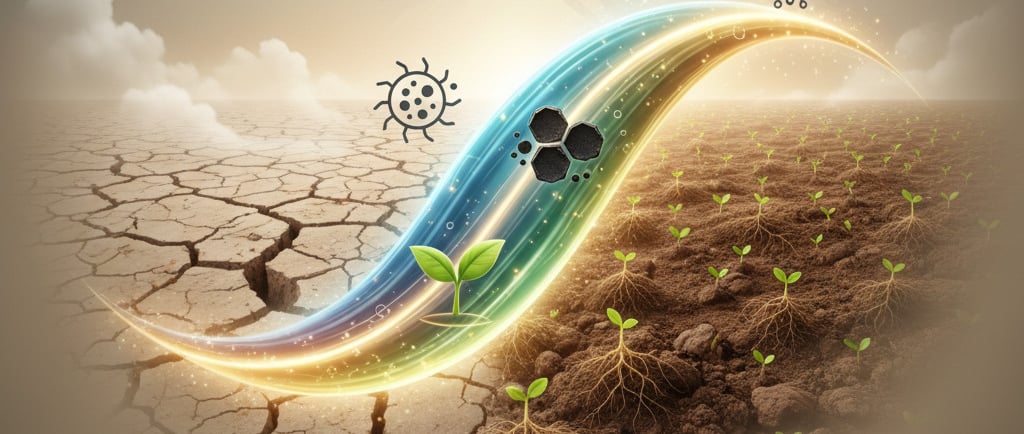
It's a problem that affects nearly half the world's population, yet often goes unnoticed: our soil is in trouble. According to the United Nations, a staggering 40% of the world's land is already degraded. This isn't just about dusty fields; it's a direct threat to our food security, biodiversity, and ability to withstand climate change. For rural communities who depend on the land for their livelihood, this silent crisis is an immediate threat.
For decades, intensive farming, deforestation, and unsustainable practices have stripped our soils of vital organic matter, imbalanced their nutrients, and left them vulnerable to erosion. While we've known about this for a long time, traditional fixes are often expensive and don't work everywhere. The good news? A recent surge in scientific innovation is giving us a powerful new toolkit to regenerate our soil and heal our ecosystems. A massive 15-year review of scientific literature has revealed the most promising emerging methods, from harnessing tiny microbes to leveraging artificial intelligence.
A New Wave of Solutions: The Regenerative Toolkit
Scientists are looking beyond simple fertilizers and are exploring a fascinating array of methods that work with nature, often enhanced by modern technology. Research in this field has exploded since 2019, with global collaborations tackling the problem from multiple angles. Here are some of the most exciting approaches:
1. The Biological Powerhouses (Working with Life)
Microbial Inoculants: Think of these as probiotics for the soil. By adding beneficial bacteria and fungi, we can kickstart a healthier soil ecosystem. These tiny allies help plants access nutrients like nitrogen and phosphorus, improve soil structure, decompose organic matter, and even suppress diseases. They are a cornerstone of building a living, resilient soil.
Biochar: This isn't just charcoal. Biochar is a special carbon-rich material made by heating organic waste (like crop residue) in a low-oxygen environment. When added to soil, it acts like a permanent sponge: it improves water retention, holds onto vital nutrients, provides a fantastic home for beneficial microbes, and locks carbon away for centuries, helping to mitigate climate change.
2. Agroecological Approaches (Smarter Farming Systems)
Cover Cropping: Instead of leaving fields bare between main harvests, farmers plant "cover crops." These plants protect the soil from erosion, reduce nutrient leaching, and add valuable organic matter back into the ground when they decompose, improving soil structure and carbon storage.
Agroforestry: This is the practice of integrating trees and shrubs into crop and animal farming systems. Trees are champions of soil health: their deep roots cycle nutrients, their leaf litter builds organic matter, and they help prevent erosion, all while sequestering carbon from the atmosphere.
Conservation Tillage: This "less is more" approach dramatically reduces or eliminates plowing (tillage). By leaving the soil and previous crop residue undisturbed, farmers can prevent erosion, improve water absorption, and help soil organic matter and beneficial organisms like earthworms thrive.
3. The Technological Revolution (Data-Driven Decisions)
Precision Agriculture & AI: The future of farming is smart. Using tools like GPS, drones, and remote sensing satellites, farmers can get a hyper-detailed picture of their fields. Artificial Intelligence (AI) and machine learning algorithms can then analyze this data to guide precise, targeted interventions. This means applying the exact amount of water or fertilizer exactly where it's needed, reducing waste and environmental impact.
Smart Soil Sensors: A new generation of IoT (Internet of Things) devices and advanced sensors (optical, electrochemical, etc.) can provide real-time data on soil moisture, pH, nutrient levels, and more. This allows for instant, data-driven decisions, moving beyond slow and expensive traditional lab tests.
The Challenges on the Road to Regeneration
While these innovations are incredibly promising, the review also highlights significant hurdles. A solution that works in a lab or a large-scale farm in the US might not be practical for a smallholder farmer in sub-Saharan Africa. The key challenges include:
Scalability & Cost: High-tech solutions like precision agriculture are expensive, and even producing enough biochar or microbial inoculants for vast areas can be a logistical challenge.
Context is King: The effectiveness of any method depends heavily on the local climate, soil type, and socio-economic conditions. A one-size-fits-all approach is doomed to fail.
Knowledge Gaps & Policy: Getting these new methods adopted requires education, financial incentives for farmers, and supportive government policies that prioritize long-term soil health over short-term yield at any cost.
The Path Forward: An Integrated Approach
Healing our rural soils requires a holistic strategy. The review makes it clear that the most successful approaches will be those that integrate scientific innovation with traditional knowledge, are supported by smart policy, and are developed in partnership with local communities. By combining the power of biology, smarter farming systems, and cutting-edge technology, we can build a future with healthier soils, more resilient ecosystems, and sustainable food security for generations to come.