Add your promotional text...
Healthier Soil, Better Crops: The Science of Microbial Biostimulants
Source & Further Information: The findings and concepts discussed in this article are largely based on the research presented in the following scientific paper: Castiglione AM, Mannino G, Contartese V, Bertea CM, Ertani A. Microbial Biostimulants as Response to Modern Agriculture Needs: Composition, Role and Application of These Innovative Products. Plants (Basel). 2021 Jul 27;10(8):1533. doi: 10.3390/plants10081533. PMID: 34451578; PMCID: PMC8400793. We encourage readers interested in the detailed methodology and complete results to consult the original publication.
1/30/20264 min read
Introduction: A Crisis Beneath Our Feet
Our planet's soil is in trouble. The very foundation of our food system is becoming degraded, with nearly 40% of the world's agricultural land losing its fertility, productivity, and vital biodiversity. This is a huge problem, especially with a growing global population and shrinking arable land. For decades, the answer was more chemical fertilizers and pesticides, but this approach has often come at a high environmental cost.
Today, a paradigm shift is underway. Spurred by initiatives like the European Union's "Farm to Fork" strategy, agriculture is moving towards a more sustainable, eco-friendly future. The goal is to produce healthy, nutritious food while preserving soil health and reducing our reliance on synthetic chemicals.
Enter a new generation of innovative products: Plant Biostimulants. Specifically, we're going to dive into Microbial Biostimulants – formulations containing living microorganisms that act as powerful, natural allies to our crops.
What Are Microbial Biostimulants?
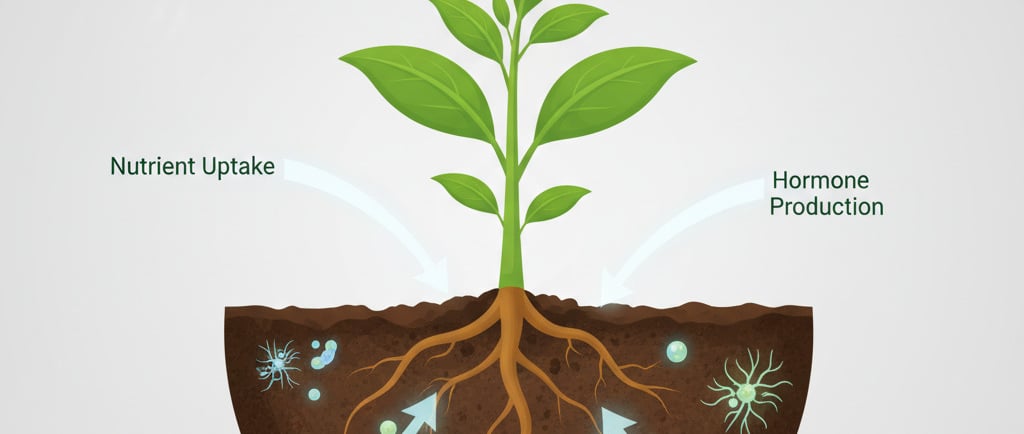
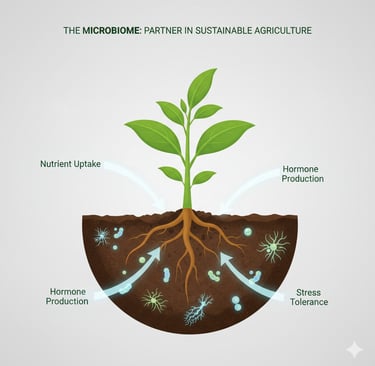
Simply put, a microbial biostimulant is a product containing beneficial microorganisms that, when applied to plants or soil, stimulates natural processes to enhance nutrient uptake, improve nutrient efficiency, boost tolerance to stresses (like drought), and improve crop quality. They're not fertilizers in the traditional sense; they work by helping the plant help itself and by improving the living ecosystem of the soil.
The main players in this microscopic world are Plant Growth Promoting Microorganisms (PGPMs), which primarily include:
Arbuscular Mycorrhizal Fungi (AMF): These fungi form a symbiotic relationship with over 80% of land plants. Their network of fine filaments (hyphae) extends far beyond the plant's roots, massively increasing the surface area for absorbing water and nutrients like phosphorus.
Plant Growth Promoting Rhizobacteria (PGPR): This is a diverse group of bacteria living in the soil around roots (the rhizosphere). Genera like Azotobacter, Rhizobium, Azospirillum, and Bacillus are famous for their ability to promote plant growth.
How Do These Tiny Helpers Work? The Mechanisms of Action
While the science is complex and still being unraveled, we know these microbes influence plants in several powerful ways:
Hormonal Regulation: PGPMs can produce their own plant hormones (like auxins, which promote root growth) or influence the plant's own hormonal balance. For instance, some bacteria can produce an enzyme (ACC deaminase) that lowers plant stress hormone levels, helping the crop stay healthier under tough conditions.
Balancing Oxidative Stress: During stress (like drought or salinity), plants produce harmful molecules called Reactive Oxygen Species (ROS). PGPMs can boost the plant's own antioxidant enzyme systems, helping to neutralize these damaging molecules and protect cells.
Improving Water & Photosynthesis: Inoculated plants often show better water management. They can maintain higher water content, improve the function of their leaf pores (stomata), and ultimately enhance their photosynthetic efficiency, even under stress.
Boosting Nutrient Use Efficiency (NUE): This is a huge one. PGPMs are masters at making nutrients available to plants. They can:
Fix Nitrogen: Convert atmospheric nitrogen into a form plants can use.
Solubilize Phosphorus: Unlock phosphorus and potassium that are chemically bound up in the soil.
Produce Siderophores: Release special molecules that scavenge for iron, an essential but often unavailable nutrient.
The "Team-Up" Effect: Why Consortia and Combinations are Better
While a single beneficial microbe strain can be effective, research increasingly shows that teamwork makes the dream work.
Co-inoculation (AMF + PGPR): When fungi and bacteria are used together, they often have synergistic effects. The bacteria can act as "mycorrhiza helpers," promoting the establishment of the fungi on the roots. In turn, the fungi can enhance the activities of the bacteria. This dual-inoculum often leads to better results in plant growth, nutrient uptake, and stress tolerance than either microbe could achieve alone.
Combining Microbes with Organic Matter: The real magic can happen when microbial biostimulants are combined with other biologically active materials like:
Compost or Humic Acids: These provide nutrients and improve soil structure, creating a better environment for both the plant and the inoculated microbes to thrive.
Algae Extracts: Rich in bioactive compounds and plant hormones, seaweed extracts can stimulate both the plant and the native soil microorganisms.
Amino Acids: These can act as anti-stress factors and are building blocks for plant processes.
These combinations often create a powerful synergistic effect, boosting the overall performance of the biostimulant far beyond the sum of its parts. However, it's not always a perfect match; sometimes, certain microbes can have antagonistic effects on each other, which is why careful selection and testing of these "consortia" are crucial.
Impact on Food Quality & Soil Health
The benefits aren't just about bigger yields. There's a growing body of evidence showing that microbial biostimulants can also improve the nutritional and quality aspects of our food. A meta-analysis of multiple studies found that microbial inoculation significantly increased the content of sugars, polyphenols, and anthocyanins in fruits, as well as their overall antioxidant activity. This aligns with consumer demand for healthier, more nutritious, and eco-sustainably grown food.
Crucially, these biostimulants are also a powerful tool for restoring soil health. Modern agriculture has often led to biological degradation – the loss of beneficial microbial life in the soil. By reintroducing and stimulating these microbial communities, biostimulants help to rebuild soil structure, improve nutrient cycling, and increase the soil's resilience to stress. This is a key strategy in achieving "Land Degradation Neutrality," a global goal to maintain and restore the health of our planet's land resources.
Conclusion: A Promising Future for Farming
Microbial biostimulants represent a significant step forward in our quest for sustainable agriculture. By harnessing the power of nature's own tiny allies, we can move away from a heavy reliance on synthetic chemicals. These innovative products offer a way to improve crop resilience to environmental stress, enhance the nutritional quality of our food, and, most importantly, rebuild the health and biodiversity of our precious soils. While regulations and research are still evolving, the potential for these microbial teams to help us meet future food demands sustainably is immense.