Add your promotional text...
Lecture 1: The Modern Sahara: A Profile of Hyper-Aridity
Series: The Sahara Reforestation Project: From Dune Sea to Green Valley Part I: The Foundation - Analysis and Initial Interventions
2/27/20267 min read
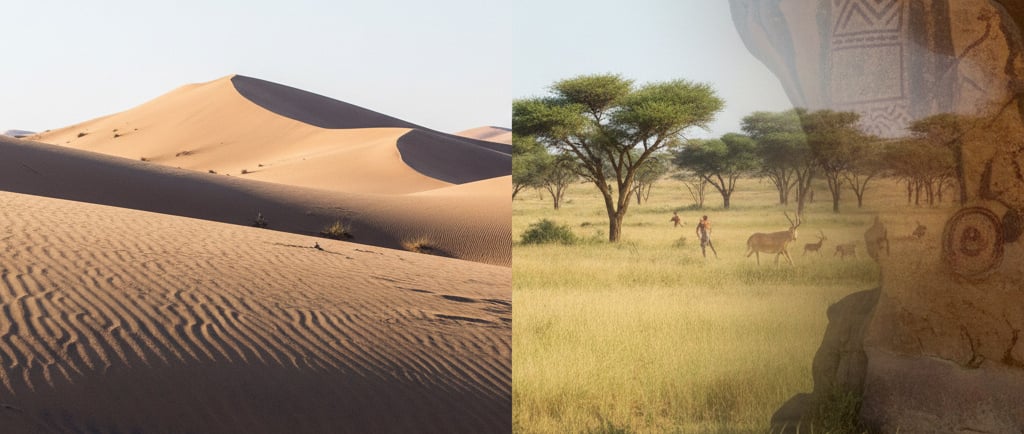
Welcome to the first lecture in our series, "The Sahara Reforestation Project: From Dune Sea to Green Valley." Before we can entertain the monumental task of transforming a desert, we must first engage in a rigorous, multidisciplinary analysis of the subject itself. The Sahara is not merely a vast expanse of sand; it is a complex, dynamic, and extreme environmental system. To comprehend the scale of the challenge ahead, we must first quantify the interlocking physical, chemical, and climatological parameters that define its modern state of hyper-aridity. This lecture will serve as our foundational profile, establishing the baseline against which all future efforts must be measured. We will dissect the climate, geology, and biology—or lack thereof—of the largest hot desert on Earth.
Furthermore, we cannot fully appreciate the Sahara's current state without understanding its past. The desert as we know it is not an eternal, immutable feature of our planet. Paleoclimatic evidence reveals a dramatically different history, a period known as the African Humid Period, or the "Green Sahara." By examining the mechanisms that turned the Sahara green in the past, we establish not only a historical precedent but also a theoretical framework for the possibility of its future transformation.
Climatological Profile: The Engine of Aridity
The defining characteristic of the Sahara is its profound lack of precipitation, a condition scientifically termed hyper-aridity. The desert spans approximately 9.2 million square kilometers of North Africa, an area comparable to the contiguous United States. Across this vast region, mean annual precipitation is typically below 100 millimeters, with the core regions, such as the Tanezrouft Basin, receiving less than 25 millimeters per year. For context, this is an order of magnitude less than what is required to sustain even the most rudimentary rain-fed agriculture.
This extreme lack of rainfall is primarily a function of large-scale atmospheric circulation patterns. The Sahara is situated predominantly under the subtropical ridge, a belt of high atmospheric pressure where air from the upper troposphere descends. This descending air warms and dries as it compresses, suppressing cloud formation and precipitation. This phenomenon, known as subsidence, creates a stable, arid climate that is largely disconnected from oceanic moisture sources.
Compounding the lack of precipitation is an exceptionally high rate of potential evapotranspiration (PET). PET is a measure of the atmosphere's "thirst"—its capacity to draw water from surfaces through evaporation and from plants through transpiration. In the Sahara, this is driven by two key factors:
High Solar Insolation: With near-perpetual clear skies, the Sahara receives some of the highest levels of solar radiation on the planet. This intense energy input heats the surface and the air above it, dramatically increasing the energy available for evaporation.
Low Relative Humidity: The descending air of the subtropical ridge is exceptionally dry. This large vapor pressure deficit between the surface and the atmosphere creates a powerful gradient that aggressively pulls moisture from any available source—be it a rare puddle, a plant leaf, or the soil itself.
The result is a PET rate that can exceed 4,000 millimeters per year in some areas. This creates a staggering annual water deficit; the atmosphere demands to evaporate more than 40 times the amount of water that actually falls as rain. Any surface water is ephemeral, vanishing almost as soon as it appears. This climatological engine is the fundamental barrier to establishing a self-sustaining ecosystem.
Geological and Pedological Profile: A Substrate Hostile to Life
The ground beneath the Saharan sky is as challenging as the atmosphere above it. The geology is varied, but the surface expression is dominated by landscapes shaped by eolian (wind-driven) processes. We can classify the Saharan surface into three primary types:
Ergs (Sand Seas): These are the iconic dune fields, covering approximately 20% of the desert. They are vast, mobile landscapes of sand particles, primarily composed of quartz. Ergs are fundamentally unstable substrates, with constantly shifting dunes that can bury any nascent vegetation. Pedologically, they are not soil; they are mineral deposits with virtually no structure, water-holding capacity, or organic content.
Regs (Stony Desert or Desert Pavement): Covering about 70% of the Sahara, regs are broad plains covered by a tightly packed layer of gravel and rocks. This "pavement" is formed as wind removes finer sand and dust particles, leaving the heavier fragments behind. While more stable than ergs, the substrate is still incredibly poor, with minimal fine material to hold water or nutrients.
Hamadas (Rocky Plateaus): These are elevated, barren plateaus of exposed bedrock. Soil is entirely absent, and the landscape is defined by stark, wind-scoured rock formations.
A unifying characteristic across these landscapes is the near-total absence of topsoil. Soil is not merely pulverized rock; it is a complex, living matrix of minerals, organic matter, water, air, and a vast community of microorganisms. The Sahara lacks the foundational ingredient for soil formation: a consistent supply of organic matter from decaying plant and animal life. Without this biological input, there is no humus to bind mineral particles, no organic acids to weather rock, and no substrate to support a healthy microbial community.
The chemical properties of the substrate are equally challenging. Saharan "soils," where they can be said to exist at all, are typically:
Nutrient-Poor: They are severely deficient in essential macronutrients, particularly nitrogen and phosphorus, which are fundamental building blocks for life.
Saline and Sodic: In low-lying depressions (known as chotts or sebkhas), intense evaporation concentrates salts at the surface, creating saline crusts that are toxic to most plants. High sodium content (sodicity) can also destroy soil structure, making it impermeable to water.
Alkaline: The pH of Saharan substrates is often high, which can lock up essential micronutrients like iron and manganese, making them unavailable for plant uptake even if they are present in the mineral matrix.
In summary, the Saharan surface is a geological and chemical desert as much as it is a climatological one. It is not a fertile field awaiting only water; it is a sterile mineral substrate that must be fundamentally transformed.
Biological Profile: Life on the Margins
Life in the hyper-arid core of the Sahara is sparse and opportunistic. The dominant life forms are extremophiles, organisms adapted to survive in the most hostile conditions imaginable.
Flora: Macrophytic life (plants) is largely confined to oases, wadis (dry riverbeds that see occasional flash floods), and mountainous regions with slightly higher rainfall or access to groundwater. The species that survive are masters of drought tolerance. They exhibit xerophytic adaptations such as deep taproots to reach groundwater, small, waxy leaves (or no leaves at all) to minimize water loss, and CAM (Crassulacean Acid Metabolism) photosynthesis, which allows them to open their stomata for CO2 uptake only during the cooler night. Examples include the Date Palm (Phoenix dactylifera) in oases and various hardy Acacia species. However, these are exceptions; for most of the Sahara, the surface is devoid of visible plant life.
Fauna: Animal life is similarly constrained. Most animals are small, nocturnal, and have evolved remarkable water conservation strategies. Desert rodents, fennec foxes, and various reptiles have highly efficient kidneys to produce concentrated urine, and they derive most of their water from the food they eat. Larger animals, like the Addax antelope, are nomadic, constantly migrating in search of scarce vegetation.
Microbiology: The unseen life is perhaps the most resilient. Cyanobacteria, lichens, and other microbes form "cryptobiotic" or "biogenic" soil crusts in semi-arid regions. These crusts lie dormant for long periods, but can spring to life with the slightest moisture, fixing nitrogen and carbon and helping to stabilize the soil surface. In the hyper-arid core, even this microbial life is pushed to its absolute limit, existing primarily in specialized niches like the underside of translucent quartz pebbles (hypolithic communities), where they are shielded from UV radiation while still receiving faint light for photosynthesis.
This existing biological profile tells us two things: life can survive here, but only through extreme, specialized adaptations. It also tells us that the biological foundation upon which a new ecosystem must be built is, for all practical purposes, absent.
Paleoclimatic Precedent: The Green Sahara (African Humid Period)
The Sahara was not always a desert. To understand the potential for a future transformation, we must look to its recent geological past. The African Humid Period (AHP), roughly from 11,000 to 5,000 years ago, saw a dramatically different Sahara. Paleoclimatic proxies—such as lakebed sediments, pollen analysis, and archaeological evidence—paint a picture of a vast savanna ecosystem, replete with large lakes (e.g., Lake Mega-Chad), flowing rivers, and abundant wildlife, including crocodiles, hippos, and giraffes. Human populations thrived, leaving behind rock art that vividly depicts a verdant, life-filled landscape.
What drove this radical transformation? The primary mechanism was a subtle, periodic change in Earth's orbit, known as the Milankovitch cycles. Specifically, a ~23,000-year cycle of "precession" (the wobble of Earth's axis) altered the timing of the seasons relative to Earth's closest approach to the Sun (perihelion). During the AHP, Northern Hemisphere summer occurred at perihelion, resulting in significantly increased solar radiation over North Africa.
This intensified heating of the landmass had a profound effect on the West African Monsoon. The stronger land-sea temperature contrast drove the monsoon winds much further north than they penetrate today, bringing seasonal, life-sustaining rains deep into the heart of the Sahara.
The transition back to a desert was geologically abrupt, occurring over just a few centuries around 5,000 years ago as the orbital parameters shifted back. This rapid collapse highlights the existence of a climatic "tipping point." However, the AHP serves as our crucial proof of concept: the Saharan climate is not a permanent fixture. It is a system that has, in the past, responded dramatically to changes in its energy balance. It demonstrates that under the right conditions, the Sahara can support a large-scale, functioning ecosystem.
Conclusion: A Baseline for Intervention
In this lecture, we have established a quantitative and qualitative baseline for the modern Sahara. We have characterized it as a system defined by a massive water deficit, driven by atmospheric subsidence and high insolation. Its surface is a sterile, nutrient-poor mineral substrate, largely devoid of the organic matter and microbial life that constitute true soil. The sparse life that exists is highly specialized for survival on the absolute margins.
However, we have also established that this state is not immutable. The precedent of the Green Sahara demonstrates that the North African climate system possesses a tipping point. By understanding the orbital forcing that triggered the AHP, we gain a theoretical underpinning for our future lectures: if a natural, modest increase in solar energy could so profoundly transform the desert, could a deliberate, large-scale artificial intervention in the region's energy and water balance achieve a similar, or even greater, outcome?
This question will be the central theme as we move forward. Our next lecture, "The Water Source I: Mega-Scale Desalination," will begin to address the first and most critical component of such an intervention: the generation of a water supply on a scale unprecedented in human history.
Thank you.