Add your promotional text...
Lecture 10: The First Enclosed Farms: Biospheres in the Desert
Series: The Sahara Reforestation Project: From Dune Sea to Green Valley Part I: The Foundation - Analysis and Initial Interventions
3/20/20266 min read
Introduction: Sustaining the Terra-formers
Welcome. Over our past several lectures, we have focused on the monumental task of initiating biogenesis on a landscape scale: creating soil, establishing microbial communities, and planting the vast pioneer shelterbelts. These are multi-decadal endeavors that will require a large, dedicated, and persistent human workforce on-site, deep within the Sahara. Before the first open-field harvests become a reality, this population of engineers, scientists, and technicians must be fed. Relying on a continuous supply chain of food transported from thousands of kilometers away is logistically precarious, energetically expensive, and fundamentally unsustainable for a project of this magnitude.
Therefore, in parallel with our extensive terraforming efforts, we must deploy intensive, self-sufficient agricultural systems. This lecture will detail the design, construction, and operation of the project's first enclosed farms. These are not conventional greenhouses; they are technologically advanced, fully-enclosed biospheres, borrowing design principles from conceptual plans for lunar and Martian colonization. We will refer to them as Controlled Environment Agriculture (CEA) modules. Their primary design imperatives are maximum resource efficiency—specifically, near-100% water recycling—and high-yield, predictable food production, thereby minimizing the strain on our nascent water grid and ensuring the nutritional security of the project's human capital.
The Rationale for Controlled Environment Agriculture (CEA)
Choosing to build hermetically sealed, high-tech farms in a desert we are actively trying to green may seem paradoxical. However, the initial Saharan environment, even with irrigation, remains brutally hostile to conventional agriculture. The rationale for CEA is compelling:
Water Conservation: This is the paramount reason. An open-field farm in the Sahara would lose enormous quantities of water to evaporation. A closed-loop CEA module, by contrast, can recapture and recycle virtually all water transpired by plants and evaporated from surfaces. Water efficiency can approach 99%, meaning the only water "lost" is that which is incorporated into the biomass of the harvested crops. This dramatically reduces the water demand on our newly constructed grid.
Climate Control: The system allows for complete control over temperature, humidity, and atmospheric composition (CO2 levels). This optimizes plant growth, removes seasonal limitations, and allows for year-round, multi-harvest cultivation, leading to yields per square meter that can be 10 to 100 times higher than open-field agriculture.
Pest and Disease Exclusion: A sealed environment physically excludes common agricultural pests and pathogens, eliminating the need for pesticides and herbicides and ensuring a stable, predictable harvest free from the vagaries of field infestations.
Resource Optimization: All inputs—water, nutrients, light—are delivered in precise, computer-controlled amounts, eliminating waste and maximizing efficiency.
These CEA modules will serve as the "vegetable gardens" and "staple crop factories" for the workforce, providing a constant supply of fresh, nutritious food in the heart of the desert.
Architectural and Engineering Design
The CEA modules would be large-scale, modular structures, likely constructed near the main operational hubs and pumping stations along the water grid.
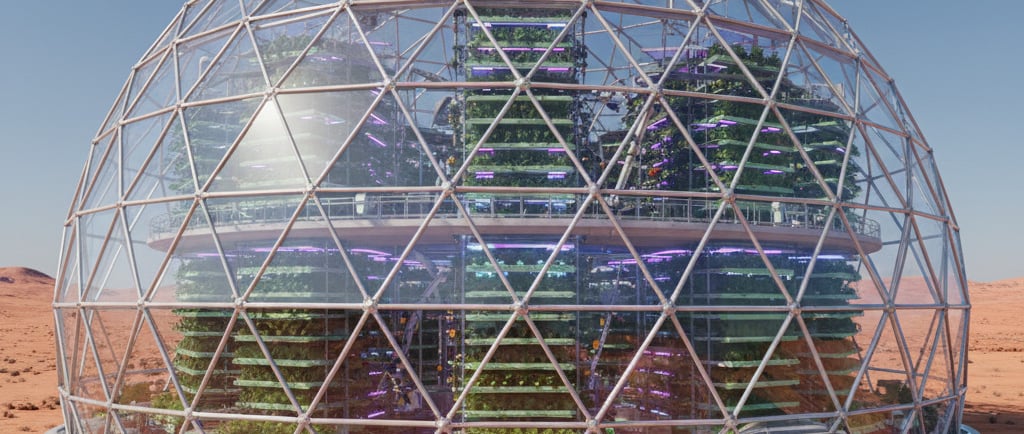
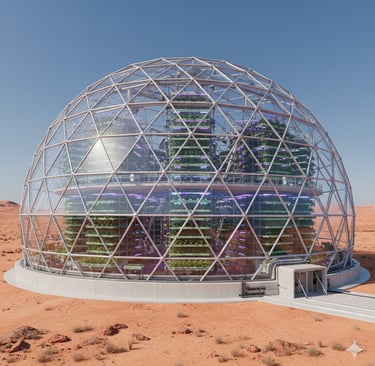
Structure: The primary structure would likely be a geodesic dome or a vaulted arch design, engineered for high structural strength against wind and for maximizing interior volume and light distribution. The covering would be a multi-layered, transparent material, such as Ethylene tetrafluoroethylene (ETFE), prized for its high light transmittance, durability, UV resistance, and self-cleaning properties. An inner layer of glass or polycarbonate might be used for added insulation and pressure sealing.
Atmospheric Sealing: The entire structure would be hermetically sealed to prevent air and moisture exchange with the outside environment. Air-locks would be used for personnel and equipment entry. This seal is the key to water recycling and CO2 management.
Thermal Management: Managing the immense solar heat gain is a critical engineering challenge. This would be achieved through a multi-faceted approach:
Spectrally Selective Glazing: Using materials that allow photosynthetically active radiation (PAR) to pass through but reflect a portion of the infrared (heat) spectrum.
Shading Systems: Automated, retractable shades to reduce peak solar load.
Geothermal Exchange: Pumping water through pipes buried deep underground (where the temperature is stable) to act as a massive heat sink during the day and a heat source at night.
Evaporative Cooling: Using closed-loop evaporative cooling systems ("swamp coolers") that do not vent moisture to the outside.
Atmospheric Control: The internal atmosphere would be actively managed. CO2 levels would be enriched (to 800-1200 ppm) during "daylight" hours to boost photosynthesis, with CO2 supplied from captured industrial sources or from the compost/biorefinery facilities. Oxygen levels, temperature, and humidity would be constantly monitored and regulated by the central ECLSS.
Biological Systems: Soilless Cultivation
To maximize control, efficiency, and yield, cultivation within the CEA modules would be entirely soilless, relying on hydroponic and aeroponic technologies.
Hydroponics:
Nutrient Film Technique (NFT): Ideal for fast-growing leafy greens (lettuce, spinach, herbs). Plants are grown in shallow channels with their roots bathed in a thin, constantly flowing film of nutrient-rich water. This ensures perfect hydration and nutrition while providing ample oxygen to the roots.
Deep Water Culture (DWC): Suitable for larger plants like tomatoes or cucumbers. The roots are suspended in a highly aerated reservoir of nutrient solution.
Drip Irrigation on Inert Substrates: For staple crops like potatoes, wheat, or soybeans, a vertical farming approach would be used. Plants would be grown in stacked layers on an inert substrate (e.g., rockwool, perlite, or even processed lunar regolith in our extraterrestrial analogues) and fed by a precision drip irrigation system that delivers the nutrient solution.
Aeroponics:
This is the most water-efficient method. Plant roots are suspended in the air within a sealed chamber and are periodically misted with a nutrient-rich aerosol. This provides unparalleled oxygenation to the root zone, often leading to the fastest growth rates. It would be used for high-value or research crops.
The Nutrient Loop: The nutrient solutions in these systems would be managed in a closed loop. Water and dissolved nutrients are delivered to the plants. The runoff, or "leachate," is collected, analyzed by chemical sensors, and then re-fortified with the specific nutrients the plants have consumed before being recirculated. This results in near-zero nutrient waste.
Water Recycling: The Core of the System
The defining feature of these biospheres is their hydrological closure. The ECLSS is designed to function like a planetary water cycle in miniature.
Transpiration Capture: The primary source of water for recycling is plant transpiration. As plants release pure water vapor from their leaves, the humidity inside the sealed dome rises.
Dehumidification and Condensation: The ECLSS continuously draws the humid air through cooling coils. As the air cools below its dew point, the water vapor condenses into pure, distilled liquid water. This is essentially an artificial rainmaking machine.
Collection and Purification: The condensed water is collected in reservoirs. While it is already very pure, it undergoes a final purification step (e.g., UV sterilization) before being used to mix new nutrient solutions or for potable water for the crew.
Greywater Integration: Greywater from the associated human habitat (sinks, showers) can also be routed into the CEA module's water treatment system, where it is purified by a combination of filtration and biological processing (e.g., passing through an algae bioreactor) before re-entering the main water supply.
Lighting and Photoperiod Control
While the transparent ETFE structure allows natural sunlight to be the primary light source, this is supplemented and controlled by an advanced LED lighting system.
Supplemental Lighting: During cloudy days or to extend the photoperiod, the LEDs provide the necessary light for photosynthesis.
Spectral Tuning: The LEDs are tunable, allowing operators to provide specific light spectrums tailored to the crop and its growth stage. For example, a higher ratio of blue light can promote vegetative growth in leafy greens, while an increased ratio of red/far-red light can be used to trigger flowering in fruiting crops.
Photoperiod Manipulation: By precisely controlling the "day" length, operators can force plants to grow, flower, or fruit on an accelerated schedule, independent of the external Saharan seasons. This allows for multiple, predictable harvests per year.
Integration with Other Project Systems
The CEA modules are not isolated islands; they are integral components of the larger terraforming project's metabolism.
Waste Integration: Inedible plant biomass (stems, roots) from the CEA modules serves as a primary carbon-rich feedstock for the project's composting and biochar facilities (Lecture 6).
Energy Integration: The modules are major energy consumers. They are powered by the same solar grid that runs the water pumps, and their energy use can be scheduled to align with periods of peak solar production.
Human Integration: They are the primary source of food and a significant source of oxygen and purified water for the human settlements. They also provide a vital psychological benefit—a lush, green, productive environment in the midst of a harsh desert.
Conclusion: A Self-Sustaining Nucleus of Life
The First Enclosed Farms are far more than just agricultural facilities; they are the self-sustaining nuclei from which a new Saharan biosphere will be managed and supported. By employing a closed-loop philosophy borrowed from space exploration, these CEA modules achieve unparalleled resource efficiency, providing the project workforce with food, water, and oxygen while placing a minimal burden on the primary water grid.
These biospheres act as a bridge. They sustain the human effort during the long decades required for the open-air ecosystems to mature. They also serve as high-tech horticultural laboratories, where crop varieties (including genetically engineered ones) can be tested and optimized in a controlled environment before being deployed into the wider, less predictable landscape. They represent the perfect synergy of biology and engineering, a necessary and foundational step in the journey from a sterile erg to a living valley.
Having now secured a sustainable food source for our terra-formers, we will return our focus to the landscape. Our next lecture, "From Pioneers to Keystone Species: Diversifying the Flora," will discuss the phased introduction of a broader palette of plants to build upon the foundation laid by the Great Green Wall, beginning the process of creating a complex, multi-layered ecosystem. Thank you.