Add your promotional text...
Lecture 11: From Pioneers to Keystone Species: Diversifying the Flora
Series: The Sahara Reforestation Project: From Dune Sea to Green Valley Part II: Expanding the Green Zone - Establishing Ecosystems
3/23/20266 min read
Introduction: Beyond Survival
Welcome. In our preceding lectures, we have successfully established a beachhead of life in the Sahara. We have engineered a water supply, initiated pedogenesis, and planted the "First Green Line"—a vast shelterbelt of exceptionally hardy pioneer species. These pioneers (Acacia, Balanites, Leptadenia) were chosen for a single, overriding characteristic: survival. Their function is primarily defensive: to stabilize the soil, break the desiccating power of the wind, and endure the harsh, unmodified environment. Now that this protective barrier is taking root and beginning to create a more clement microclimate in its lee, we can transition from a strategy of mere survival to one of ecological construction.
This lecture marks a crucial shift in our biological approach. We will move beyond the initial vanguard of pioneers to discuss the phased introduction of a second and third wave of plant species. These are the ecosystem builders. Our focus will shift from selecting for pure hardiness to selecting for ecological function: species that actively and efficiently build soil, fix nitrogen, and create a complex, multi-layered canopy. We will introduce the concept of "keystone species" in this designed ecosystem and outline the principles of ecological succession that will guide our planting strategy for decades to come.
Ecological Succession in a Designed Ecosystem
In natural ecosystems, the process by which a barren landscape is colonized and develops into a mature, complex community is called ecological succession. It begins with pioneer species, which are gradually replaced by intermediate species, and finally by a stable climax community. For the Sahara Reforestation Project, we are not waiting for this process to unfold over centuries; we are actively managing and accelerating it. Our strategy is one of "assisted succession."
The First Green Line has created a zone of ecological opportunity. On the leeward side of the shelterbelts, wind speeds are reduced, peak temperatures are moderated, and humidity is slightly elevated. The soil, while still young, is stabilized, microbially active, and receiving a steady input of organic matter from the pioneers' leaf litter. This moderated environment can now support a wider, and slightly less extremophilic, palette of species.
Our diversification strategy will proceed in waves, introducing species based on their functional roles and their position in the successional sequence.
The Second Wave: The Soil Builders and Nitrogen Fixers
The primary goal of the second wave of planting is to rapidly accelerate soil formation and nutrient enrichment. While our pioneer species contribute to this, we will now introduce specialists selected specifically for these tasks.
Perennial Grasses: Grasses are unparalleled soil builders.
Biological Function: Perennial grasses, particularly C4 grasses adapted to warm, arid climates (e.g., species of Panicum, Cenchrus, Andropogon), develop dense, fibrous root systems. This "root mat" is incredibly effective at binding soil particles, creating stable aggregates, and improving soil structure. Furthermore, the rapid turnover of these fine roots contributes a massive amount of organic carbon directly into the soil profile, feeding the microbial community and building humus.
Species Selection: We would select a diverse mix of native African savanna grasses, genetically screened and enhanced for drought tolerance and rapid biomass production. Their function is to create the foundational sod layer, preventing erosion between the larger trees and shrubs and creating the organic matrix of the topsoil.
Planting Strategy: Seeds of these grasses would be aerially sown or drilled into the soil in the protected zones behind the primary windbreaks.
Herbaceous and Shrubby Legumes: Nitrogen remains a key limiting nutrient. While some pioneer trees are nitrogen-fixers, we will now introduce a diverse understory of herbaceous and shrubby legumes to maximize nitrogen input into the system.
Biological Function: These plants (e.g., species of Tephrosia, Crotalaria, Indigofera) form symbiotic relationships with Rhizobium bacteria in their root nodules, converting atmospheric N2 into ammonia. They act as living fertilizer factories, continuously enriching the soil.
Ecological Role: As an understory layer, they provide ground cover, reduce soil evaporation, and their nitrogen-rich leaf litter is a high-quality food source for decomposers, accelerating nutrient cycling. They are a critical link in building a self-sustaining nitrogen cycle.
The Third Wave: Keystone Species and Canopy Diversification
With a stable, nitrogen-enriching ground cover established, we can introduce the larger, longer-lived species that will form the structural backbone of the new savanna and woodland ecosystems. This wave includes "keystone species"—species whose impact on the ecosystem is disproportionately large relative to their abundance.
Keystone Tree Species:
Faidherbia albida (Apple-ring Acacia): This is a prime candidate for a keystone species in our agroforestry systems. It is a large, nitrogen-fixing tree with a unique phenology: it is "reverse-deciduous," meaning it drops its leaves during the wet season and grows them during the dry season. This makes it an ideal companion for crops; it provides nitrogen-rich leaf litter and full sun to the crops below during their growing season, and provides shade and reduces evaporative stress during the hot, dry season.
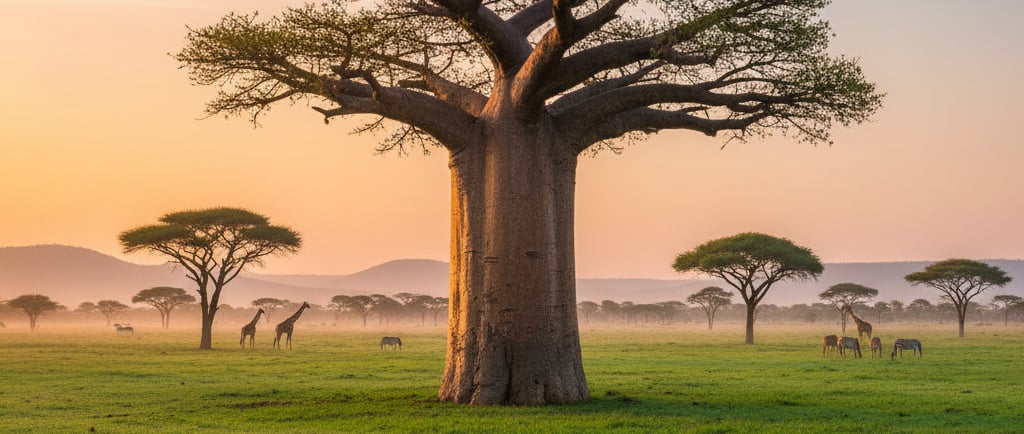
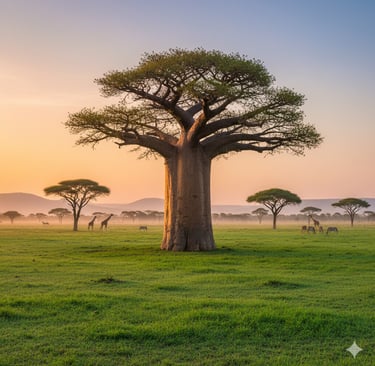
Adansonia digitata (Baobab): The African Baobab is an ecological marvel. Its massive, succulent trunk can store up to 120,000 liters of water, making it an island of hydration in the landscape. It provides a unique habitat for countless species (birds, insects, reptiles), and its fruit and leaves are nutritious. As a long-lived, massive biomass and water store, it would be a critical keystone of the mature savanna.
Vitellaria paradoxa (Shea Tree): This tree is vital for both ecological and economic reasons. It is extremely hardy, fire-resistant, and its nuts produce shea butter, a valuable commodity. Integrating such species provides a long-term economic incentive for maintaining the health of the new ecosystem.
Canopy Diversification: To create a resilient, multi-layered ecosystem, we must move beyond a monoculture of pioneers. This phase involves planting a diverse mix of trees and large shrubs with different forms and functions:
Upper Canopy: Tall, light-demanding species that will form the highest layer of the forest or savanna (e.g., Baobabs, certain Acacias).
Mid-Canopy: Medium-sized, more shade-tolerant trees that grow beneath the upper canopy (e.g., Shea trees, Desert Date).
Understory: A dense layer of large shrubs and small trees that thrive in the moderated conditions below the main canopy.
Ecological Principle: This structural complexity creates a wider variety of niches, supporting a much greater diversity of animal life. It also more efficiently captures sunlight and partitions resources (water, nutrients), leading to a more productive and stable ecosystem overall.
Genetic Landscaping: Deploying Genetically Optimized Cultivars
The selection of species is only the first step. For each candidate species, we would deploy not a single genotype, but a carefully curated portfolio of genetically diverse and specifically optimized cultivars. The "Genetic Engineering" lectures will cover the "how," but this lecture outlines the "what" and "why."
Source Material: We would draw on the vast genetic diversity present in global seed banks (like the Svalbard Global Seed Vault) and in wild populations from Earth's most challenging arid environments.
Targeted Traits: Using advanced genomic selection and CRISPR-based gene editing, we would develop cultivars optimized for:
Water Use Efficiency (WUE): Maximizing biomass produced per liter of water transpired.
Salt Tolerance: Enhancing the plants' ability to exclude or sequester salt ions.
Heat Tolerance: Improving the stability of photosynthetic enzymes at high temperatures.
Growth Rate: Accelerating the establishment phase.
Root Architecture: Promoting deeper or more extensive root systems.
Strategic Deployment: We would engage in "genetic landscaping"—planting different cultivars in different locations based on fine-scale variations in soil, water availability, and microclimate, as predicted by our AI management system. This data-driven approach maximizes the success rate and productivity of the entire afforestation effort.
Planting Strategy: From Corridors to Mosaics
The spatial arrangement of these new species is a critical element of landscape ecology. We would not simply plant uniform blocks.
Expansion from Corridors: The new species would first be planted in the protected zones created by the First Green Line. As these new plantings mature, they themselves become shelterbelts, allowing for a wave-like expansion of the green zone deeper into the desert.
Creating a Mosaic: The landscape would be designed as a mosaic of different habitat types: dense woodland patches, open savanna, agricultural zones, and riparian corridors. This heterogeneity is crucial for biodiversity.
Successional Planting: In a given area, the fast-growing grasses and herbaceous legumes would be planted first. Once they have stabilized and enriched the soil for a few years, the larger, slower-growing tree species would be introduced amongst them. The grasses and legumes act as a "nurse crop," protecting the young tree seedlings.
Conclusion: Building a Complex, Resilient System
This lecture has detailed the critical transition from an ecosystem of hardy survivors to one of functional builders. The phased introduction of perennial grasses, diverse legumes, and carefully selected keystone and canopy trees is the process by which we assemble a complex, multi-layered, and resilient ecosystem from the ground up.
This is not simply planting trees; it is a profound act of applied ecological science. By accelerating and guiding the process of ecological succession, we are creating a system that is increasingly capable of sustaining itself. The diversification of the flora provides the structural complexity and functional redundancy needed to support a wider array of animal life and to create a more stable, self-regulating microclimate. The integration of genetically optimized cultivars further ensures that our new ecosystem is tailored for success in the unique conditions of the Sahara.
With this diverse and functional plant community taking root, we can now begin to consider the next trophic levels. Our next lecture, "Animal Introduction I: The Soil Engineers and Decomposers," will discuss the vital importance of re-introducing the invertebrates that will turn our quiet, green landscape into a truly living, breathing soil. Thank you.