Add your promotional text...
Lecture 12: Kickstarting the Water Cycle: The "Biotic Pump" Hypothesis
Series: The Sahara Reforestation Project: From Dune Sea to Green Valley Part II: Expanding the Green Zone - Establishing Ecosystems
3/25/20266 min read
Introduction: From Irrigation to Precipitation
Welcome. Thus far, our entire strategy for greening the Sahara has been predicated on a colossal act of artificial hydration. We have designed systems to produce or extract water and a vast grid to transport it, sustaining our nascent ecosystems through a form of planetary-scale life support. This approach is effective but energetically expensive and perpetually reliant on technology. The ultimate goal of any true terraforming project, however, is to create a self-sustaining, self-regulating system. For the Sahara, this means achieving a state where natural, predictable precipitation becomes a significant, if not primary, source of water.
This lecture will transition our focus from the ground to the sky. We will explore a compelling, though still debated, scientific theory known as the Biotic Pump Hypothesis. This theory posits that large, contiguous forests are not merely passive recipients of rainfall but are, in fact, powerful meteorological engines that actively create atmospheric pressure gradients to draw in moist air from the oceans.
We will first dissect the physics of the biotic pump, contrasting it with conventional climatological models. We will then apply this theoretical framework to our Sahara Reforestation Project, modeling the potential for our newly planted continental-scale forest to reach a critical threshold, reactivate the West African Monsoon, and pull life-giving moisture deep into the heart of North Africa. This lecture explores the tantalizing possibility of turning our engineered ecosystem into a self-watering system.
Conventional Meteorology vs. The Biotic Pump
To understand the novelty of the biotic pump, we must first briefly review the conventional understanding of what drives large-scale atmospheric moisture transport.
Conventional View (Temperature-Driven): Traditional climatology posits that the primary driver of atmospheric circulation is differential heating. Air over the hot equator rises, and air over the colder poles sinks, creating large-scale circulation cells (like Hadley cells). Land heats up faster than the ocean in summer, creating a low-pressure zone over the continent that draws in moist air from the higher-pressure ocean, leading to monsoonal rains. In this model, forests are primarily passive players, influencing local weather through evapotranspiration and surface roughness, but not driving the continental-scale winds.
The Biotic Pump Hypothesis (Condensation-Driven): Proposed by physicists Anastassia Makarieva and Victor Gorshkov, the biotic pump theory introduces a powerful, often-overlooked physical force: the pressure gradient created by water vapor condensation. The core of the theory rests on a fundamental principle of gas physics. When water vapor—a gas—condenses into liquid water droplets to form clouds, it is effectively removed from the gaseous phase of the atmosphere. This localized removal of gas molecules leads to a sharp and significant drop in air pressure. According to the ideal gas law (PV=nRT), a reduction in the number of gas molecules (n) in a given volume (V) at a given temperature (T) must result in a drop in pressure (P).
This condensation-induced low pressure, the theory argues, is far more powerful than the low pressure created by temperature differences alone. A large, transpiring forest, by releasing immense quantities of water vapor that subsequently condenses into clouds above it, creates a persistent, powerful low-pressure zone. This zone acts like an atmospheric vacuum, actively sucking in moist air from adjacent regions, primarily the high-humidity air over the oceans.
The Mechanism of the Forest-Driven "Pump"
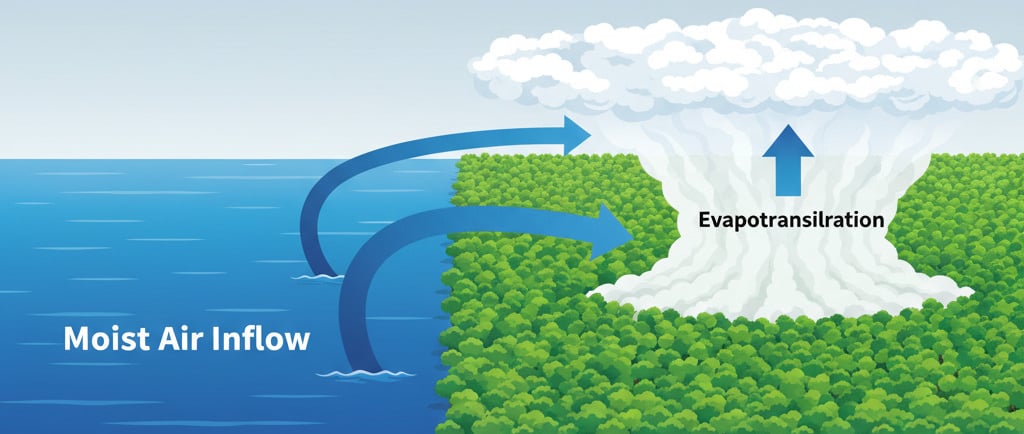
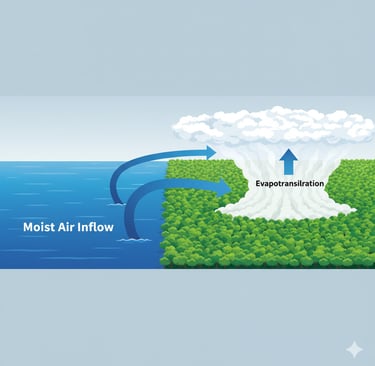
Let's visualize the biotic pump mechanism in the context of a large coastal forest, such as the Amazon or the Congo Basin:
High Transpiration: The dense forest canopy releases enormous quantities of water vapor through transpiration. This process is far more efficient at humidifying the air than evaporation from an open water surface of the same area.
Cloud Formation and Condensation: This water vapor rises, cools, and condenses to form clouds. The condensation process massively reduces the partial pressure of the gaseous atmosphere in that column of air.
Creation of a Low-Pressure Gradient: A strong low-pressure zone is established over the forest.
Inflow of Oceanic Air: The surrounding air, particularly the moist, vapor-rich air over the nearby ocean, flows horizontally from the region of higher pressure towards the newly created low-pressure zone over the forest.
Perpetuation of the Cycle: This inflow of moist air provides more water vapor, which is then transpired and condenses, reinforcing the low-pressure zone and continuously pulling more moisture inland.
Crucially, the theory posits that this effect is dependent on the forest being large and contiguous. A fragmented forest cannot maintain the strong, cohesive low-pressure zone needed to power the pump. There is a critical threshold of forest cover and transpiration intensity required to "turn on" this continental-scale moisture transport.
Applying the Biotic Pump Model to the Sahara
The paleoclimatic evidence of the "Green Sahara" provides a compelling case study. The increased solar insolation during the African Humid Period would have supported a more vigorous vegetation cover, which, according to the biotic pump theory, would have been the engine that pulled the West African Monsoon far to the north. The collapse of the Green Sahara, in this view, was not just a result of decreasing rainfall, but a catastrophic feedback loop: as orbital forcing weakened the monsoon and vegetation began to die back, the biotic pump weakened, further reducing moisture inflow, which led to more vegetation loss, until the pump collapsed entirely.
Our project aims to reverse this process. By artificially irrigating and planting a forest on a continental scale, we are attempting to manually re-assemble the components of the biotic pump.
Phase 1 (The Artificial Phase): In the early decades and centuries, our new Saharan forests are entirely dependent on artificial irrigation. Transpiration occurs, but it is not yet driving a net inflow of moisture; it is simply recycling the water we provide. The local microclimate is altered, but the continental macroclimate remains unchanged.
Phase 2 (Reaching the Tipping Point): The central hypothesis is that as the reforested area expands—covering millions of square kilometers with a dense, actively transpiring canopy—it will eventually reach a critical size and density. At this point, the volume of water vapor being transpired and condensed will be sufficient to create a low-pressure zone powerful enough to overcome the prevailing subtropical high-pressure ridge.
Phase 3 (Reactivating the Monsoon): Once this tipping point is crossed, the biotic pump would begin to function. The reforested Sahara would start to actively draw in moist air from the tropical Atlantic and the Gulf of Guinea. This would re-establish and dramatically strengthen the northward penetration of the West African Monsoon, bringing predictable, seasonal rains back to the Sahara.
Phase 4 (Self-Sustainment): In this final phase, the system becomes self-sustaining. The natural rainfall provided by the biotic pump becomes sufficient to support the forest, allowing the artificial irrigation from the water grid to be gradually phased out. The project transitions from life support to stewardship.
Modeling the Threshold: A Herculean Task
Predicting the exact threshold for reactivating the biotic pump is a monumental challenge for climate modelers. It requires integrating complex variables into next-generation Earth System Models:
Total Leaf Area Index (LAI): A measure of the total leaf surface area per unit of ground area. This is a proxy for the forest's total transpiration capacity.
Canopy Characteristics: The specific transpiration rates of our genetically engineered pioneer species.
Spatial Configuration: The contiguity and geographic placement of the reforested areas. A continuous belt from the Atlantic coast inland is likely more effective than scattered patches.
Background Climate Dynamics: How the pump will interact with existing large-scale circulation patterns like the El Niño-Southern Oscillation (ENSO) and the North Atlantic Oscillation (NAO).
Initial estimates, based on the theory's proponents, suggest that a reforested area on the order of several million square kilometers would be required. This aligns with the continental scale of our project. The modeling effort would be a central task for the project's climate science division, continuously refining predictions as the reforested area expands and real-world data is collected.
Implications and Controversies
The Biotic Pump Hypothesis is not without its critics, and it represents a significant departure from some tenets of classical meteorology. The primary debate centers on the magnitude of the condensation-induced pressure gradient compared to thermal gradients.
However, if the theory is even partially correct, the implications are profound. It suggests that large-scale deforestation in regions like the Amazon is not just a loss of biodiversity and a carbon source; it is an act of dismantling a continent's primary irrigation machine, risking permanent aridification. Conversely, it implies that large-scale, strategic afforestation is not just a carbon sequestration strategy; it is a tool for active climate and water cycle engineering.
For the Sahara Reforestation Project, embracing the biotic pump as a guiding theoretical framework provides a tangible, science-based endgame. It transforms the project from an indefinite effort of artificial irrigation into a project with a finite, albeit very long-term, goal: to rebuild a natural engine that will once again make the desert bloom.
Conclusion: The Ultimate Goal of Self-Regulation
This lecture has introduced the Biotic Pump Hypothesis as the theoretical mechanism by which our engineered Saharan ecosystem could eventually become self-sustaining. By establishing a vast, contiguous forest, we aim to create a powerful low-pressure system fueled by condensation, strong enough to pull moisture from the Atlantic and restart the West African Monsoon.
This represents the ultimate biological leverage. We invest colossal amounts of energy and water upfront to build the biological infrastructure (the forest), which then takes over the work of continental-scale water transport for us, powered by the sun. The project's success, in the long run, will be measured not by the capacity of its pipelines, but by the moment we can begin to turn them off.
Having established this grand, long-term climatological goal, our next series of lectures will return to the more immediate, ground-level challenges of building a complex ecosystem. Our next lecture, "The Role of Agroforestry: Integrating Crops and Trees," will detail the sustainable agricultural systems that will be the first to benefit from the moderated microclimates created by our expanding green zones. Thank you.