Add your promotional text...
Lecture 13: The Role of Agroforestry: Integrating Crops and Trees
Series: The Sahara Reforestation Project: From Dune Sea to Green Valley Part II: Expanding the Green Zone - Establishing Ecosystems
3/27/20266 min read
Introduction: Beyond Monoculture
Welcome. In our previous lectures, we have focused on large-scale ecological engineering: establishing vast shelterbelts and contemplating the reactivation of continental weather patterns. Now, we must turn our attention to a more intimate scale, but one that is equally critical to the long-term success and sustainability of the Sahara Reforestation Project: the production of food. While the initial human workforce is sustained by high-tech, enclosed CEA modules, the ultimate vision for a green Sahara is one of productive, open-air agriculture.
However, the conventional agricultural model of vast, open monoculture fields is ill-suited for the fragile, nascent ecosystems we are building. Such systems are vulnerable to wind erosion, high evaporative water loss, and rapid nutrient depletion. Instead, we must adopt a more integrated, ecologically-inspired model.
This lecture will detail the principles and application of agroforestry, the intentional integration of trees and shrubs with crop and/or animal farming systems. We will explore how agroforestry is not a compromise, but a synergistic model that enhances productivity, builds resilience, and accelerates ecosystem development. For the new Sahara, agroforestry will not be a niche practice; it will be the foundational paradigm for all open-field agriculture.
The Principles of Agroforestry: A Symbiosis of Systems
Agroforestry is a land-use management system that leverages the beneficial interactions between woody perennials (trees, shrubs) and agricultural components. Instead of separating forestry and farming into distinct land uses, it combines them in space or time. The underlying principle is to mimic the structure and function of a natural ecosystem, creating a more complex, resilient, and productive system than a monoculture.
The key interactions can be categorized as follows:
Complementary Resource Use: Different species utilize resources at different times or in different spatial zones, leading to more efficient overall resource use. For example, deep-rooted trees can access water and nutrients from lower soil profiles, leaving shallower resources for annual crops.
Ecological Services: The trees provide a suite of "ecosystem services" that directly benefit the crops. These include microclimate moderation, soil improvement, and pest control.
Diversified Production: The system yields multiple products—annual crops, timber, fruit, nuts, fodder—increasing economic stability and food security.
Designing Agroforestry Systems for the Sahara
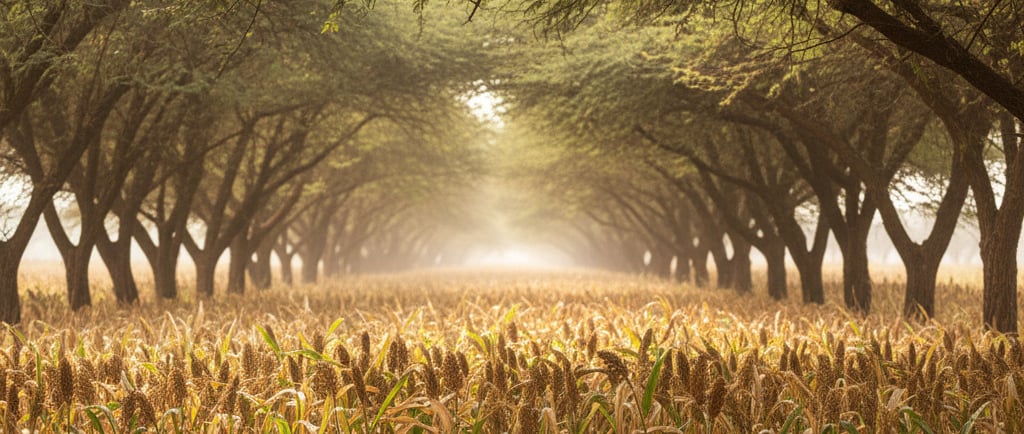
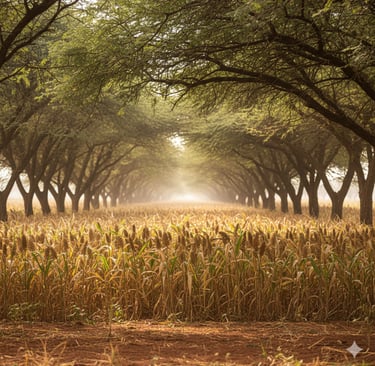
For our Saharan context, the primary agroforestry system to be deployed is alley cropping. In this system, annual or perennial crops are cultivated in the "alleys" between widely-spaced rows of trees or shrubs. The design of these systems must be meticulously tailored to the Saharan environment.
Tree Selection: The choice of tree species is paramount. They must be not only drought- and heat-tolerant but must also possess characteristics that are complementary, not competitive, with the understory crops. Key candidate traits include:
Nitrogen Fixation: Leguminous trees (e.g., Acacia, Prosopis, Leucaena) are essential to continuously enrich the soil with nitrogen, reducing the need for synthetic fertilizers.
Deep Root Systems: To minimize competition for water and nutrients with the shallower-rooted annual crops.
Open Canopy Structure: Trees with a light, feathery canopy (like many Acacias) allow sufficient sunlight to reach the crops below, a phenomenon known as "dappled shade."
Phenology: The timing of leaf fall is critical. As discussed in Lecture 11, species like Faidherbia albida are ideal "reverse-deciduous" trees that provide nitrogen-rich mulch and full sun during the crop growing season.
Spatial Arrangement and Orientation: The spacing and orientation of the tree rows are critical engineering parameters.
Orientation: Tree rows would be oriented perpendicular to the prevailing wind direction (as an extension of the larger shelterbelt strategy) to maximize wind speed reduction. In some cases, orientation might be aligned with the sun's path to optimize light conditions for the crops in the alleys.
Spacing: The width of the alleys would be a carefully calculated parameter, balancing the need for sufficient sunlight for the crops against the need for the trees' microclimate-moderating effects to extend across the alley. This would vary depending on the tree species, its mature canopy size, and the light requirements of the alley crop.
Alley Crop Selection: The crops grown in the alleys would be chosen for their adaptation to the semi-shaded, resource-competitive environment. We would focus on highly drought- and heat-tolerant staple crops, such as:
Sorghum (Sorghum bicolor)
Pearl Millet (Pennisetum glaucum)
Cowpea (Vigna unguiculata)
Teff (Eragrostis tef)
The Ecosystem Services of Saharan Agroforestry
Let's dissect the specific benefits that this integrated system provides, which make it far superior to monoculture in our context.
Microclimate Moderation: This is the most immediate and impactful service.
Wind Speed Reduction: The tree rows act as a series of smaller, distributed windbreaks, reducing wind velocity by up to 50% within the alleys. This drastically lowers the risk of wind erosion and physical damage to crops.
Evapotranspiration Reduction: By reducing wind speed and providing partial shade, the trees lower the evaporative demand on both the soil and the crop plants. This translates directly to a significant reduction in irrigation water requirements compared to an open field—a critical efficiency gain.
Temperature Buffering: The shade from the tree canopy moderates extreme soil and air temperatures, reducing heat stress on the crops during the day and slightly increasing minimum temperatures at night.
Soil Health and Fertility Enhancement:
Organic Matter Input: The continuous shedding of leaf litter ("litterfall") from the trees provides a steady source of organic matter to the soil surface. This "green manure" feeds the soil microbiome, improves soil structure, and enhances water-holding capacity.
Nutrient Cycling and Pumping: The deep roots of the trees act as "nutrient pumps." They can capture nutrients that have leached below the reach of crop roots and bring them back to the surface, where they are redeposited via litterfall.
Nitrogen Fixation: If leguminous trees are used, they continuously add substantial amounts of nitrogen to the system, a process of "self-fertilization" that is fundamental to the system's long-term sustainability.
Erosion Control: The combination of the tree canopy intercepting rainfall and the tree root systems binding the soil provides excellent protection against water erosion, especially during the establishment of the new monsoonal rains.
Biodiversity and Pest Management:
Habitat Creation: The structural complexity of the agroforestry system—with its different layers of canopy, leaf litter, and root zones—creates a multitude of habitats for a wide range of organisms.
Integrated Pest Management (IPM): The trees provide a habitat for beneficial insects (pollinators, predators of crop pests) and birds. This increased biodiversity creates a more stable ecosystem where pest outbreaks are less likely to occur, reducing or eliminating the need for chemical pesticides.
Economic and Product Diversification
Beyond the ecological benefits, agroforestry provides a more resilient economic foundation for the new Saharan settlements.
Multiple Yields: The system produces both an annual yield (from the alley crops) and a long-term yield (from the trees).
High-Value Tree Products: The tree component can be selected to produce valuable secondary products, creating diversified income streams. Examples include:
Fruits and Nuts: Species like the Desert Date (Balanites aegyptiaca) or genetically-adapted nut trees.
Fodder: The leaves and pods of many leguminous trees (like Leucaena) are highly nutritious fodder for livestock. This integrates another agricultural component, a system known as silvopasture.
Timber and Fuelwood: Through selective pruning and thinning (coppicing), the trees can provide a sustainable source of wood for construction and biomass for energy.
Gums and Resins: Species like Acacia senegal produce Gum Arabic, a valuable export commodity.
This diversification makes the farming system less vulnerable to the failure of a single crop and provides a continuous stream of products and income, which is critical for the economic development of the new settlements.
Conclusion: The Cornerstone of Saharan Agriculture
Agroforestry is not merely a "greener" alternative to conventional farming; for the Sahara Reforestation Project, it is a strategic necessity. The challenges of the nascent Saharan environment—high winds, intense solar radiation, fragile soils, and limited water—are precisely the challenges that agroforestry systems are uniquely equipped to mitigate.
By integrating trees into our agricultural landscapes, we are leveraging natural ecological principles to build a system that is not only productive but also self-reinforcing. The trees protect the crops, the crops and trees together build the soil, and the integrated system as a whole conserves water and fosters biodiversity. This approach moves us away from an input-intensive agricultural model that fights against nature, towards a knowledge-intensive model that partners with it.
The alley cropping systems detailed in this lecture will form the backbone of food production in the open, greened Sahara. They are the practical application of the ecological principles we have been establishing, turning our newly created landscapes into sustainable, resilient, and productive ecosystems.
Having established our model for sustainable agriculture, we will next address the complex trophic levels above the producers. Our following lectures will detail the phased introduction of animal life, starting with the unseen but vital engineers of the soil. Thank you.