Add your promotional text...
Lecture 14: Animal Introduction I: The Soil Engineers and Decomposers
Series: The Sahara Reforestation Project: From Dune Sea to Green Valley Part II: Expanding the Green Zone - Establishing Ecosystems
3/30/20266 min read
Introduction: The Living Labyrinth Beneath Our Feet
Welcome. In our journey to green the Sahara, we have so far focused on establishing the foundational pillars of the ecosystem: we have provided water, created a proto-soil from sand and organic matter, and planted a diverse community of flora, from microbial biocrusts to complex agroforestry systems. We have built the "house" of the ecosystem. Now, we must introduce the unseen architects, engineers, and janitors who will make this house a living, breathing, and self-sustaining home: the soil invertebrates and their microbial partners.
A forest or a field of crops is only the visible fraction of the ecosystem's biomass. The vast majority of terrestrial life, in both numbers and diversity, resides within the soil. Without a complex and functioning soil food web, our new Saharan soils would be little more than inert hydroponic media, reliant on constant external inputs. Nutrient cycles would stall, organic matter would fail to decompose, and the soil's physical structure would degrade.
This lecture will detail the critical and deliberate introduction of the first wave of animal life to the Sahara Reforestation Project. We will not begin with charismatic megafauna, but with the humble yet profoundly powerful soil engineers and decomposers. Our focus will be on three key functional groups: the earthworms (the bioturbators), the termites (the lignocellulose specialists), and the wider community of microfauna and mesofauna that drive the engine of decomposition and nutrient cycling.
The Functional Roles of the Soil Biota
Before selecting our candidate species, we must define the ecological functions we need to establish. The soil food web is responsible for several processes that are indispensable for a self-sustaining ecosystem:
Decomposition: The breakdown of complex organic matter (dead leaves, roots, wood, animal waste) into simpler compounds.
Nutrient Mineralization: The conversion of nutrients locked in organic matter (like organic nitrogen and phosphorus) back into inorganic forms (like nitrate and phosphate) that are available for plant uptake.
Soil Structure Formation (Pedogenesis): The creation and stabilization of soil aggregates, pores, and channels.
Bioturbation: The physical mixing of soil layers, which distributes organic matter, aerates the soil, and improves water infiltration.
Regulation of Microbial Populations: Grazing by soil microfauna (like protozoa and nematodes) on bacteria and fungi can stimulate nutrient cycling and regulate microbial community structure.
Our strategy is to introduce a curated suite of organisms to perform these functions, kickstarting a food web that will eventually become self-organizing.
Group I: The Earthworms - Ecosystem Engineers Par Excellence
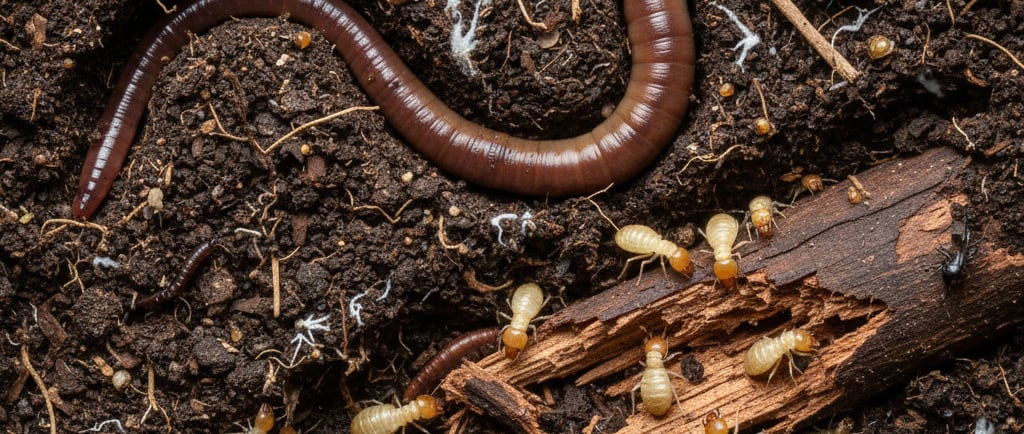
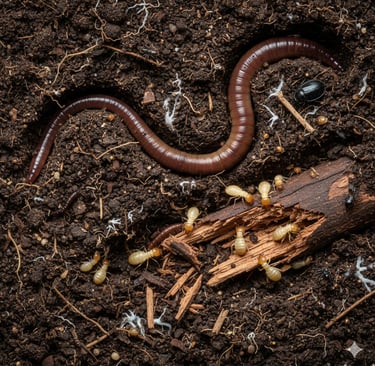
Earthworms are arguably the most important ecosystem engineers in temperate and tropical soils. Their introduction into the newly formed Saharan soils is a milestone.
Biological Function and Species Selection: We would introduce species from different ecological categories to perform distinct roles:
Epigeic worms (Surface dwellers): Species like Eisenia fetida (the composting worm). These live in the surface litter layer, rapidly breaking down fresh organic matter. They are specialists in decomposition.
Endogeic worms (Topsoil dwellers): Species that live and burrow horizontally within the upper soil layers (e.g., Aporrectodea caliginosa). They feed on soil and its associated organic matter, creating a network of channels that improves aeration and water infiltration.
Anecic worms (Deep burrowers): Species like Lumbricus terrestris (the common nightcrawler). These create deep, permanent, vertical burrows, sometimes several meters down. They drag surface litter deep into the soil profile, a powerful mechanism for mixing organic matter. Their deep channels act as superhighways for water infiltration and root growth.
Impact on Soil Properties: The introduction of earthworms will have a transformative effect:
Improved Soil Structure: Their burrowing activity creates a network of macropores, dramatically increasing soil aeration and drainage. Their casts (excrement) are rich in nutrients and are composed of highly stable soil aggregates, which are the building blocks of a healthy soil structure.
Enhanced Nutrient Cycling: As they consume and digest organic matter and mineral soil, they shred the material, increasing its surface area for microbial attack. Their gut microbiome mineralizes nutrients, converting them into plant-available forms.
Stimulation of Microbial Activity: Earthworm burrows are hotspots of microbial activity. The mucus lining of the burrows is a rich carbon source, and their casts are densely populated with beneficial bacteria and fungi.
Introduction Strategy: Earthworms (as live individuals or cocoons) would be introduced into the most mature and organic-rich zones first, such as the agroforestry alleys and the compost-amended soils of the shelterbelts. They would be bred in massive vermicomposting facilities, which would also serve to process organic waste from the human settlements.
Group II: The Termites - Lignocellulose Specialists
While earthworms are masters of processing leaf litter and soil organic matter, they are generally poor at breaking down tough, woody debris. In arid and savanna ecosystems, this critical role is filled by termites. While often viewed as pests, they are essential decomposers in these environments.
Biological Function and Species Selection: We would focus on introducing species from the subfamily Macrotermitinae, the fungus-growing termites. These organisms have a remarkable symbiotic relationship.
The Symbiosis: Worker termites forage for dead wood, grasses, and other dry plant material. They chew this material but do not fully digest it. They use the masticated material to build a "fungus comb" within their subterranean mounds.
The Fungal Partner (Termitomyces): They cultivate a specific fungus, Termitomyces, on this comb. The fungus is the only organism capable of breaking down the highly resistant lignin and cellulose in the plant material.
Nutrient Provision: The termites then feed on the nutrient-rich fungal mycelium. This external digestion allows them to unlock the vast energy and nutrient stores in woody debris that would otherwise be unavailable to the ecosystem.
Ecological Engineering: The mounds built by these termites are significant structures:
"Islands of Fertility": Termite activity concentrates nutrients from a wide foraging area into their mound. Abandoned mounds become hotspots of soil fertility, often colonized by nutrient-demanding plants.
Altered Soil Hydrology: The structure of the mounds and their associated tunnels can alter water infiltration patterns in the landscape, in some cases improving local water retention.
Introduction Strategy: The introduction of termites requires extreme care. We must select native, non-pest species and introduce them in a controlled manner into the developing woodland and savanna zones. Their populations would be monitored to ensure they are fulfilling their ecological role without becoming a threat to wooden structures in human settlements.
Group III: The Micro and Mesofauna - The Engine Room of Decomposition
While earthworms and termites are the visible engineers, the bulk of the decomposition work is carried out by a vast and diverse community of smaller invertebrates.
The Mesofauna (0.1mm - 2mm): This group includes springtails (Collembola) and mites (Acari).
Function: These organisms are the primary "shredders" of the soil. They graze on fungi and bacteria and, most importantly, they chew and shred dead organic matter (leaf litter), breaking it down into smaller fragments. This fragmentation vastly increases the surface area available for the final decomposers—the bacteria and fungi.
The Microfauna (<0.1mm): This group includes protozoa (amoebae, flagellates) and nematodes (roundworms).
Function (The "Microbial Loop"): These microscopic predators are the primary grazers of bacteria and fungi. This grazing is not just about population control; it is a critical step in nutrient mineralization. When a protozoan consumes a bacterium, it digests the carbon for energy but excretes the excess nitrogen and phosphorus as inorganic, plant-available nutrients. This "microbial loop" is a major driver of nutrient availability in healthy soils.
Introduction Strategy: Unlike earthworms, these smaller organisms are difficult to introduce deliberately on a mass scale. The most effective strategy is to introduce them as part of the compost. The high-quality, mature compost produced in our facilities (Lecture 6) would be managed to cultivate a dense and diverse population of these beneficial meso- and microfauna. Therefore, every application of compost to the Saharan soil is also a mass inoculation event for the entire lower tier of the soil food web.
Conclusion: Assembling the Living Soil Machine
This lecture has detailed the deliberate assembly of the soil's living machinery. The introduction of these functional groups of invertebrates transforms the soil from a simple mixture of sand and dead organic matter into a dynamic, self-organizing system.
The earthworms act as the plows, mixing and aerating the soil, creating its physical structure.
The termites act as the specialized grinders, tackling the tough, woody material that other decomposers cannot.
The meso- and microfauna, introduced with the compost, form the bustling engine room of decomposition and nutrient cycling, ensuring that the resources locked in dead biomass are rapidly returned to the living.
By introducing these soil engineers and decomposers, we are kickstarting the biogeochemical cycles that are the hallmark of a healthy, fertile, and resilient ecosystem. We are moving beyond providing inputs and are now fostering the intricate processes that will, in time, allow the system to sustain itself.
With the soil now truly alive, we can begin to consider the larger animals that will interact with this new landscape. Our next lecture, "Animal Introduction II: The Pollinators," will address the critical step of establishing the insect communities necessary for the reproduction of our flowering plants. Thank you.