Add your promotional text...
Lecture 15: Animal Introduction II: The Pollinators
Series: The Sahara Reforestation Project: From Dune Sea to Green Valley Part II: Expanding the Green Zone - Establishing Ecosystems
4/1/20266 min read
Introduction: The Architects of Genetic Exchange
Welcome. In our previous lecture, we populated the foundational layer of our new ecosystem's food web, introducing the vital community of soil engineers and decomposers. We have brought the soil to life. Now, we must facilitate the life cycle of the flora that stands upon it. While our very first pioneer plants were chosen for their hardiness and ability to self-pollinate or be wind-pollinated, the creation of a diverse, resilient, and productive ecosystem—particularly one that includes flowering and fruiting crops for agriculture—requires a more sophisticated mechanism for genetic exchange. It requires the introduction of pollinators.
Pollination, the transfer of pollen from the male anther of a flower to the female stigma, is the critical process that enables sexual reproduction in the vast majority of flowering plants (angiosperms). This process is the engine of genetic recombination, allowing for adaptation, evolution, and the production of fruits and seeds. While wind and water can serve as vectors, over 80% of flowering plants on Earth rely on animal pollinators.
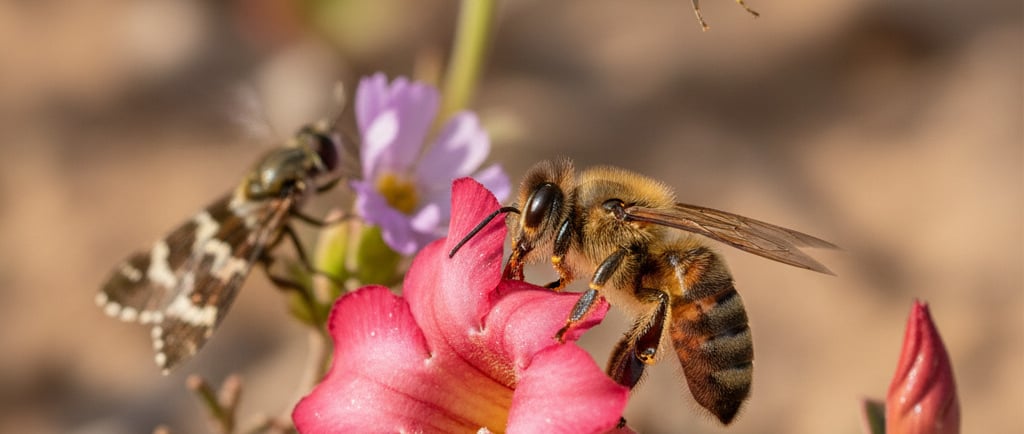
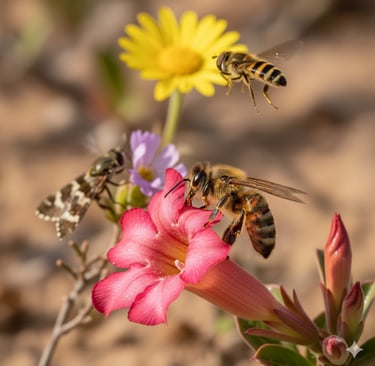
This lecture will detail the managed introduction of the first wave of aerial animal life to the Sahara Reforestation Project: the essential pollinators. We will discuss the strategic selection of resilient native species, focusing on a diverse portfolio of bees, flies, and moths. Our objective is not merely to enable the production of fruit, but to weave a complex web of plant-pollinator interactions that will form the backbone of the new Saharan biodiversity.
The Functional Imperative of Pollination in the New Sahara
In our engineered ecosystem, the need for animal-mediated pollination is multi-faceted and critical for long-term success.
Ensuring Crop Yields: Many of the agroforestry crops and future orchard species we intend to cultivate (from legumes like cowpea to various fruits and nuts) are dependent on or significantly benefit from insect pollination. Without effective pollinators, yields would be drastically reduced or fail entirely.
Maintaining Genetic Diversity: For the long-term health and adaptability of our non-crop plant populations (trees, shrubs, wildflowers), cross-pollination is essential. It allows for the mixing of genes, which is the raw material for natural selection to act upon, enabling the plant communities to adapt to the specific local conditions of the new Sahara and to evolve resilience against future diseases or climate shifts.
Supporting Ecosystem Stability: A diverse and abundant pollinator community is a key indicator of a healthy ecosystem. The intricate relationships between plants and their pollinators form a foundational layer of the food web. The insects themselves become a food source for other introduced animals, such as birds and lizards, further increasing the ecosystem's complexity and stability.
Species Selection: A Portfolio Approach to Pollination
Relying on a single pollinator species (e.g., only the European honeybee, Apis mellifera) would be a fragile and ecologically unsound strategy. Instead, we will adopt a portfolio approach, introducing a curated selection of different pollinator guilds to ensure that a wide variety of flower shapes, sizes, and blooming times are serviced. The initial focus will be on hardy, generalist species native to North Africa and the Sahel, as they are already adapted to arid conditions.
Guild I: The Bees (Hymenoptera: Apoidea)
The Workhorses (Apis mellifera): We would introduce managed hives of a resilient subspecies of the honeybee, such as Apis mellifera sahariensis. As social insects with large colonies, they are highly efficient, generalist pollinators capable of visiting a vast number of flowers. They will be critical for large-scale crop pollination in the agroforestry systems. Their hives can also be managed for secondary products like honey and beeswax.
The Solitary Specialists (e.g., Megachile, Anthophora): Solitary bees are equally, if not more, important for ecosystem health. Species like leafcutter bees (Megachile) and mason bees are highly effective pollinators for specific plants that honeybees may not service efficiently. They nest in pre-existing cavities, soil, or plant stems. We would introduce them by providing suitable nesting habitats (bee hotels, bare ground patches) and ensuring their host plants are present.
The Buzz Pollinators (e.g., Bombus, Xylocopa): Bumblebees and carpenter bees are capable of "buzz pollination" (sonication), where they vibrate their flight muscles to shake pollen out of flowers with poricidal anthers. This is essential for the pollination of key crops like tomatoes and eggplants, which we will cultivate in the agricultural zones.
Guild II: The Flies (Diptera)
The Unsung Heroes (Syrphidae - Hoverflies): Hoverflies are often overlooked but are incredibly important pollinators, second only to bees in many ecosystems. Their larvae are also voracious predators of aphids, providing a dual benefit of pollination and pest control. They are generalists, visiting a wide range of simple, open-faced flowers.
Other Dipterans: Various other fly species, including bee flies (Bombyliidae) and even some muscid flies, contribute to pollination. Their presence is a sign of a healthy decomposer cycle, as many have larval stages that live in decaying organic matter, linking the soil food web to the pollination web.
Guild III: The Moths and Butterflies (Lepidoptera)
The Nocturnal Shift (Moths, e.g., Sphingidae - Hawkmoths): Many plants, particularly those with pale, fragrant flowers that open at night, are adapted for pollination by moths. Hawkmoths are powerful fliers with long proboscises, capable of pollinating deep-throated flowers. Establishing a community of nocturnal pollinators ensures that reproductive opportunities are not limited to daylight hours.
The Diurnal Specialists (Butterflies): While generally less efficient pollinators than bees on a per-visit basis, butterflies are important for their long-distance flight, which can facilitate gene flow between distant plant populations. Their selection of specific host plants for their caterpillar stage also drives plant diversity.
Introduction Strategy: A Phased and Supported Rollout
The introduction of pollinators cannot be a simple case of releasing insects into the environment. It must be a carefully managed process, synchronized with the development of the flora.
Habitat and Forage First: The primary prerequisite is the establishment of a continuous and diverse supply of floral resources. Before any pollinators are introduced, the pioneer and secondary wave plants must be mature enough to provide a consistent source of nectar and pollen throughout the year. This includes planting a mix of species with different flowering times to avoid periods of floral dearth.
Managed Introduction of Social Bees: Honeybee colonies would be introduced first into the most mature agroforestry zones. They would be managed in apiaries by project ecologists, similar to agricultural beekeeping. Their health and population levels would be closely monitored.
Provisioning for Solitary Bees: To support solitary bees, we would actively create nesting habitats. This includes leaving areas of bare, undisturbed ground, providing bundles of hollow reeds or drilled blocks of wood ("bee hotels"), and ensuring the presence of plants whose leaves or resins are used for nest construction.
Attracting and Supporting Native Colonists: For flies and moths, the strategy is less about direct introduction and more about creating a suitable environment. As the ecosystem matures—with flowering plants for adults and decaying organic matter or specific host plants for larvae—native species from the periphery of the Sahara (the Sahel, the Atlas Mountains) will naturally begin to colonize the new green zone. Our role is to ensure the habitat is ready for them.
Genetic Diversity: The introduced populations, particularly of managed bees, must be genetically diverse to ensure they are resilient to diseases and can adapt to the local conditions.
Monitoring and a Changing Relationship
The plant-pollinator network will be one of the most important ecological systems to monitor.
Monitoring Techniques: We would use a combination of direct observation, pan trapping, and advanced techniques like eDNA (environmental DNA) analysis from flower surfaces to track the diversity, abundance, and activity of the pollinator community.
A Co-evolutionary Trajectory: Over the long term, we would expect to see co-evolutionary adaptations. The plants may evolve to better attract the most effective local pollinators, and the pollinators may adapt to become more efficient at foraging on the most abundant floral resources. Our project is, in effect, initiating a new chapter in evolutionary history.
Conclusion: Weaving the Web of Life
The introduction of pollinators is a profound step beyond simply planting a forest. It is the act of breathing a dynamic, interactive process into our static green landscape. These insects are the vectors of genetic information, the architects of biodiversity, and the guarantors of our future harvests.
By adopting a diverse, multi-guild approach, we are creating a resilient and robust pollination network, capable of servicing a wide array of plant species and adapting to changing conditions. The establishment of this network transforms our collection of individual plants into a true, sexually reproducing community. It is a critical link that connects the primary producers (plants) to the higher trophic levels that will follow, forming a foundational layer of the vibrant and complex ecosystem we aim to build.
Having now established the means for our flora to reproduce, our next lectures will begin to explore the introduction of larger animals that will shape this new landscape through their own interactions. Thank you.