Add your promotional text...
Lecture 16: Managing Mega-Herbivores: The Return of Grazers
Series: The Sahara Reforestation Project: From Dune Sea to Green Valley Part II: Expanding the Green Zone - Establishing Ecosystems
4/3/20266 min read
Introduction: The Missing Keystone Process
Welcome. In our systematic construction of the new Saharan ecosystem, we have established the primary producers—the diverse flora—and the critical facilitators of their reproduction—the pollinators. Our soil is alive with decomposers, and our agroforestry systems are taking root. However, a key ecological process is still missing, a process that has shaped savannas and grasslands for millions of years: herbivory. An ecosystem without herbivores is an incomplete, unbalanced system, prone to stagnation and catastrophic change.
This lecture will address the introduction of the first large vertebrates into our terraformed Sahara: the mega-herbivores. This is not an act of simply populating a landscape for aesthetic purposes; it is a deliberate ecological intervention designed to introduce a keystone process that will actively manage, shape, and maintain the health of the developing savanna and woodland ecosystems.
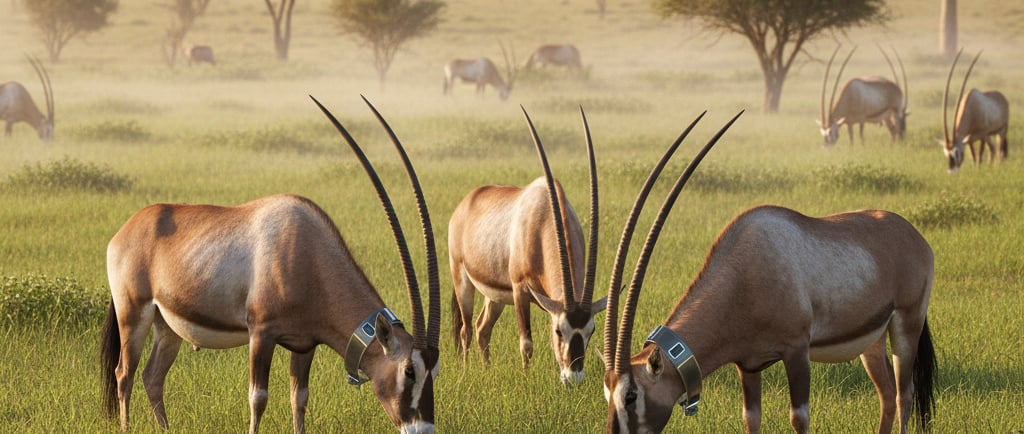
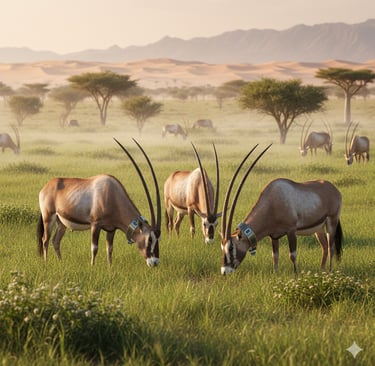
We will focus on the reintroduction of native, desert-adapted ungulates like the Addax and the Scimitar-horned Oryx. Our discussion will cover their profound ecological roles as landscape engineers, the critical necessity of implementing scientifically managed grazing patterns to prevent the very land degradation we seek to reverse, and the use of advanced technology to monitor and guide these new herds.
The Ecological Role of Large Herbivores
In grassland and savanna ecosystems, large herbivores are not merely consumers; they are powerful agents of ecological regulation and engineering. Their absence would lead to several detrimental outcomes in our new Sahara:
Accumulation of Moribund Biomass: In the absence of grazing, perennial grasses would grow, mature, and die, creating a thick, undecomposed thatch layer. This thatch smothers new growth, reduces biodiversity by outcompeting smaller herbaceous plants (forbs), and, most dangerously, creates a massive, continuous fuel load, dramatically increasing the risk and intensity of wildfires.
Woody Encroachment: Without browsers and grazers to suppress them, fast-growing woody shrubs and trees can quickly dominate open grasslands, converting diverse savanna into dense, species-poor thickets.
Reduced Nutrient Cycling: Herbivores are mobile nutrient-cycling factories. They consume dispersed, low-nutrient plant matter and concentrate it into nutrient-rich dung and urine patches. This accelerates the decomposition process and creates "hotspots" of fertility that drive landscape heterogeneity.
Lack of Disturbance: Gentle, continuous disturbance is vital for ecosystem health. The trampling and grazing actions of herbivores create patches of bare ground, ideal for the germination of certain pioneer plant species, thus increasing overall biodiversity.
By reintroducing large herbivores, we are re-establishing these critical top-down regulatory processes that are essential for the long-term health, diversity, and resilience of our new savanna ecosystems.
Species Selection: Reviving the Ghosts of the Sahara
The choice of species for reintroduction is guided by a principle of ecological restoration. We will focus on species that are not only physiologically adapted to arid conditions but were also native to the North African landscape, some of which are now extinct in the wild or critically endangered.
Candidate Species I: The Addax (Addax nasomaculatus)
Biological Profile: The Addax is a master of desert survival. It is a true xerophile, capable of obtaining nearly all the water it needs from the plants it eats. Its broad, flat hooves are adapted for walking on sand. As a grazer and browser, it consumes a wide range of grasses and desert shrubs, making it a versatile vegetation manager.
Conservation Status: Critically endangered and now found only in a few isolated pockets, the Sahara Reforestation Project would serve as a massive, managed ark for this species, playing a vital role in its conservation.
Candidate Species II: The Scimitar-horned Oryx (Oryx dammah)
Biological Profile: Declared extinct in the wild in 2000 (though reintroduction efforts are underway), the Scimitar-horned Oryx is another icon of the historical Saharan megafauna. It is incredibly heat-tolerant, possessing a remarkable ability to raise its body temperature to reduce water loss through evaporative cooling. It is primarily a grazer, making it an ideal candidate for managing the new perennial grasslands.
Candidate Species III: The Dama Gazelle (Nanger dama)
Biological Profile: This critically endangered gazelle is a browser, feeding on the leaves of Acacia trees and other shrubs. Its role would be to control woody vegetation, complementing the grazing pressure of the Oryx and Addax and helping to maintain the open structure of the savanna.
Genetic Considerations: The founding populations for reintroduction would be sourced from the global captive breeding programs. A critical first step would be a comprehensive genomic analysis of the available individuals to ensure maximum genetic diversity in the reintroduced herds, preventing inbreeding and maximizing their long-term adaptive potential.
The Critical Challenge: Managing Grazing Pressure
The reintroduction of herbivores is a double-edged sword. While essential for ecosystem health, unmanaged grazing is one of the leading causes of desertification worldwide. The central challenge is to harness the beneficial effects of herbivory while rigorously preventing overgrazing. Overgrazing occurs when plants are consumed faster than they can regrow, leading to the loss of vegetation cover, soil compaction, and wind/water erosion—the very conditions we are trying to reverse.
Our strategy will be based on the principles of Managed Intensive Rotational Grazing (MIRG), but adapted for a vast, semi-wild landscape.
The Principle of Pulsed Grazing: Natural grassland ecosystems co-evolved with large, migratory herds that would graze an area intensively for a short period and then move on, not returning for a long time. This "pulsed" grazing pressure, followed by a long recovery period, is what maintains the health of the grassland. Our management system will seek to replicate this dynamic.
Paddock Design and Virtual Fencing: The vast savanna zones would be subdivided into enormous "paddocks," each many square kilometers in size. These would not be separated by physical fences, which are impractical on this scale and would obstruct the migration of other wildlife. Instead, we will employ "virtual fencing" technology.
The Technology: Each animal in the managed herds would be fitted with a GPS collar equipped with solar power and satellite communication. The boundaries of the current grazing paddock are defined digitally. If an animal approaches the virtual boundary, the collar emits an auditory warning cue. If it continues, the collar delivers a mild, harmless electrical stimulus, conditioning the herd to remain within the designated zone.
Management: Project ecologists can redraw these virtual fences remotely, allowing them to rotate the herds from one paddock to another with precision, ensuring each paddock receives the optimal period of grazing pressure followed by a long, uninterrupted period of recovery.
Monitoring and Adaptive Management
This high-tech grazing management system must be informed by a constant stream of high-resolution environmental data.
Forage Monitoring: A network of satellites (using NDVI - Normalized Difference Vegetation Index) and on-the-ground sensors will continuously monitor the biomass and health of the vegetation in each paddock. The AI management system will analyze this data to determine the "forage carrying capacity" and decide precisely when a paddock has been grazed enough and when it has recovered sufficiently for the herds to return.
Animal Health Monitoring: The GPS collars will do more than just provide location. They will be equipped with biometric sensors (accelerometers, temperature sensors) to monitor the activity levels, behavior, and health of the animals. This data can provide early warnings of disease, malnutrition, or stress.
Ecosystem Response Monitoring: Ecologists will continuously monitor the broader ecosystem response to the reintroduction. This includes tracking changes in plant species composition (are we favoring desirable grasses?), soil carbon levels, water infiltration rates, and the populations of other animal species (insects, birds) that are impacted by the grazing patterns.
This data-driven, adaptive management approach allows for a continuous feedback loop. We can adjust the stocking density, the duration of grazing, and the length of the recovery periods in real-time based on the measured response of the ecosystem, ensuring a sustainable and beneficial impact.
Conclusion: Restoring a Keystone Process
The reintroduction of large herbivores marks a pivotal transition in the Sahara Reforestation Project. We are moving beyond simply establishing the building blocks of an ecosystem and are now beginning to manage the dynamic, interactive processes that define a living landscape. These animals are not passive inhabitants; they are active participants, shaping the environment through their behavior.
By reintroducing native, desert-adapted species like the Addax and Scimitar-horned Oryx, we are not only fulfilling a conservation imperative but are also deploying a powerful biological tool for vegetation management. Through the implementation of a technologically advanced system of virtual fencing and adaptive management, we can replicate the beneficial effects of natural migratory grazing, harnessing herbivory to maintain the health, diversity, and resilience of the new Saharan savannas while rigorously preventing the land degradation that has plagued so many arid regions on Earth.
With the soil, plants, pollinators, and now the grazers in place, the major structural and functional components of our terrestrial ecosystem are beginning to assemble. Our next lectures will turn to the high-tech, human-centric systems that run in parallel with this grand ecological project. Thank you.