Add your promotional text...
Lecture 18: The Human Element: Building Sustainable Desert Cities
Series: The Sahara Reforestation Project: From Dune Sea to Green Valley Part II: Expanding the Green Zone - Establishing Ecosystems
4/8/20266 min read
Introduction: An Architecture of Adaptation
Welcome. Our lectures have thus far been preoccupied with the immense task of engineering an ecosystem. We have discussed the creation of water, the genesis of soil, the planting of forests, and the management of a continental-scale agricultural system. But a project of this magnitude is not an end in itself; it is a means to create a new, habitable space for humanity. A green Sahara will be populated. The scientists, engineers, farmers, and families who drive and inhabit this transformation will need places to live, work, and build a society.
This lecture will address the human element directly. We will explore the principles of urban planning and architecture required to build sustainable, livable cities within the unique and demanding environment of the new Sahara. These will not be conventional cities merely transplanted into the desert. They must be conceived from the ground up as an integral part of the new ecosystem they inhabit.
Our focus will be on an architecture of adaptation. We will delve into design principles that draw inspiration from ancient desert vernaculars while integrating cutting-edge technology. The key themes will be passive environmental control, the total recycling of water and waste, and a deep, symbiotic integration with the surrounding agricultural and natural landscapes. These cities must be more than just sustainable; they must be regenerative.
The Urban Planning Paradigm: The Oasis City Concept
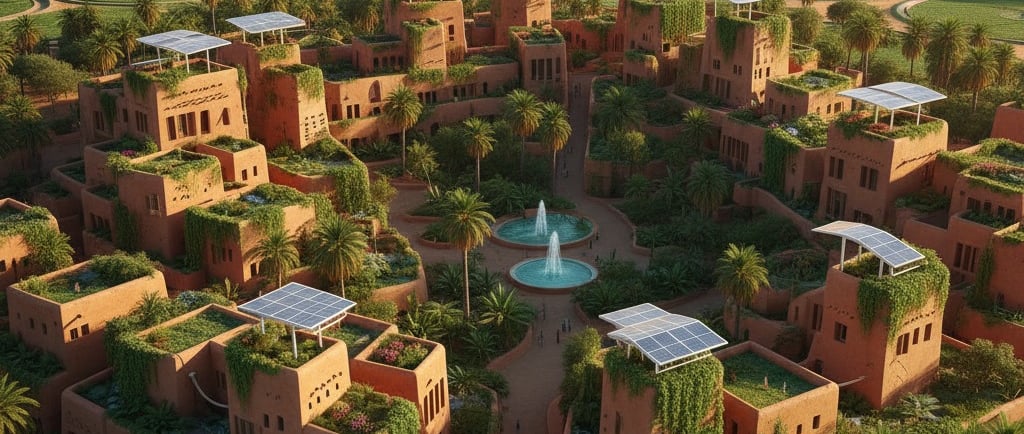
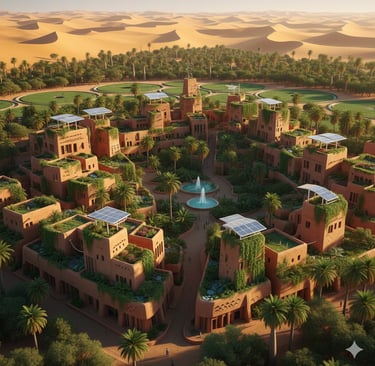
The placement and layout of the new Saharan settlements will be a strategic decision, not an arbitrary one. They will be located at key nodes of the new infrastructure—along the water grid, adjacent to major agricultural zones, and in locations with favorable geological or topographical features. The overarching urban planning model will be that of the "Oasis City."
This concept is built on several core principles:
Compact, Dense Urban Cores: To minimize the urban footprint and reduce the energy required for transportation, the cities will be designed with dense, walkable cores. This contrasts with the sprawling, low-density suburban model of the 20th century.
Greenbelt Integration: Each city will be surrounded by a dedicated "greenbelt" of intensive agroforestry, orchards, and recreational parkland. This greenbelt is not merely decorative; it is a functional component of the city's life support system, providing food, moderating the microclimate, and serving as a zone for water recycling.
Transit-Oriented Development: Transportation within and between cities will prioritize public and autonomous electric transport, with infrastructure designed to minimize the need for personal vehicles.
Modular and Scalable Growth: Cities will be planned to grow organically through the addition of new, self-contained, walkable neighborhoods, each with its own local amenities, preventing uncontrolled sprawl.
Architectural Principles: Passive Survivability and Modern Technology
The design of the buildings themselves will be the primary interface between the inhabitants and the desert environment. The goal is to achieve thermal comfort and livability with the minimum possible expenditure of energy, a concept known as passive design or bioclimatic architecture.
Learning from Vernacular Architecture: We begin by studying the principles perfected over millennia by traditional desert cultures.
Thermal Mass: Buildings will be constructed from materials with high thermal mass, such as compressed earth blocks (CEBs) made from local Saharan soil, or advanced concrete formulations. These materials absorb the intense heat of the day and slowly release it during the cold desert night, dramatically buffering interior temperature swings.
Courtyard Design: The inward-facing courtyard building is a classic desert typology. The courtyard creates a shaded, protected microclimate. During the day, it remains cool; at night, the cool, dense air pools within it. It can be further cooled by the integration of fountains and vegetation (evaporative cooling).
Narrow Streets and Shading: The urban layout will feature narrow, winding streets oriented to minimize solar exposure during the hottest parts of the day. Buildings will be designed to shade each other, and additional shade structures, such as fabric canopies or "solar sails," will be used extensively.
Natural Ventilation and Wind Catchers (Malqaf): Inspired by traditional Middle Eastern architecture, buildings will incorporate modern versions of the malqaf or wind catcher. These are towers designed to catch cooler, higher-altitude winds and channel them down into the building's interior, creating natural convective air circulation and flushing out hot air.
Integrating Modern Technology: These passive strategies will be augmented by advanced, energy-efficient technologies.
Advanced Glazing: Windows will be a critical component. They will use triple- or quadruple-pane glazing with spectrally selective coatings that allow visible light to pass through while reflecting infrared (heat) radiation. Electrochromic "smart glass" that can be tinted electronically to control solar gain in real-time will be standard.
Radiant Cooling: Instead of energy-intensive air conditioning that cools the air, buildings will employ radiant cooling systems. Chilled water, cooled geothermally or via nighttime radiative sky cooling, will be circulated through pipes in the floors and ceilings, absorbing heat directly from the occupants and surfaces.
Building-Integrated Photovoltaics (BIPV): Solar panels will not be an afterthought; they will be the building skin. Façades, roofs, and shade structures will be clad in photovoltaic materials, turning the entire city into a distributed power plant.
The Urban Metabolism: A Closed-Loop System
A sustainable desert city must function like a biological organism, with a circular, closed-loop metabolism. The goal is zero waste and total resource recycling.
The Water Loop: This is the most critical system. There will be no such thing as "wastewater," only water in different states of purity.
Segregated Plumbing: Buildings will have a dual plumbing system. "Blackwater" from toilets will be sent to a dedicated biogas digester. "Greywater" from sinks, showers, and laundries will be collected separately.
Greywater Recycling and The "Living Machine": The greywater will be treated on-site at the building or neighborhood level. It will pass through a "Living Machine" or "Ecological Fluidized Bed" system—a series of tanks containing a carefully curated ecosystem of algae, bacteria, snails, and plants (like reeds and water hyacinths). This biological system removes nutrients and purifies the water.
Reuse: The treated greywater is then reused for non-potable purposes: flushing toilets, irrigating the city's green spaces and the surrounding agricultural greenbelt, and providing evaporative cooling. This drastically reduces the city's demand for fresh, potable water from the main grid.
The Nutrient Loop: Waste is a resource.
Anaerobic Digestion: Blackwater and organic kitchen waste are fed into an anaerobic digester. In the absence of oxygen, methanogenic archaea break down the waste, producing two valuable outputs:
Biogas (Methane): A renewable fuel that can be used for cooking or to generate electricity.
Digestate: A nutrient-rich liquid fertilizer that is a perfect input for the surrounding agroforestry systems.
Composting: Inedible plant matter from urban gardens and parks is composted, turning it back into valuable soil for the city's green spaces.
The Energy Loop:
Distributed Generation: As mentioned, the city's buildings themselves will generate a significant portion of their own power via BIPV.
Microgrid Management: Each neighborhood will operate as a smart microgrid, managing its own energy production and consumption. AI-powered systems will balance supply and demand, storing excess solar energy in local batteries and trading energy with adjacent neighborhoods or the main Saharan grid.
Integration with the Surrounding Ecosystem
The Oasis City is not a fortress against the desert; it is an integrated node within it.
The Agricultural Greenbelt: The city's primary function in the broader landscape is to process and recycle resources. Its output of treated water and nutrient-rich fertilizer directly supports the intensive agriculture in its immediate greenbelt. This creates a tight, symbiotic loop between the urban and agricultural systems.
Ecological Corridors: Urban planning will explicitly incorporate ecological corridors. Strips of native vegetation will be designed to run through and around the city, allowing for the movement of wildlife (pollinators, birds) between the larger wilderness zones. This prevents the city from becoming a sterile barrier in the landscape.
Biophilic Design: The principle of "biophilia"—the innate human tendency to connect with nature—will be a core design tenet. Green walls, rooftop gardens, interior courtyards, and accessible parklands will be ubiquitous. The architecture will be designed to blur the line between inside and outside, providing constant connection to the living world that the project is creating.
Conclusion: A Blueprint for Regenerative Urbanism
The cities of the new Sahara must be more than just showcases of sustainable technology. They must be deeply integrated, living systems that are symbiotic with the very ecosystem they are helping to create. By combining the timeless wisdom of passive desert architecture with the efficiencies of modern technology and the principles of circular metabolism, we can design settlements that are not extractive, but regenerative.
These Oasis Cities will be the human heart of the Sahara Reforestation Project. They will be the hubs of innovation, the centers of culture, and the homes for the generations of terra-formers who will carry this project forward. Their design philosophy—one of deep integration, resource efficiency, and respect for the surrounding environment—will serve as a blueprint, not only for future settlements across the Sahara, but potentially for sustainable human habitation in challenging environments across our world and beyond.
Having designed the human habitat, our next lectures will delve further into the technological and societal structures that will govern this new world. Thank you.