Add your promotional text...
Lecture 2: The Water Source I: Mega-Scale Desalination
Series: The Sahara Reforestation Project: From Dune Sea to Green Valley Part I: The Foundation - Analysis and Initial Interventions
3/2/20267 min read
Introduction: The Water Imperative
Welcome to our second lecture. In our previous discussion, we established the profile of the modern Sahara as a system defined by a profound and persistent water deficit. The climatological engine of subsidence and high evapotranspiration ensures that natural precipitation is negligible. Therefore, any attempt to green the Sahara must, by necessity, begin with the artificial introduction of a water source on a scale that dwarfs any hydrological engineering project in human history. This endeavor is not about drilling a few wells; it is about creating a new, continental-scale water supply.
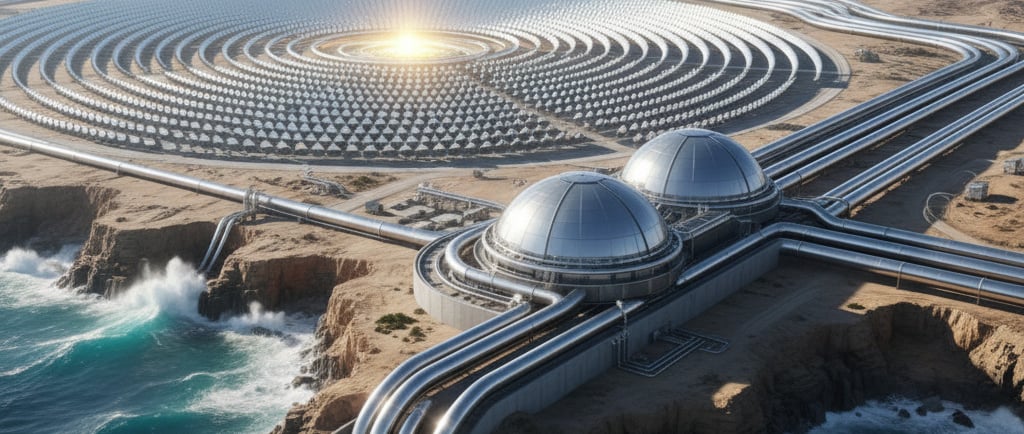
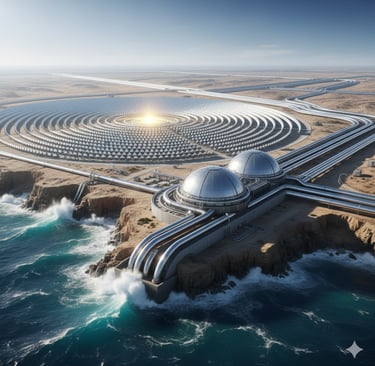
This lecture will address the first, and most technologically feasible, pillar of this water strategy: mega-scale desalination of seawater. We will focus on the two leading technologies—Reverse Osmosis (RO) and Multi-Stage Flash (MSF)—and analyze their principles, efficiencies, and limitations. More importantly, we will quantify the colossal energy requirements of such an undertaking and propose a synergistic solution: the co-location of these desalination plants with vast concentrating solar power (CSP) installations along the North African coasts. The objective is to design a system capable of producing not just millions, but billions, of cubic meters of fresh water annually, the foundational resource for initiating biogenesis in the desert.
Principles of Desalination: Overcoming Osmotic Pressure
At its core, desalination is the process of removing dissolved salts (primarily sodium chloride) from a solvent, in this case, water. Seawater typically contains around 35,000 parts per million (ppm) of total dissolved solids (TDS), while freshwater suitable for agriculture should be below 500 ppm. The fundamental challenge in separating salt from water is overcoming the thermodynamic barrier of osmotic pressure. When a semipermeable membrane separates saltwater and freshwater, water molecules will naturally flow from the fresh side to the salt side to equalize the salt concentration. Osmotic pressure is the external pressure that must be applied to the saltwater side to stop this natural flow. To desalinate, we must apply a pressure greater than the osmotic pressure to force water molecules in the reverse direction, leaving the salts behind. For typical seawater, this osmotic pressure is approximately 27 bar (2.7 megapascals).
Two primary technological families have been developed to overcome this barrier on an industrial scale: membrane-based processes, dominated by Reverse Osmosis (RO), and thermal-based processes, exemplified by Multi-Stage Flash (MSF).
Technology I: Reverse Osmosis (RO)
Reverse Osmosis is currently the most widely deployed desalination technology globally, prized for its relatively high energy efficiency. The process is conceptually straightforward:
Pre-treatment: Seawater is drawn from the ocean and undergoes extensive pre-treatment. This is a critical stage that involves screening to remove large debris, coagulation and flocculation to clump smaller suspended solids, and multi-media filtration to remove fine particulates. This step is essential to prevent fouling and damage to the delicate RO membranes.
High-Pressure Pumping: The pre-treated seawater is pressurized by high-pressure pumps to well above its osmotic pressure, typically in the range of 55 to 82 bar (800-1200 psi).
Membrane Separation: The pressurized seawater is forced into modules containing spiral-wound semipermeable membranes. These membranes are engineered from thin-film composite polymers (typically polyamide) that are highly permeable to water molecules but largely impermeable to larger hydrated salt ions (like Na+ and Cl-).
Permeate and Brine: As the feedwater flows across the membrane surface, a portion of it passes through as purified freshwater, known as "permeate." The remaining, now highly concentrated saltwater, is called "brine" or "concentrate" and is continuously discharged from the system. A typical modern seawater RO plant achieves a recovery rate of 40-50%, meaning for every 100 liters of seawater processed, 40-50 liters of freshwater are produced.
The primary operational cost of RO is the energy required to run the high-pressure pumps. Significant efficiency gains have been made through the development of energy recovery devices (ERDs), such as pressure exchangers, which transfer the high pressure from the outgoing brine stream to the incoming feedwater stream, recovering up to 98% of the hydraulic energy and reducing overall energy consumption by over 50%. Modern, large-scale seawater RO (SWRO) plants can operate with an energy consumption of 3.0-4.5 kWh per cubic meter (m³) of produced freshwater.
Technology II: Multi-Stage Flash (MSF)
Multi-Stage Flash distillation was the dominant technology before the maturation of RO, particularly in the energy-rich regions of the Middle East. MSF is a thermal process that mimics the natural water cycle of evaporation and condensation.
Heating: A continuous stream of seawater (brine) is heated in a device called a brine heater, typically using low-pressure steam from a co-located power plant or industrial process. The brine is kept under high pressure to prevent it from boiling at this stage.
Flashing Chambers: The heated, pressurized brine is then passed through a series of chambers (stages), each at a successively lower pressure.
"Flashing" into Vapor: As the brine enters a chamber with a lower pressure, its boiling point suddenly drops, causing a portion of the water to violently and instantly boil or "flash" into steam (water vapor).
Condensation: This steam rises and comes into contact with condenser tubes running through the top of the chamber. These tubes are cooled by the incoming seawater feed on its way to the brine heater, which pre-heats the feedwater and efficiently condenses the steam back into highly pure distilled water.
Collection: The condensed freshwater, or "distillate," is collected in trays beneath the condenser tubes. The remaining, slightly more concentrated and cooler brine flows to the next stage, which is at an even lower pressure, and the process repeats. A large MSF plant can have 15-25 stages.
MSF is robust and less sensitive to feedwater quality than RO, but it is significantly more energy-intensive. It requires both thermal energy (for the steam) and electrical energy (for the pumps). The total equivalent energy consumption is typically in the range of 10-16 kWh/m³. Its primary advantage lies in its ability to be integrated with thermal power plants in a process called co-generation, where waste heat from electricity generation is used as the thermal input for desalination.
The Energy Requirement: A Continental-Scale Challenge
To grasp the scale of the Saharan project, we must move from discussing individual plants to a continental infrastructure. Let us set a hypothetical, yet conservative, initial target: the production of 100 billion cubic meters (100 km³) of freshwater per year. This volume, while immense, is a starting point, equivalent to less than half the annual discharge of the Nile River.
If we were to produce this volume using the most efficient modern SWRO technology at an average of 3.5 kWh/m³, the annual energy requirement would be:
100,000,000,000 m³ * 3.5 kWh/m³ = 350,000,000,000 kWh, or 350 Terawatt-hours (TWh) per year.
To put this number in perspective, 350 TWh is roughly equivalent to the entire annual electricity consumption of the United Kingdom or Italy. Powering this with traditional fossil fuels would be environmentally counterproductive and logistically unsustainable. The only viable energy source at this scale, located in the ideal geography, is solar power.
Synergistic Solution: Concentrating Solar Power (CSP) and Desalination
The North African coast, the ideal location for our desalination plants, also possesses some of the highest Direct Normal Irradiance (DNI) in the world, making it perfectly suited for Concentrating Solar Power (CSP). Unlike photovoltaic (PV) panels which convert light directly to electricity, CSP uses mirrors (heliostats or parabolic troughs) to concentrate sunlight onto a receiver, heating a fluid (like molten salt or oil) to very high temperatures (400-600°C).
This thermal energy offers a unique synergy with desalination:
Electricity Generation for RO: The heated fluid is used to create steam, which drives a conventional turbine to generate electricity. This electricity can directly power the high-pressure pumps of massive co-located RO plants.
Thermal Energy Storage: A key advantage of CSP over PV is its ability to store thermal energy in large, insulated tanks of molten salt. This allows the plant to continue generating electricity for hours after sunset, providing the consistent, 24/7 power that large-scale industrial processes like desalination require.
Waste Heat for Thermal Desalination (Co-generation): The low-pressure, lower-temperature steam exiting the turbine is typically condensed with cooling water in a standard power plant. In a co-located desalination facility, this "waste" steam is the perfect thermal input to drive a Multi-Stage Flash (MSF) or a related thermal process called Multi-Effect Distillation (MED).
This creates the potential for a highly efficient, integrated system. A vast CSP farm could generate high-grade heat to produce electricity for a primary bank of RO units, while its low-grade waste heat is used to run a secondary bank of MSF/MED units. This hybrid approach leverages the efficiency of RO while utilizing the full energy potential of the solar thermal process, increasing the total water output per unit of solar energy collected.
Quantifying the Solar Infrastructure
Let's estimate the land area required for the CSP plants. A modern CSP plant with thermal storage has an approximate annual output of 400 GWh per square kilometer of mirror field. To generate our required 350 TWh (350,000 GWh), the required mirror area would be:
350,000 GWh/year / 400 GWh/year/km² = 875 square kilometers.
While this is a vast area—larger than the city of Berlin—it is a minuscule fraction of the Saharan desert. Distributed along the thousands of kilometers of coastline in Morocco, Algeria, Tunisia, Libya, and Egypt, this represents a technologically achievable, albeit monumental, engineering project.
Environmental Considerations: Brine Management
A critical externality of any large-scale desalination project is the management of the hypersaline brine. For every liter of freshwater produced, roughly 1-1.5 liters of brine, at nearly twice the salinity of seawater and containing residual pre-treatment chemicals, must be discharged.
Simply pumping this dense, negatively buoyant brine back into the coastal waters can create "dead zones" on the seafloor, harming local marine ecosystems like seagrass meadows. For a project of this magnitude, sophisticated brine management is non-negotiable. Strategies include:
Diffuser Systems: Discharging the brine through multi-port diffusers over a large area to promote rapid mixing and dilution with the ambient seawater.
Co-discharge with Power Plant Cooling Water: Mixing the brine with the large volumes of cooling water discharged from the CSP plant's thermal cycle to achieve significant pre-dilution.
Salinity Gradient Energy: Advanced concepts exploring the potential to generate energy from the salinity difference between the brine and seawater.
Mineral Extraction: The brine is a rich source of minerals, including sodium, magnesium, potassium, and lithium. Developing industrial processes to extract these valuable materials could create a secondary revenue stream and reduce the final volume of waste.
Conclusion: A Feasible First Step
In this lecture, we have demonstrated that the production of a continental-scale water supply for the Sahara, while requiring an unprecedented engineering effort, is founded on proven technologies. The synergy between Concentrating Solar Power and hybrid RO/MSF desalination systems provides a scientifically sound and energetically viable pathway. The required energy (350 TWh/year) and land footprint for the solar collectors (~875 km²), while enormous, are within the realm of achievable mega-projects when viewed on a multi-decadal timescale.
We have established that the "water problem," in principle, has a technological solution. However, producing the water is only the first step. The next, equally monumental challenge is transporting it thousands of kilometers into the desert's interior. Our next lecture, "The Water Grid: A Continental Plumbing System," will address the colossal task of engineering the arteries that will carry this newly created freshwater to the heart of the Sahara.