Add your promotional text...
Lecture 20: The First Open-Field Harvests: A Milestone for the Sahara
Series: The Sahara Reforestation Project: From Dune Sea to Green Valley Part II: Expanding the Green Zone - Establishing Ecosystems
4/13/20266 min read
Introduction: From Theory to Tangible Reality
Welcome. For the past nineteen lectures, we have navigated a landscape of immense theoretical and engineering challenges. We have discussed the physics of desalination, the geology of aquifers, the biochemistry of soil creation, the genetics of plant adaptation, and the complex ecology of designed ecosystems. We have laid out, step by step, a multi-decadal plan for the largest geo-engineering and bioremediation project in human history. Today, we transition from the blueprint to the reality.
This lecture marks the culmination of the entire foundational phase of the Sahara Reforestation Project. It is a moment of profound significance, where the convergence of all our preparatory work—water, soil, and biology—is put to its ultimate test. We will document the first successful, large-scale, open-field harvests of staple crops from our agroforestry systems.
This is more than a simple agricultural milestone. This first harvest is the definitive proof of concept. It demonstrates, with tangible, measurable results, that our integrated system is viable. It validates the immense investment of energy, technology, and time, and signifies the moment the new Sahara begins to transition from a project that consumes resources to an ecosystem that produces them.
Setting the Stage: The First Agricultural Zones
The first open-field harvests did not occur in a random patch of desert. They took place in meticulously prepared "Zone Alpha" agricultural blocks, strategically located in the lee of the now well-established pioneer shelterbelts (the "First Green Line"). Let us revisit the state of this landscape, a product of two to three decades of intensive preparation:
The Microclimate: The shelterbelts, now reaching a semi-mature state, have tangibly altered the local environment. Ground-level wind speeds are reduced by over 60%. Peak daytime air and soil temperatures are several degrees Celsius lower than in the exposed desert. Local humidity is measurably higher, reducing the evaporative stress on the crops.
The Soil (Technosol): The substrate is no longer sterile sand. It is a fully-engineered technosol, approximately 30-40 centimeters deep. It is a composite of the original sand, enriched with massive quantities of biochar and compost. It is teeming with the microbial life we introduced, and now supports a thriving community of earthworms and other soil invertebrates. Its water-holding capacity and nutrient content, while still modest compared to ancient prairie soils, are orders of magnitude greater than the original desert.
The Water Infrastructure: Each agricultural block is serviced by the AI-managed, high-efficiency drip irrigation grid. A dense network of subsurface soil moisture and salinity sensors provides continuous, real-time data, allowing for the prescriptive application of water and nutrients. Subsurface tile drainage systems stand ready to manage salt leaching.
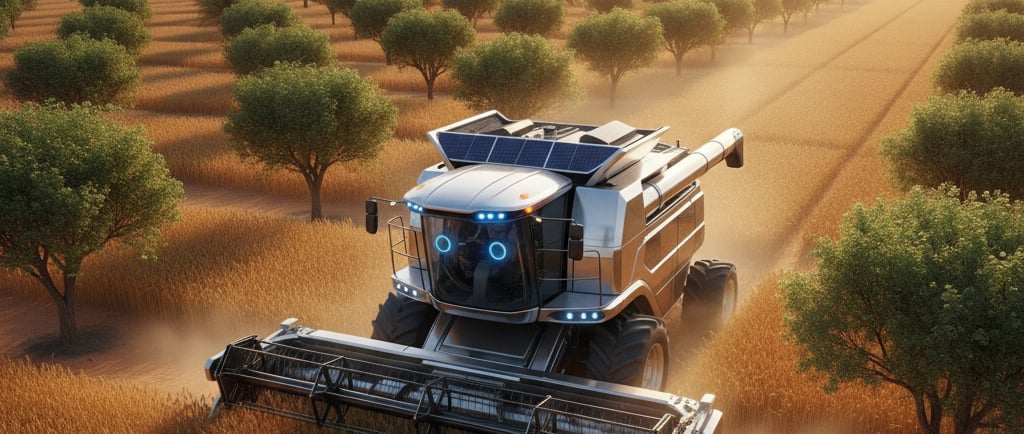
The Agroforestry System: The fields are laid out in the alley cropping model we detailed in Lecture 13. Rows of nitrogen-fixing trees, such as Faidherbia albida and various Acacia species, are interplanted with the crop alleys, providing dappled shade, nitrogen enrichment via leaf litter, and further wind reduction.
The Chosen Crops: A Portfolio of Resilience
The crops selected for this first large-scale trial were not chosen for maximum yield in ideal conditions, but for maximum resilience and nutritional value in this challenging new environment. They are a portfolio of genetically enhanced, arid-adapted C4 and CAM-pathway crops.
Sorghum (Sorghum bicolor): A C4 grain crop with exceptional drought and heat tolerance. The cultivars planted were genetically optimized for enhanced water use efficiency and improved grain size. It served as the primary staple grain.
Pearl Millet (Pennisetum glaucum): Arguably the most drought-tolerant of all major cereal crops. It thrives in high temperatures and low-fertility soils. It provided a secondary, highly resilient grain source.
Cowpea (Vigna unguiculata): A nitrogen-fixing legume, serving a dual purpose. It produced a high-protein food source (the peas) while also actively enriching the soil with nitrogen for the subsequent crop rotation. Its broad leaves also provided excellent ground cover, suppressing weeds and reducing soil evaporation.
Quinoa (Chenopodium quinoa): While not a traditional Saharan crop, quinoa was selected for its remarkable salinity tolerance (halophytism) and its complete protein profile. It was planted in zones with slightly higher anticipated soil salinity as a test of our salinity management strategies.
The Growing Season: A Data-Driven Symphony
The management of the growing season was a testament to the power of our integrated technological and biological systems.
Planting: Seeds, pre-coated with a beneficial microbial and mycorrhizal inoculant, were drilled into the soil by semi-autonomous planting machines.
Irrigation Management: The AI water management system was the central conductor. Instead of a fixed schedule, it operated a dynamic "on-demand" system. Data from the soil moisture sensor network, combined with real-time weather station data and predictive models, determined the precise timing and volume of each irrigation event for each specific alley. The goal was to maintain soil moisture within the optimal "management allowable depletion" range, minimizing both drought stress and water waste.
Nutrient Management (Fertigation): Nutrients were not broadcast-applied. They were delivered directly to the root zone through the drip irrigation system, a process known as fertigation. The AI system calculated the precise nutrient requirements for the crops based on their growth stage (monitored via satellite NDVI data) and soil sensor readings, injecting a tailored nutrient cocktail into the irrigation water.
Pest and Disease Monitoring: Fleets of autonomous drones equipped with hyperspectral cameras continuously surveyed the fields. By analyzing the spectral signature of the crop canopy, the system could detect the earliest signs of pest infestation or disease outbreaks, often days before they were visible to the human eye. This allowed for highly targeted, localized intervention with biological pest controls (e.g., the release of predatory insects), completely avoiding the need for broad-spectrum chemical pesticides.
The Harvest: Quantifying Success
After a full growing season, the moment of truth arrived. The harvest was conducted by autonomous robotic harvesters, equipped with yield monitors that mapped the productivity of every square meter of the field.
The results were not merely a success; they were a profound validation of the entire systems approach.
Yields: While not yet matching the yields of the world's most fertile, temperate-zone breadbaskets, the yields of sorghum and millet were substantial and, critically, stable across the large agricultural blocks. They were well within the range of productive, rain-fed agriculture in semi-arid regions of Earth, and far exceeded initial projections for a first-generation technosol.
Water Use Efficiency (WUE): This was the most significant metric. The WUE—measured in kilograms of harvested biomass per cubic meter of water applied—was exceptionally high, thanks to the combination of drip irrigation, microclimate moderation from the agroforestry trees, and the genetically enhanced traits of the crops. The system was demonstrating an unprecedented ability to turn scarce water into food.
Soil Health Indicators: Post-harvest soil analysis showed a marked improvement over the pre-planting baseline. Soil organic matter content had increased measurably due to root turnover and crop residue. Microbial biomass and activity were significantly higher. Earthworm populations, introduced prior to planting, had established themselves and begun the vital work of bioturbation. The soil was not being depleted; it was actively improving with cultivation.
Salinity Levels: Data from the soil EC sensors and the subsurface drainage effluent confirmed that the periodic leaching irrigations, as managed by the AI, were successfully controlling root zone salinity, keeping it well below the tolerance threshold for the crops.
Conclusion: The Sahara Begins to Give Back
The first open-field harvests from Zone Alpha are a watershed moment in human history. For millennia, our relationship with the Sahara has been one of retreat and defense. We have witnessed its expansion and struggled to survive at its margins. With this harvest, that relationship has been fundamentally inverted. For the first time, on a large, systematic scale, we are not taking from the Sahara; the Sahara is providing for us.
This harvest is the tangible proof that our scientific principles and engineering systems are sound. It demonstrates that:
Our water infrastructure can deliver the necessary resource with precision.
Our engineered technosols, born from sand, carbon, and microbes, can support productive agriculture.
Our agroforestry model is effective at conserving resources and building a resilient microclimate.
Our data-driven, AI-managed approach to farming can achieve efficiencies that are critical for sustainability.
This milestone marks the end of the purely foundational phase of the project, a phase characterized by immense upfront investment and preparation. We now enter a new phase, one of expansion, diversification, and ecological maturation. The success of these first agricultural zones provides the blueprint and the confidence to dramatically scale up the greening effort. The food produced will now help to sustain the growing population of the project, reducing its reliance on external support and creating a positive feedback loop of growth and self-sufficiency.
We have turned sand into soil, and soil into sustenance. The greening of the Sahara has begun. Our next series of lectures will explore the maturation of these new ecosystems and the scaling of our society within them. Thank you.