Add your promotional text...
Lecture 21: The Emergence of Rivers: Hydrological Engineering and Ecology
Series: The Sahara Reforestation Project: From Dune Sea to Green Valley Part III: Maturing the Ecosystem and Scaling Up
4/15/20266 min read
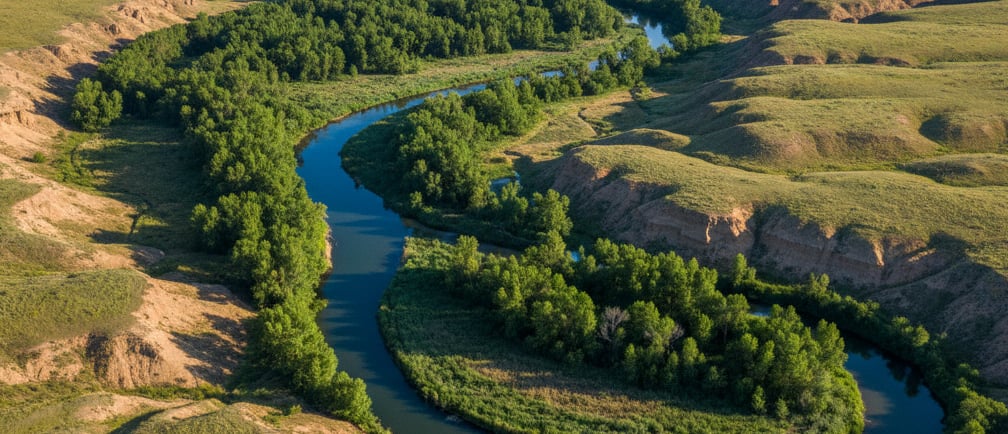
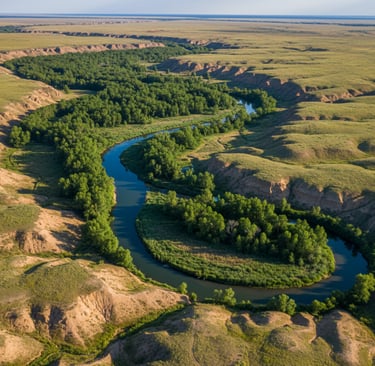
Introduction: From Pipes to Living Waterways
Welcome. In the preceding twenty lectures, we have laid the foundation for a new Sahara, culminating in the milestone of the first open-field harvests. Our success to this point has been built upon a rigidly controlled, engineered infrastructure. Water, the lifeblood of this entire endeavor, has been confined to a circulatory system of pipelines, canals, and precision drip emitters—a closed, artificial network. However, the ultimate goal of terraforming is not to create a permanent planetary-scale hydroponic facility, but to foster a self-regulating, naturalistic ecosystem.
This lecture marks a pivotal transition in our hydrological strategy: the shift from engineered conveyance to the emergence of living rivers. As decades of irrigation, afforestation, and altered microclimates begin to manifest in a rising groundwater table and nascent shifts in local rainfall, we must proactively manage the birth of a new surface hydrology.
We will discuss the dual-pronged approach of this new phase. First, the geo-engineering of stable river channels, guided by ancient paleochannels and modern hydrological modeling. Second, and more critically, the bio-engineering of complex riparian ecosystems—the dense, vibrant corridors of life along riverbanks—that are essential for the stabilization, health, and ecological function of these new waterways.
The Precursors to River Formation
Rivers do not spontaneously appear. Their emergence in our new Sahara will be the result of several interacting factors that we have deliberately set in motion over the first 50 to 100 years of the project.
Rising Groundwater Table (Piezometric Surface): Decades of large-scale irrigation, even with high-efficiency drip systems, will inevitably lead to some water percolating past the root zone. This deep percolation, combined with managed aquifer recharge programs, will slowly but surely raise the subterranean water table. As the water table rises to meet the surface in low-lying areas, it will create springs, seeps, and saturated wetlands.
Increased Local Precipitation and Runoff: As the vast new forests mature and the biotic pump (discussed in Lecture 12) begins to tentatively function, we anticipate a gradual increase in local and regional rainfall. Initially, this will manifest as more frequent and intense convective storms. When this rain falls on the still-developing landscapes, it will generate surface runoff, which naturally collects in depressions and flows downhill.
Engineered Discharge: As our water grid matures, we will have the capacity to create controlled, large-scale releases of water from our main reservoirs and canal systems. This allows us to initiate and guide river formation proactively, rather than waiting for it to happen unpredictably.
The convergence of these three factors—groundwater emergence, natural runoff, and controlled discharge—will create the first ephemeral, and then perennial, streams and rivers in the Sahara in over 5,000 years. Unmanaged, this process could lead to catastrophic erosion, channel instability, and the creation of sterile, incised canyons. Our task is to engineer this process from the outset.
Hydrological Engineering: Guiding the Flow
Our first priority is to create stable, predictable channels for these new rivers to occupy.
Resurrecting Paleochannels: The Sahara is crisscrossed by the ghostly remnants of ancient river systems from the African Humid Period, now buried under sand but clearly visible in satellite radar imagery. The most famous of these is the Tamanrasset River, a paleoriver that was once comparable in scale to the Amazon. Our primary engineering strategy will be to excavate and re-establish these ancient, geologically stable channels. This is far more efficient and sustainable than attempting to carve entirely new paths.
Channel Design and Geomorphology: The engineered river channels will not be simple, straight canals. They will be designed based on the principles of fluvial geomorphology to mimic the characteristics of stable natural rivers. This includes:
Meandering Patterns: Gentle, sinuous curves are engineered to dissipate stream energy, reducing erosion on outer banks and creating depositional zones (point bars) on inner banks.
Pool-Riffle Sequences: The channel bed will be sculpted to create alternating deep pools (slow-moving water) and shallow riffles (fast-moving, aerated water). This morphological diversity is critical for creating a variety of aquatic habitats.
Grade Control Structures: At intervals along the river's course, we will construct subtle, rock-based grade control structures or weirs. These "steps" in the river profile help to control the river's longitudinal slope, preventing down-cutting (incision) and stabilizing the channel bed.
Floodplain Reconnection: A key design principle is to ensure the river is connected to its floodplain. Instead of building high levees to contain the water (a common 20th-century engineering mistake), we will design broad, shallow floodplains. Periodic, managed high-flow releases will be allowed to inundate these areas, dissipating flood energy, depositing nutrient-rich sediment, and recharging the alluvial aquifer.
Bio-engineering: The Riparian Ecosystem
Once the physical channel is shaped, the critical work of biological stabilization begins. A riparian zone is the interface between land and a river. A healthy, vegetated riparian zone is the immune system of a river.
The Functions of a Riparian Forest:
Bank Stabilization: The dense root networks of riparian plants are the single most important factor in preventing bank erosion. They form a living, self-repairing retaining wall.
Water Quality Improvement: The riparian zone acts as a biological filter. As runoff from the surrounding landscape flows through it, the vegetation slows the water, allowing sediment to drop out. The plants and their associated microbes absorb and process excess nutrients (like nitrogen and phosphorus from agricultural runoff), preventing them from polluting the river.
Thermal Regulation: The canopy of the riparian forest shades the river, keeping the water cool. This is critical for maintaining high dissolved oxygen levels, which are essential for aquatic life.
Habitat Creation: Riparian zones are hotspots of biodiversity, providing a unique combination of terrestrial and aquatic habitats for a vast array of species, from insects and amphibians to birds and mammals. They are also vital wildlife corridors.
Phased Planting Strategy: The establishment of the riparian forest will follow a successional model, starting with fast-growing pioneers and followed by longer-lived species.
Phase I (The Binders): Immediately after channel construction, the banks will be planted with fast-growing, water-loving grasses, sedges, and reeds. Their fibrous roots will provide immediate surface stabilization. We will also plant pioneer trees with rapid growth and strong root systems, such as willows (Salix) and tamarisk (Tamarix).
Phase II (The Structurers): Once the pioneers have stabilized the banks, we will introduce a more diverse mix of larger, longer-lived trees and shrubs adapted to riverside conditions. This would include species like the African poplar (Populus euphratica), sycamore figs (Ficus sycomorus), and date palms (Phoenix dactylifera) in appropriate zones.
Phase III (The Understory): A diverse understory of shade-tolerant shrubs, ferns, and herbaceous plants will be established to create a complex, multi-layered forest structure.
Introducing the Aquatic Food Web
A river is more than just flowing water and trees; it is a living aquatic ecosystem. The introduction of aquatic life will be a carefully managed, bottom-up process.
The Microbial and Algal Base: The first step is to inoculate the water with a diverse community of phytoplankton (free-floating algae), periphyton (algae that grows on rocks), and beneficial bacteria. These are the primary producers and decomposers of the aquatic food web.
The Primary Consumers: Once a stable algal population is established, we will introduce zooplankton (microscopic animals like Daphnia and copepods) and benthic invertebrates (insects, snails, crustaceans) that graze on the algae and detritus.
The Secondary Consumers: The next trophic level includes the introduction of native, hardy fish species. We would start with detritivores and herbivores, such as certain species of Tilapia, which are well-adapted to North African waters.
The Apex Predators: Finally, piscivorous (fish-eating) fish and birds (like kingfishers and herons) would be introduced to regulate the fish populations and complete the food web.
Conclusion: From an Engineering Project to a Living System
The emergence of the first perennial rivers in the Sahara marks a profound shift in the character of our project. It signifies the point where we begin to transition from a landscape defined by artificial inputs to one governed by naturalistic, self-organizing processes. The river is the first large-scale ecosystem component that integrates subsurface hydrology (groundwater), surface hydrology (runoff), and atmospheric hydrology (rainfall) into a single, dynamic system.
The engineering of the channels provides the stable template, but it is the bio-engineering of the riparian and aquatic ecosystems that brings the river to life. This living corridor will become the central artery of biodiversity, a source of water and life radiating out into the surrounding landscape. Its health will be a primary indicator of the health of the entire Saharan ecosystem.
The management of these rivers will be an ongoing task, but the goal is to gradually reduce direct intervention, allowing the system to achieve a dynamic equilibrium. With a network of living rivers established, the new Sahara is no longer just a collection of greened zones; it is beginning to function as a cohesive, integrated continental biosphere.
Our next lectures will continue to explore the maturation of these diverse ecosystems and the introduction of the final layers of complexity into our new world. Thank you.