Add your promotional text...
Lecture 22: Lake Formation and Aquaculture
Series: The Sahara Reforestation Project: From Dune Sea to Green Valley Part III: Maturing the Ecosystem and Scaling Up
4/17/20266 min read
Introduction: From Flowing Arteries to Placid Hearts
Welcome. In our previous lecture, we detailed the emergence of a new fluvial network, engineering the channels and riparian ecosystems of the first Saharan rivers. These rivers are the arteries of our developing biosphere, transporting water, nutrients, and life across the landscape. However, a complete hydrological and ecological system requires more than just conduits of flow; it requires reservoirs of stability, biodiversity, and productivity. It requires lakes.
This lecture will address the next logical step in our hydrological engineering: the creation of large, permanent, standing water bodies. We will explore the strategic formation of artificial lakes by utilizing natural geological depressions, with a primary focus on the immense potential of the Qattara Depression in Egypt.
Furthermore, these new lakes will not be merely passive scenic features. They will be actively managed as productive aquatic ecosystems. We will detail the principles and application of aquaculture within these new environments, focusing on the cultivation of species like Tilapia. This strategy is designed to create a sustainable, large-scale source of protein for the growing Saharan population and to integrate waste streams into a productive, circular bio-economy.
The Rationale for Lake Formation: Ecological and Climatological Anchors
The creation of large lakes serves several critical functions that rivers alone cannot fulfill:
Hydrological Buffering and Water Storage: Lakes act as massive strategic reservoirs. They can store vast quantities of water from seasonal high flows or managed releases from the water grid, providing a buffer against periods of lower rainfall or increased demand. This stabilizes the entire regional water supply.
Climatological Moderation (The "Lake Effect"): A large body of water has high thermal inertia; it heats and cools much more slowly than the surrounding land. This creates a significant local climate-moderating effect. Lakeside areas will experience less extreme daily temperature swings, with cooler days and warmer nights. More importantly, the lake surface provides a vast area for evaporation, which can significantly increase local humidity and contribute to the formation of localized "lake-effect" precipitation downwind.
Biodiversity Hotspots: Lentic (still water) ecosystems support a completely different and far more diverse assemblage of species than lotic (flowing water) ecosystems. Lakes provide habitats for phytoplankton, zooplankton, submerged and emergent aquatic plants (macrophytes), benthic invertebrates, fish, amphibians, and a vast array of waterfowl. They become continental hotspots of biodiversity.
Sediment and Nutrient Traps: As rivers flow into a lake, their velocity drops, causing suspended sediment and associated nutrients to settle out. This process clarifies the outflowing water and concentrates nutrients within the lake, which can then be harnessed for biological productivity.
Case Study: The Qattara Depression Hydro-Solar and Ecological Project
To illustrate the scale and method of lake formation, we will focus on the most ambitious target: the Qattara Depression in northwestern Egypt.
Geological Context: The Qattara Depression is a massive natural basin, covering approximately 19,600 square kilometers, with its deepest point reaching 133 meters below sea level. Its proximity to the Mediterranean Sea (approximately 56 kilometers at its closest point) has made it a target for mega-engineering concepts for over a century.
The Engineering of Inundation: The project would involve excavating a large canal or tunnel from the Mediterranean coast to the depression's northern rim. Rather than simply flooding the basin, the inflow of seawater would be precisely controlled.
Hydroelectric Generation: The 60-meter (average) drop from sea level to the depression floor would be harnessed. The inflowing seawater would be passed through a series of turbines, creating a massive hydroelectric power station, generating gigawatts of clean electricity to support the wider Saharan grid.
Controlled Fill and Salinity Management: The rate of inflow would be balanced against the high rate of evaporation from the lake surface. This would allow for the creation of a lake of a specific, desired size and depth. The constant inflow and evaporation would result in a hypersaline lake, similar in chemistry to the Great Salt Lake or the Dead Sea.
The Hypersaline Ecosystem: A hypersaline lake is not a dead sea. We would inoculate it with a specialized community of extremophilic organisms:
Primary Producers: Halophilic algae, such as Dunaliella salina, which thrive in extreme salinity and are a rich source of beta-carotene and other valuable biochemicals.
Primary Consumers: Brine shrimp (Artemia salina) and brine flies, which feed on the algae.
Apex Predators: These organisms would form the base of a food web supporting vast flocks of migratory birds, such as flamingos, that are adapted to feed in saline environments.
Freshwater Integration: While the main body of the lake would be saline, freshwater from our continental water grid would be piped to its shores. This would create a unique interface: a series of brackish to freshwater lagoons, estuaries, and wetlands along the lake's perimeter. It is in these less-saline, highly productive zones that our primary aquaculture efforts would be concentrated.
Smaller, entirely freshwater lakes would be created in other natural depressions further inland by directing the flow of our engineered rivers and filling them with water from the grid.
Aquaculture: Farming the Water
With stable aquatic ecosystems established, we can implement aquaculture as a core component of the Saharan food production system. The goal is to create a sustainable, high-yield protein source that is far more water-efficient than terrestrial livestock.
Species Selection: The Case for Tilapia: The primary candidate for Saharan freshwater aquaculture is the Nile Tilapia (Oreochromis niloticus).
Biological Rationale: Tilapia are an ideal choice for several reasons. They are native to Africa and are extremely hardy, tolerating a wide range of water conditions, including high temperatures and relatively low dissolved oxygen. They are omnivorous, with a diet that can be based largely on algae and plant-based feeds. Most importantly, they are fast-growing and have a high feed conversion ratio.
Aquaculture Systems Design: We would deploy a variety of systems tailored to different environments.
Extensive Aquaculture (Lake Ranching): In the large, newly formed freshwater lakes, we would practice a form of "lake ranching." Genetically diverse, selectively bred populations of Tilapia would be released into the lake. They would feed primarily on the natural productivity of the lake (phytoplankton and zooplankton). Harvesting would be done using managed fishing techniques. This system has a low input cost and produces fish in a semi-natural environment.
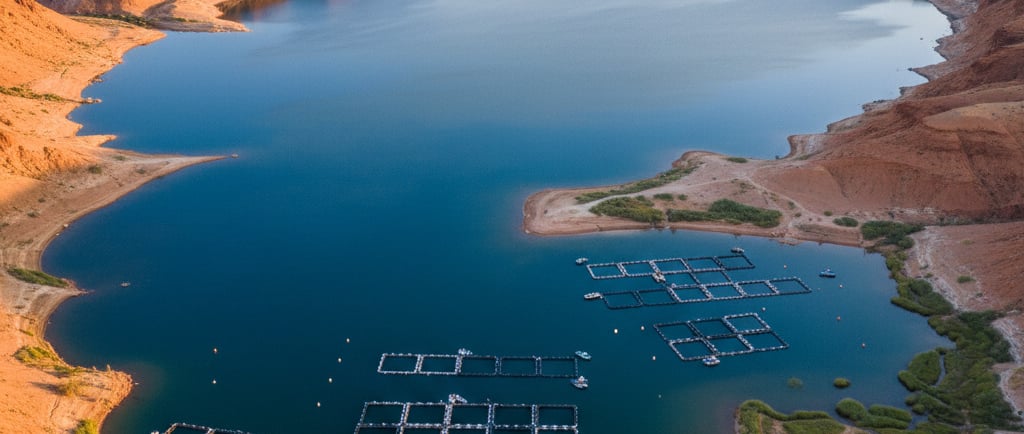
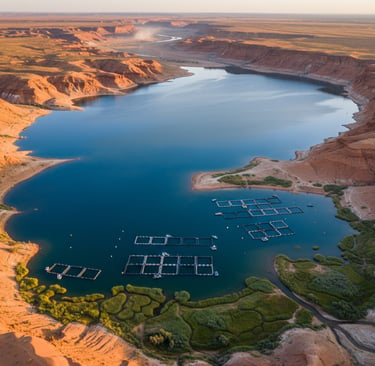
Semi-Intensive Cage Culture: In protected bays and lagoons along the lake shores, we would deploy large floating cages. Fish are stocked at a higher density in these cages and their natural diet is supplemented with a formulated, plant-based feed. This allows for higher yields and easier management and harvesting.
Intensive Recirculating Aquaculture Systems (RAS): For the highest level of production and resource control, we would build land-based Recirculating Aquaculture Systems. In an RAS, fish are raised in high-density tanks. The water from the tanks is continuously pumped through a series of filters: a mechanical filter to remove solid waste, and a biological filter (biofilter) where beneficial bacteria convert toxic ammonia (from fish waste) into harmless nitrate. The purified water is then re-oxygenated and returned to the fish tanks.
The Circular Economy: Integrated Agri-Aqua-Culture
The true elegance of this system lies in its integration with the surrounding terrestrial agriculture, creating a closed-loop, circular economy.
The RAS-Hydroponics Link (Aquaponics): The nutrient-rich water from the RAS is a perfect, ready-made hydroponic fertilizer solution. Instead of being simply recirculated, the water, now rich in nitrates, can be diverted to irrigate high-value crops (like lettuce, herbs, and tomatoes) in the project's CEA modules (Lecture 10). The plants absorb the nutrients, cleaning the water, which can then be returned to the fish tanks. This aquaponics system produces two crops (fish and vegetables) from one input of feed.
Waste as a Resource:
The solid waste (sludge) filtered out from the aquaculture systems is a highly effective organic fertilizer, rich in phosphorus and micronutrients. This sludge would be processed and applied to the fields of the agroforestry systems.
The feed for the aquaculture systems would be sourced locally. It would be formulated from byproducts of the terrestrial agriculture (e.g., oilseed cakes, grain processing waste) and from dedicated protein crops, such as Spirulina or insect meal produced in our other biological loops.
This integration means that nutrients are continuously recycled between the aquatic and terrestrial components of the ecosystem. Nothing is wasted.
Conclusion: Anchors of Productivity and Biodiversity
The formation of lakes and the implementation of aquaculture represent a profound maturation of the Saharan ecosystem. The lakes act as hydrological and climatological anchors, stabilizing the environment and creating vast new habitats. They are the hearts of the new biosphere, just as the rivers are its arteries.
By integrating aquaculture into these new water bodies, we are not just adding a new feature; we are creating a highly productive, sustainable, and water-efficient protein production system. The circular integration of this system with our terrestrial agriculture—where the waste from the fish feeds the plants, and the waste from the plants feeds the fish—is a core tenet of the project's regenerative design.
We have now populated our landscape with a complex flora and our waters with a productive fauna. We have established systems for food, water, and nutrient recycling. The ecosystem is becoming increasingly complex and self-sufficient. Our next lectures will address the final layers of the food web and the overarching governance and societal structures that will manage this new world. Thank you.