Add your promotional text...
Lecture 24: The Carbon Sink: Quantifying the Sahara's New Role
Series: The Sahara Reforestation Project: From Dune Sea to Green Valley Part III: Maturing the Ecosystem and Scaling Up
4/22/20266 min read
Introduction: From a Global Source to a Global Sink
Welcome. In our lectures to this point, we have framed the Sahara Reforestation Project primarily through the lens of bioremediation and the creation of a habitable, productive landscape. We have focused on water, soil, and the establishment of a complex, multi-trophic ecosystem. However, a project of this magnitude does not exist in a planetary vacuum. The transformation of 9 million square kilometers of desert has profound implications for global biogeochemical cycles, most notably the global carbon cycle.
Historically, the Sahara is a net source of atmospheric carbon, not through emissions, but through its role as a source of wind-blown dust that interacts with global climate systems. The project we have outlined will fundamentally invert this role. By establishing a vast, continent-scale biosphere, we are creating one of the largest and most potent carbon sinks on the planet.
This lecture will shift our perspective from the local ecology of the Sahara to its global climatological significance. We will focus on quantifying the immense carbon sequestration potential of the new Saharan forests and, critically, its newly engineered soils. We will discuss the mechanisms of carbon capture and storage in this ecosystem and detail the rigorous, multi-layered system of measurement, reporting, and verification (MRV) that will be required to certify this carbon sink and integrate it into the framework of global climate change mitigation efforts.
The Global Carbon Cycle: A Brief Overview
To understand the impact of our project, we must first understand the context of the global carbon cycle. Carbon is in a constant state of flux between several major reservoirs: the atmosphere (as CO2), the oceans, the terrestrial biosphere (plants and soils), and the lithosphere (rocks). The current climate crisis is a result of anthropogenic emissions (primarily from burning fossil fuels) overwhelming the capacity of the natural oceanic and terrestrial sinks to absorb this excess atmospheric CO2.
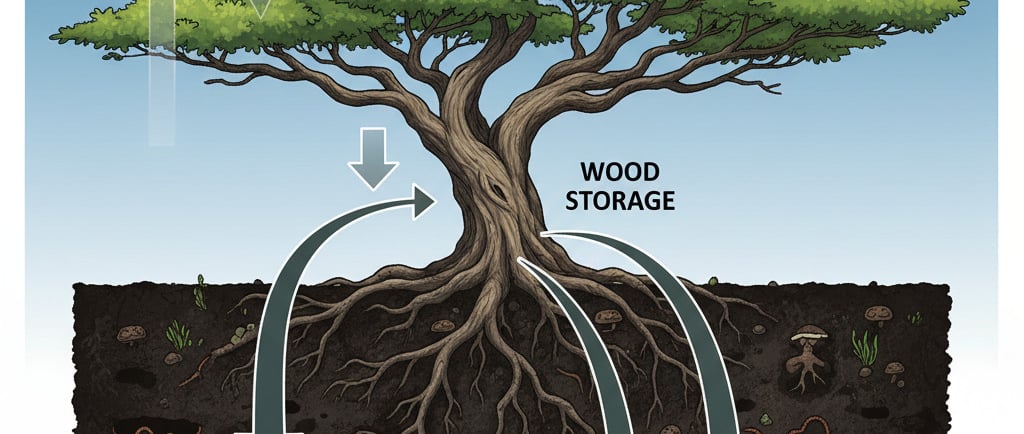
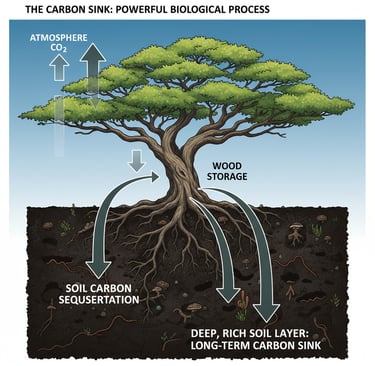
A "carbon sink" is any process or reservoir that absorbs more carbon from the atmosphere than it releases. The Sahara Reforestation Project is designed to create two massive, synergistic carbon sinks:
The Biomass Sink: The carbon stored in the living tissues of the new vegetation (trunks, branches, leaves, and roots).
The Soil Organic Carbon (SOC) Sink: The carbon stored in the soil in the form of decomposing organic matter and stable humus.
Our objective is to quantify the rate and total capacity of carbon accumulation in these two sinks.
Mechanism 1: The Biomass Carbon Sink
The fundamental mechanism of the biomass sink is photosynthesis. The equation 6CO2 + 6H2O → C6H12O6 + 6O2 is the biochemical engine of carbon sequestration. Plants are, in essence, carbon-fixing machines, converting atmospheric CO2 into the organic compounds that constitute their physical structure.
Quantifying the Sequestration Rate: The rate of carbon uptake in the new Saharan forests and savannas will be a function of:
Net Primary Productivity (NPP): This is the rate at which the ecosystem generates new biomass. It is a function of species type, age, and environmental conditions (water availability, light, temperature, nutrients). Our genetically engineered, fast-growing species are selected to maximize NPP.
Carbon Content: On average, the dry biomass of a plant is approximately 50% carbon by weight.
Modeling and Measurement: We will use a combination of direct measurement and remote sensing to quantify this sink:
Allometric Equations: Ecologists will develop specific allometric equations for our key tree species. These are mathematical relationships that correlate easily measurable parameters (like tree trunk diameter and height) with the total biomass of the tree (above and below ground).
Field Inventories: A network of permanent forest inventory plots will be established across the Sahara. In these plots, every tree will be periodically measured. This ground-truth data is used to calculate the biomass and carbon stock on a per-hectare basis.
Remote Sensing and AI: This field data will be used to train machine learning algorithms. These algorithms will analyze high-resolution satellite imagery and LiDAR (Light Detection and Ranging) data, which can measure forest height and structure across the entire continent. The AI can then extrapolate the plot-level measurements to create a dynamic, high-resolution map of the total carbon stored in the Saharan biomass, updated in near real-time.
Long-Term Storage: The carbon stored in long-lived woody biomass, particularly the trunks of trees, is sequestered for the lifespan of that tree, which can be hundreds of years. The management of the forests for selective, sustainable harvesting of timber (which is then used in long-lasting products like building materials) can further extend this sequestration timeline.
Mechanism 2: The Soil Organic Carbon (SOC) Sink
While the biomass sink is impressive, the soil organic carbon sink has the potential to be even larger and more durable over millennial timescales. As we've discussed, our strategy is not just to plant trees, but to build deep, rich soils.
Mechanisms of SOC Accumulation:
Litterfall: The decomposition of leaf, branch, and other plant litter on the soil surface is a primary input of carbon.
Root Turnover: The continuous growth and death of fine plant roots deposits organic carbon directly into the soil profile. This is a particularly important and often underestimated pathway.
Microbial Necromass: The dead bodies of the vast soil microbial community are a significant source of stable organic matter.
Biochar Application: As detailed in Lecture 6, the addition of biochar is a direct and powerful method of carbon sequestration. The recalcitrant carbon in biochar is resistant to decomposition and can persist in the soil for centuries to millennia.
Formation of Humus: Through complex microbial processes, some of this organic matter is transformed into humus—large, complex, stable organic molecules that bind to mineral surfaces, protecting them from further decomposition. This is the mechanism for very long-term carbon storage in soil.
Quantifying the SOC Sink: Measuring SOC is more complex than measuring biomass.
Systematic Soil Sampling: A rigorous, grid-based soil sampling program will be implemented. Autonomous rovers will collect soil cores to a depth of at least one meter.
Laboratory Analysis: These cores will be analyzed in laboratories to determine their bulk density and organic carbon concentration (using methods like dry combustion). This allows for the calculation of the carbon stock in tons per hectare.
Spectroscopy and Remote Sensing: We will deploy advanced field-portable and airborne spectroscopic sensors. These devices measure the reflectance of light from the soil surface, which can be correlated with soil organic carbon content. This technology, calibrated with the physical soil samples, will allow for rapid, large-scale mapping of SOC stocks.
Flux Towers: A network of eddy covariance flux towers will be installed across different ecosystem types (forest, savanna, agroforestry). These towers directly measure the net exchange of CO2 between the ecosystem and the atmosphere, providing a continuous, real-time measurement of whether a given landscape is acting as a carbon sink or source.
The Scale of the Sink: A Planetary Impact
Let's attempt a preliminary, order-of-magnitude estimate. If we successfully afforest 5 million square kilometers of the Sahara (roughly half its area) with a mix of savanna and woodland, and achieve an average carbon sequestration rate of 5 to 10 tons of CO2 equivalent per hectare per year (a plausible range for young, growing ecosystems), the annual sequestration would be:
5,000,000 km² = 500,000,000 hectares
500,000,000 ha * (5 to 10 tCO2/ha/year) = 2.5 to 5.0 Gigatons of CO2 per year.
To put this in context, current global anthropogenic CO2 emissions are on the order of 40 Gigatons per year. The Sahara Reforestation Project, therefore, has the potential to sequester 6% to 12% of current total global emissions annually during its primary growth phase. This represents a climate change mitigation tool of unparalleled scale, far exceeding the potential of conventional afforestation projects.
Measurement, Reporting, and Verification (MRV): The Currency of Carbon
To have a credible impact on global climate policy and to potentially finance the project through carbon markets, this massive carbon sink must be rigorously and transparently quantified. This requires a world-class Measurement, Reporting, and Verification (MRV) system.
Measurement (M): As detailed above, this is the multi-layered system of field inventories, soil sampling, flux towers, remote sensing, and AI-driven modeling.
Reporting (R): All data and methodologies will be reported annually to a global oversight body (such as the UNFCCC, the United Nations Framework Convention on Climate Change) in a standardized, transparent format. The data will be open-access to the global scientific community.
Verification (V): The reported sequestration figures will be subject to independent, third-party verification. This would involve international teams of scientists auditing the data, conducting their own field measurements, and validating the models used.
This rigorous MRV system is what transforms the carbon sink from a scientific estimate into a certified, verifiable, and potentially tradable asset. The sale of carbon credits on a global market, representing the verified tons of CO2 removed from the atmosphere, could become a significant long-term funding mechanism for the project's ongoing maintenance and expansion.
Conclusion: Inverting the Equation
The Sahara Reforestation Project, initiated as an endeavor to create a new habitable and agricultural landscape, reveals itself in this lecture to be one of the most powerful climate change mitigation strategies conceivable. By transforming a vast, reflective, and relatively inert part of the Earth's surface into a dark, productive, carbon-absorbing biosphere, we are fundamentally inverting its role in the planetary system.
The combination of rapid biomass accumulation in our engineered forests and the deliberate, large-scale creation of a deep, carbon-rich soil (supercharged by biochar) creates a carbon sink of global significance. The rigorous, technology-driven MRV system ensures that this contribution is quantifiable, credible, and can be integrated into the global effort to stabilize our planet's climate.
The greening of the Sahara, therefore, is not just a regional project. It is a planetary one. It is an act of deliberate, constructive geo-engineering that seeks to partially counteract the unintentional, destructive geo-engineering of the past two centuries.
Having examined the project's profound impact on the global carbon cycle, our next lecture will delve into the societal and political structures required to govern such a monumental, multi-generational undertaking. Thank you.