Add your promotional text...
Lecture 27: The Social Dimension: Nomadic Cultures and New Livelihoods
Series: The Sahara Reforestation Project: From Dune Sea to Green Valley Part III: Maturing the Ecosystem and Scaling Up
4/29/20266 min read
Introduction: The Human Landscape of the Sahara
Welcome. In our extensive planning for the Sahara Reforestation Project, we have focused primarily on the non-human elements: the climate, the water, the soil, and the vast ecosystems we intend to build. We have treated the Sahara as a blank canvas, a tabula rasa for ecological engineering. This perspective, however, is incomplete and perilous. The Sahara is not empty. It is a landscape rich with millennia of human history, culture, and adaptation. It is the home of resilient nomadic and semi-nomadic peoples, such as the Tuareg, the Sahrawi, the Tubu, and the Moors.
A project of this magnitude, which will fundamentally reshape the physical environment, will inevitably and profoundly impact the human landscape. A purely technocratic approach that ignores the existing social fabric is not only unethical but is also doomed to fail. True sustainability requires social sustainability.
This lecture will address this critical social dimension. We will explore the anticipated socio-economic effects of the terraforming project on the Sahara's indigenous populations. Critically, we will move beyond a simple impact assessment to outline a proactive strategy for integration and partnership. The goal is not to displace or marginalize these cultures, but to create a new, hybrid socio-economic model that synergistically combines their deep, traditional ecological knowledge with the project's modern agricultural and technological systems, fostering new livelihoods and a unique, resilient Saharan society.
Understanding the Existing Socio-Economic Fabric: The Nomadic Tradition
To plan for the future, we must first respect the present. The traditional livelihoods of Saharan peoples are masterpieces of adaptation to hyper-aridity.
Pastoral Nomadism: The cornerstone of the Saharan economy is pastoralism. Groups like the Tuareg have traditionally managed herds of camels, goats, and sheep, moving them across vast territories in a seasonal pattern (transhumance) to exploit sparse and ephemeral vegetation and water sources. This is not random wandering; it is a highly sophisticated system of resource management based on generations of accumulated environmental knowledge.
Trade and Caravan Routes: Historically, nomadic groups controlled the trans-Saharan caravan routes, facilitating trade in salt, gold, textiles, and other goods between North Africa and the Sahel. This established them as connectors and merchants, not just herders.
Cultural Identity and Social Structure: This mobile lifestyle has shaped a unique cultural identity, with a strong emphasis on kinship, oral history, independence, and a profound spiritual and practical connection to the desert landscape. Social structures are often clan-based and highly decentralized.
Modern Pressures: In the 20th and 21st centuries, this traditional way of life has been under immense pressure from political boundaries that restrict movement, climate change-induced desertification that disrupts traditional routes, and economic marginalization.
The Sahara Reforestation Project represents both the greatest threat to this traditional way of life (by utterly transforming the landscape they know) and, if managed correctly, its greatest opportunity for revitalization.
The Initial Impact: Disruption and Opportunity
The first decades of the project will be a period of profound disruption. The construction of pipelines, solar farms, and the first green zones will inevitably cross traditional grazing lands and caravan routes. The emergence of new settlements and agricultural centers will create new economic gravity wells, pulling people away from traditional livelihoods.
A purely top-down implementation would risk cultural erasure and social conflict. Therefore, the project's charter must include, from its inception, a "Social and Cultural Integration Mandate." This mandate would be overseen by a dedicated council of anthropologists, sociologists, and, most importantly, representatives and elders from the various Saharan communities. Its guiding principle is Free, Prior, and Informed Consent (FPIC) for all major project phases that impact traditional lands.
A Strategy for Integration: Blending Traditional Knowledge with Modern Practice
The core of the strategy is to recognize that Traditional Ecological Knowledge (TEK) is not an archaic curiosity; it is a valuable and highly refined dataset, complementary to our modern scientific approach.
Integrating Pastoralism into the New Ecosystem: Instead of replacing pastoralism, we will seek to integrate it into the new, more productive savanna ecosystems.
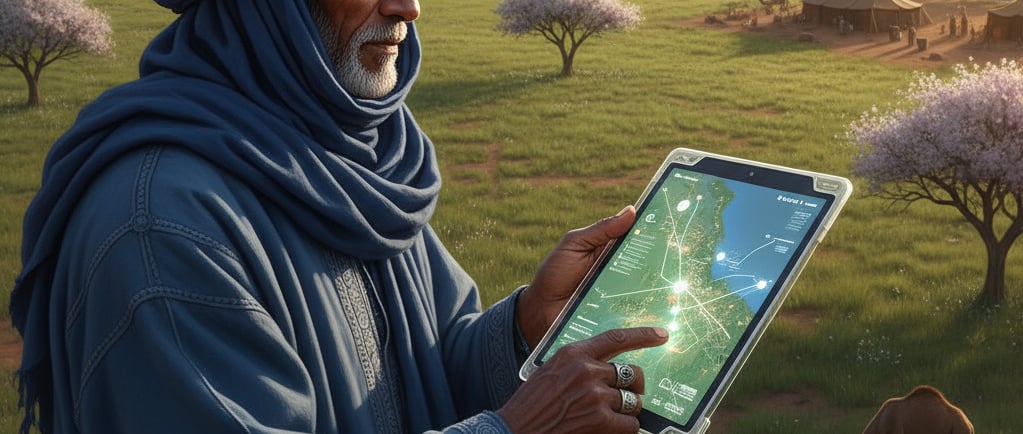
From Nomads to Rangers: The deep knowledge of animal husbandry and landscape management possessed by nomadic groups is an invaluable resource. We will actively recruit and train pastoralists to become the professional "rangers" of our new, managed herbivore populations (both domestic livestock and reintroduced wildlife like the Oryx). Their generational expertise in tracking, herd behavior, and reading the landscape is something that technology cannot easily replicate.
Modernizing Transhumance: The traditional practice of moving herds will be synergized with our high-tech management systems. The rangers, equipped with real-time data from our satellite and sensor networks, will manage the rotational grazing patterns of the herds within the virtual fence system. This combines their intuitive understanding of animal needs with the quantitative precision of our ecological models.
New Livestock and Fodder: The project will introduce livestock breeds better adapted for high-productivity ranching, but the knowledge of managing hardy species like camels and goats will remain critical, especially in the transitional zones. The agroforestry systems will produce high-quality, reliable fodder, removing the "boom and bust" cycle of traditional desert grazing.
New Livelihoods in the Green Economy: The project will create a vast array of new economic opportunities, and dedicated programs will be established to ensure that Saharan communities are the primary beneficiaries.
Agricultural Training: Members of nomadic communities will be offered training and land grants to become owner-operators within the new agroforestry systems. The project would prioritize the establishment of community-managed agricultural cooperatives.
Eco-Tourism: The eco-tourism industry will be developed in partnership with local communities. Their cultural heritage, storytelling, and deep connection to the land are the "software" that will make the "hardware" of the new landscape a compelling destination. Former nomads can become expert guides, sharing both the new ecology and their own rich history.
Bioprospecting and Non-Timber Forest Products: Local knowledge of native plants and their traditional uses (for medicine, food, materials) is an invaluable resource for identifying high-value species and products that can be sustainably cultivated and harvested, such as Gum Arabic.
Technical Roles: Education and vocational training programs will be established to provide pathways into technical roles within the project, from water grid maintenance and sensor network technicians to roles in the new research universities.
Settlement and Cultural Preservation: The transition from a nomadic to a more settled lifestyle is a delicate and complex process that must be voluntary and community-led.
Hybrid Settlement Models: The new Oasis Cities will be designed with input from Saharan communities. This could involve creating neighborhoods that incorporate architectural styles and social spaces that reflect traditional nomadic life (e.g., modern, permanent structures that evoke the feel of a tent encampment, with a focus on communal spaces).
Maintaining Mobility: Not everyone will choose a settled life. The project must guarantee the continued right to movement and establish designated "pastoral corridors" that allow for a modernized form of transhumance to continue, connecting the new savanna zones.
Cultural Heritage Centers: The project will fund the establishment of cultural centers dedicated to the preservation and celebration of Tuareg, Sahrawi, and other Saharan cultures. These centers will serve as archives for oral history, music, and art, and as living community hubs.
The Governance Model: A Seat at the Table
To ensure this integration is not merely tokenistic, the governance structure of the Saharan Authority must include meaningful representation from the indigenous communities. A council of elders and community representatives would hold formal advisory and, in some cases, veto power over project decisions that directly affect cultural sites, traditional lands, and community well-being. This moves the relationship from one of consultation to one of genuine partnership.
Conclusion: A Hybrid Culture for a Hybrid Ecology
The social dimension of the Sahara Reforestation Project is arguably its most complex and most important challenge. The physical terraforming of the desert must be accompanied by a sensitive and respectful social transformation. A failure to justly and effectively integrate the existing Saharan populations would represent a profound moral and practical failure, creating a hollow, green shell devoid of its human soul.
Our proposed strategy is one of synergy. We do not seek to erase the nomadic past, but to offer a new context in which its core skills and deep knowledge can thrive. By blending Traditional Ecological Knowledge with advanced technology, by creating pathways to new livelihoods within the green economy, and by empowering these communities with a voice in the governance of their transformed homeland, we can foster the development of a new, hybrid Saharan culture.
This new culture, like the agroforestry systems we are planting, will be a synthesis of the old and the new—a society that remembers the lessons of the desert while embracing the opportunities of the garden. It will be a culture that is resilient, adaptive, and uniquely Saharan, forming the human heart of the new green valley.
Our next lectures will continue to explore the large-scale governance and international implications of this new world. Thank you.