Add your promotional text...
Lecture 28: Biodiversity and Conservation Corridors
Series: The Sahara Reforestation Project: From Dune Sea to Green Valley Part III: Maturing the Ecosystem and Scaling Up
5/1/20266 min read
Introduction: Beyond the Island Biome
Welcome. Our vision for the Sahara Reforestation Project has, to this point, been largely inward-looking. We have focused on the immense task of creating a vast, productive, and stable green zone within the historical boundaries of the desert. We have designed agroforestry systems, savanna grasslands, and new riverine habitats. However, an ecosystem, no matter how large, that is disconnected from the wider continental biosphere is fundamentally an island. The principles of island biogeography, as formulated by MacArthur and Wilson, tell us that such isolated habitats are inherently vulnerable, suffering from lower species richness and a higher risk of extinction events due to their lack of connectivity.
To create a truly resilient and dynamic Saharan ecosystem, we must break this isolation. We must strategically connect the green dots. This lecture will address the critical principles of landscape ecology and conservation biology that must guide the spatial design of our reforestation effort.
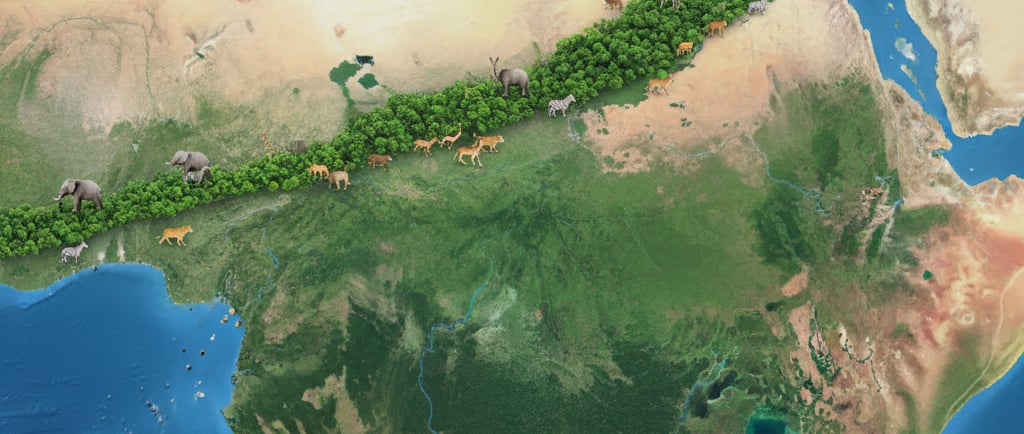
Our focus will be on the deliberate engineering of biodiversity and conservation corridors. These are contiguous pathways of suitable habitat designed to link our new Saharan ecosystems with the existing, biodiversity-rich biomes that lie at its periphery: the Sahelian savanna to the south, the Mediterranean ecosystems of the Atlas Mountains to the north, and the Nile River Valley to the east. We will discuss how these corridors facilitate genetic flow, enable natural species migration, and transform our project from a collection of isolated green patches into a fully integrated and functioning component of the African continent's ecological fabric.
The Ecological Imperative for Connectivity
A fragmented landscape, composed of isolated patches of habitat, suffers from several critical ecological deficiencies that conservation corridors are designed to overcome:
Genetic Isolation and Inbreeding Depression: Small, isolated populations of plants and animals are at high risk of inbreeding. A lack of gene flow from outside populations leads to a loss of genetic diversity, which can result in "inbreeding depression"—a reduction in the overall health, fertility, and adaptive potential of the population, making it highly vulnerable to disease or environmental change.
Limited Dispersal and Colonization: Many species, particularly larger mammals, birds, and even plants with specific dispersal mechanisms, are unable or unwilling to cross large tracts of unsuitable habitat (like open desert). This prevents the natural colonization of our new Saharan ecosystems and traps existing populations within their isolated patches.
Inability to Respond to Climate Change: As climates shift, species need to be able to migrate to track their preferred environmental conditions. Fragmented landscapes block these migratory pathways, effectively trapping species in areas that may become unsuitable for them in the future.
Edge Effects: The boundaries between a habitat patch and the surrounding matrix (the "edge") often have different environmental conditions (e.g., higher wind, more light, different temperatures) than the core of the habitat. An ecosystem with a high edge-to-area ratio (i.e., many small, fragmented patches) can be dominated by these less-than-ideal edge conditions. Corridors help to create larger, more contiguous core habitat areas.
By designing and implementing a network of conservation corridors, we are directly addressing these issues, building a landscape that is not only habitable but also genetically robust and dynamically resilient.
Designing the Saharan Corridor Network: A Macro-Scale Approach
The design of the Saharan corridor network is a task of continental-scale landscape architecture, guided by GIS (Geographic Information System) modeling, existing topographical features, and the ecological requirements of target species. The network will be comprised of several major axes.
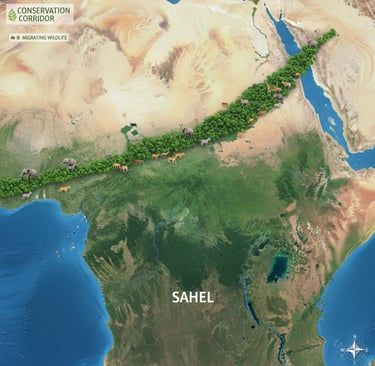
The Trans-Saharan Vertical Corridor (Primary Axis):
Route: This would be the most ambitious corridor, a wide, contiguous belt of savanna and woodland habitat stretching from the northern edge of the Sahel in nations like Niger and Mali, northwards through central Algeria, to the southern slopes of the Atlas Mountains.
Ecological Function: This corridor is the primary bridge connecting the rich biodiversity of sub-Saharan Africa with the new Saharan ecosystem and the Palearctic realm of North Africa. It would be the main migratory route for large herbivores, their predators, and countless bird species.
Engineering: The route would be chosen to follow topographically favorable paths, potentially leveraging ancient paleochannel systems that offer lower elevations and deeper soils. This corridor would receive the highest priority for water from the main arterial grid.
The Atlantic Coastal Corridor:
Route: A continuous strip of coastal savanna, wetland, and forest habitat running along the Atlantic coast from Senegal and Mauritania north to Morocco.
Ecological Function: This corridor connects the Sahelian coastal ecosystems with those of the Mediterranean. It is critically important for migratory shorebirds and waterfowl and leverages the higher humidity and moderating influence of the ocean.
The Nile River Corridor:
Route: This involves the massive expansion and ecological restoration of the riparian zone along the Nile River. The goal is to widen the existing narrow strip of agriculture into a broad, multi-kilometer-wide corridor of natural forest and wetland.
Ecological Function: This corridor would connect the ecosystems of East and Central Africa with the new Sahara and the Mediterranean, serving as a vital north-south migratory flyway and a rich source of biodiversity for colonizing the eastern Sahara.
The Biological and Structural Composition of a Corridor
A conservation corridor is not just a line of trees. To be effective, it must be a fully functioning, albeit linear, ecosystem.
Structural Heterogeneity: The corridors will be designed as a mosaic of habitat types to cater to the needs of a wide range of species. This includes:
Dense Woodland Thickets: To provide cover for shy or forest-dwelling species.
Open Savanna: For grazing herbivores.
Riparian Zones: Wherever the corridor crosses a wadi or engineered river, a rich riparian ecosystem will be established, providing a critical water source and unique habitat.
Stepping-Stone Patches: In areas where a fully continuous corridor is difficult to establish (e.g., across a particularly rugged mountain range), we will create a series of large, interconnected "stepping-stone" habitat patches, close enough for species to move between them.
Keystone Resources: The corridors will be intentionally planted with keystone plant species that provide critical resources. This includes year-round water sources (from the irrigation grid), patches of mineral licks, and a diversity of fruit- and nut-bearing trees to support frugivorous animals.
Width Considerations: The required width of a corridor is a subject of intense ecological debate and depends on the target species. For large, wide-ranging mammals like lions or wild dogs, a corridor must be many kilometers wide to provide sufficient core habitat and minimize negative edge effects. Our primary corridors would be designed with widths ranging from 10 to 50 kilometers.
Facilitating Colonization and Managing Genetic Flow
The corridors are the conduits for the natural colonization of the new Sahara.
Passive Colonization: Once the corridors are established and connected to source ecosystems (like the Sahel), many species will begin to colonize the new territories on their own. This includes wind-dispersed plants, insects, birds, reptiles, and small mammals. Our role is to monitor this natural process.
Assisted Migration: For larger, less mobile, or critically endangered species (such as the reintroduced predators), we may need to engage in "assisted migration," physically translocating founding populations from the source ecosystems into the newly connected Saharan habitats.
Monitoring Genetic Flow: The success of the corridors will be measured by their effectiveness in facilitating gene flow. We will use advanced population genomics to achieve this. By periodically collecting non-invasive genetic samples (e.g., hair, scat) from animal populations in the source ecosystems and within the new Sahara, we can track the movement of genes across the landscape. This data will allow us to determine if the corridors are functioning as intended or if they contain unforeseen barriers that need to be addressed.
Conclusion: Weaving a Continental Web of Life
The design and implementation of biodiversity and conservation corridors represent a critical maturation in the philosophy of the Sahara Reforestation Project. It marks our understanding that we are not creating an isolated garden, but are instead mending a vast, severed piece of the African continent's ecological tapestry.
These corridors are the sutures that will bind our new ecosystem to the ancient, resilient biomes at its borders. They are the conduits for life and genetic diversity, ensuring that the new Sahara does not become a static, inbred museum of our own creation, but a dynamic, evolving, and fully integrated component of the planetary biosphere. The successful establishment of these corridors will be a testament to a design philosophy that prioritizes not just creation, but connection.
By connecting the green dots, we are building a whole that is far greater than the sum of its parts—a resilient, continental-scale ecosystem with the capacity to adapt and endure for millennia to come. Our next lectures will continue to explore the long-term management and societal implications of this new, interconnected world. Thank you.