Add your promotional text...
Lecture 29: Fire Ecology in a New Forest
Series: The Sahara Reforestation Project: From Dune Sea to Green Valley Part III: Maturing the Ecosystem and Scaling Up
5/4/20266 min read
Introduction: The Inevitable Element
Welcome. Over the course of this lecture series, we have meticulously detailed the assembly of a new Saharan biosphere, focusing on the constructive elements of water, soil, and life. We have planted forests, established savannas, and reintroduced animal life. In doing so, we have not only cultivated life but have also created a vast and unprecedented repository of biomass. This accumulation of organic matter—in the form of grasses, shrubs, and trees—introduces a new and powerful ecological force that we have not yet addressed: fire.
In any terrestrial ecosystem with sufficient biomass and periods of dryness, wildfire is not a question of if, but of when and how. The Sahara Reforestation Project, by design, creates a landscape with a distinct dry season, accumulating massive fuel loads. To ignore the role of fire would be to plan for the project's eventual, catastrophic failure.
This lecture will address the critical and complex topic of fire ecology in our engineered Saharan ecosystem. We will move beyond the simplistic view of fire as a purely destructive force and explore its dual nature as both a significant risk to be managed and a powerful ecological tool to be harnessed. Our discussion will cover a three-pronged strategy: proactive fire risk mitigation through landscape design and species selection, the implementation of a sophisticated fire detection and suppression system, and the deliberate application of controlled burns as an essential tool for ecosystem management.
Fire as a Risk: The Threat of Catastrophic Wildfire
Before we can use fire as a tool, we must first respect it as a threat. The conditions in our new Sahara—seasonal dryness, high winds, and vast, contiguous tracts of vegetation—are a recipe for large, high-intensity wildfires. A catastrophic, uncontrolled wildfire could, in a matter of weeks, destroy centuries of terraforming work, releasing vast quantities of sequestered carbon back into the atmosphere, sterilizing the soils we have painstakingly built, and causing widespread ecosystem collapse.
The primary risks are associated with:
High Fuel Loads: The accumulation of dead, dry biomass (leaf litter, dead wood, cured grasses) in the absence of sufficient decomposition or grazing.
Fuel Continuity: Large, unbroken expanses of forest or grassland allow fire to spread rapidly and uncontrollably over vast areas.
Extreme Fire Weather: The combination of high temperatures, low humidity, and strong winds creates conditions where fire behavior becomes erratic and impossible to suppress.
Our entire fire management strategy is designed to prevent these conditions from aligning to create a catastrophic event.
Strategy I: Proactive Mitigation through Ecological Design
The most effective way to fight a fire is to prevent it from starting or spreading uncontrollably. This is achieved through intelligent landscape design and species selection.
Creating a Fire-Resistant Mosaic: The principle of a landscape mosaic, which we introduced for biodiversity, is also our primary fire defense. Instead of planting a single, continuous forest, the landscape will be deliberately fragmented into a patchwork of different vegetation types with varying flammability.
Fuel Breaks: Wide corridors of low-flammability vegetation will be designed to crisscross the landscape. These "green firebreaks" would consist of less-flammable native succulent plants, carefully managed agricultural zones, or broadleaf evergreen trees with low oil content.
Juxtaposition of Ecosystems: Highly flammable ecosystems, like pine forests or dry grasslands, will be interspersed with less flammable ones, like wetlands, riparian forests, or montane ecosystems. This breaks up fuel continuity and slows the spread of any potential wildfire.
Species Selection for Fire Resistance/Resilience: The genetic engineering and species selection component of our project will explicitly target fire-adaptive traits.
Fire-Resistant Species: We will prioritize the planting of species with low flammability. This includes trees with thick, insulating bark, self-pruning lower branches (to prevent fire from climbing into the canopy), and leaves with high moisture content and low volatile oil content.
Fire-Resilient (Pyrophyte) Species: In ecosystems that are naturally fire-prone (like savannas), we will use species that are not just resistant, but are actively adapted to survive and even benefit from periodic, low-intensity fires. This includes grasses that resprout quickly from their roots after a fire and trees with serotinous cones (like some species of pine) that only release their seeds after being exposed to the heat of a fire, ensuring the next generation is born into a nutrient-rich, competition-free environment.
Herbivore Management as Fuel Reduction: The managed grazing of our reintroduced mega-herbivores (Lecture 16) is a critical fire management tool. By consuming large quantities of grass biomass, the grazers reduce the fine fuel load in the savanna ecosystems, significantly lowering the intensity and rate of spread of grass fires.
Strategy II: High-Tech Detection and Suppression
Even with the best mitigation, ignitions (from lightning or human activity) will occur. An advanced, integrated system for rapid detection and response is therefore essential.
Detection Network:
Geostationary Satellites: A dedicated constellation of satellites in geostationary orbit will provide continuous thermal infrared monitoring of the entire continent. AI-powered algorithms will analyze this data in real-time to detect the "hotspot" signature of a new ignition, often within minutes of it starting.
Watchtowers and Drones: This satellite data will be supplemented by a network of automated watchtowers in high-risk areas, equipped with optical and infrared cameras. Fleets of long-endurance autonomous drones will patrol the forests, providing high-resolution imagery and "sniffing" for the chemical signatures of smoke.
Suppression Systems: The goal is aggressive initial attack to suppress a fire while it is still small.
Autonomous Firefighting Drones: Upon detection of a small fire, the system will automatically dispatch a squadron of large, autonomous drones. These drones will be capable of dropping precise loads of water or fire retardant, guided by real-time thermal imagery to target the most active parts of the fire front.
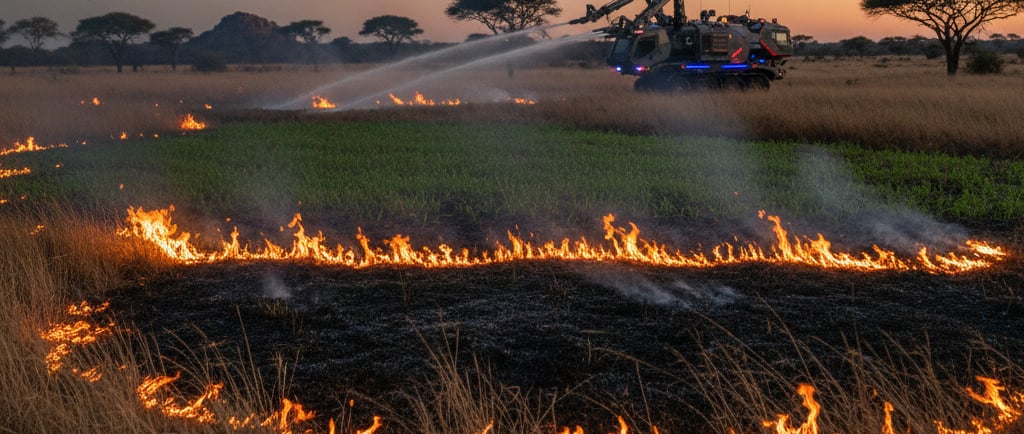
Robotic Ground Crews: For fires that reach a larger size, semi-autonomous robotic firefighting vehicles will be deployed. These rugged, remotely operated units can construct firebreaks, lay down fire hoses, and work in hazardous conditions that would be too dangerous for human crews.
Human Wildland Firefighters: The system will be overseen by elite, highly trained human wildland firefighters. Their role is strategic: directing the autonomous systems, conducting complex back-burning operations, and handling incidents that require human ingenuity and experience.
Strategy III: Fire as a Tool - The Prescribed Burning Program
Perhaps the most sophisticated component of our strategy is the recognition that fire is not just an enemy to be vanquished, but an essential ecological process to be harnessed. The complete suppression of all fire leads to the dangerous accumulation of fuel, making an eventual catastrophic wildfire almost inevitable. Therefore, we will implement a large-scale, scientifically-grounded prescribed burning program.
The Rationale for Controlled Burns: A prescribed burn is a fire that is intentionally ignited under carefully controlled conditions (specific wind, temperature, humidity, and fuel moisture levels) to achieve specific ecological objectives. These objectives include:
Hazardous Fuel Reduction: The primary goal is to safely consume the accumulated dead biomass on the forest floor, reducing the risk of a future, high-intensity wildfire.
Nutrient Cycling: Fire rapidly mineralizes the nutrients (like phosphorus and potassium) that are locked up in dead organic matter, making them immediately available for new plant growth.
Controlling Invasive Species and Disease: Fire can be used to control the spread of non-native, fire-intolerant plant species or to sanitize an area affected by a plant pathogen.
Maintaining Habitat for Fire-Adapted Species: As mentioned, many species in savanna and certain forest ecosystems are dependent on fire for their reproduction and to maintain their open habitat structure. Prescribed burns are essential for the health of these pyrophic communities.
The Prescribed Burning Process:
Planning and Modeling: Each burn is meticulously planned. Fire behavior models, fed with data from our sensor networks, are used to predict how the fire will behave under the prescribed weather conditions. The burn plan defines the exact area to be burned, the desired fire intensity, and the contingency plans.
Execution: The fires are typically ignited by aerial drip torches (dispensing ignited fuel from helicopters or drones) or by ground crews. The ignition patterns are designed to control the direction and speed of the fire's spread.
Monitoring and Control: Throughout the burn, the fire's behavior is monitored in real-time using drones and ground sensors. Human and robotic crews are on standby to ensure the fire remains within its prescribed boundaries.
Ecological Fire Regimes: The goal is not to burn everything, but to re-establish a "fire regime"—the natural pattern, frequency, and intensity of fire in an ecosystem. Savanna grasslands might be burned on a frequent, low-intensity cycle (e.g., every 2-5 years). Denser woodlands might be burned on a less frequent, higher-intensity cycle. Riparian and wetland areas might be excluded from burning altogether.
Conclusion: Living with Fire
The creation of a vast, vegetated Sahara necessitates a paradigm shift in our relationship with fire. This lecture has outlined a mature, multi-faceted strategy that moves beyond a simplistic policy of total suppression. Our approach is one of proactive, intelligent fire management.
We begin by engineering a fire-resistant landscape through the creation of a habitat mosaic and the selection of fire-adapted species. We then deploy the most advanced technology on the planet for the rapid detection and suppression of unwanted ignitions. Finally, and most importantly, we embrace fire as an essential ecological process, using a scientifically-grounded prescribed burning program to maintain the health and resilience of the ecosystem and prevent the buildup of catastrophic fuel loads.
By learning to live with fire—and to use it wisely as a tool—we ensure the long-term persistence of the new Saharan biosphere. We are not merely fire-fighters; we are fire ecologists, managing an ancient and powerful force to sustain the new world we have built.
Our next lecture will bring together many of the themes we have discussed, as we focus on the establishment of a central nervous system for the entire project: the Saharan Agricultural University. Thank you.