Add your promotional text...
Lecture 30: The Saharan Agricultural University: A Center for Arid Land Studies
Series: The Sahara Reforestation Project: From Dune Sea to Green Valley Part III: Maturing the Ecosystem and Scaling Up
5/6/20265 min read
Introduction: The Intellectual Heart of the New Sahara
Welcome. Over the past twenty-nine lectures, we have detailed a project of unprecedented physical and biological engineering. We have discussed the creation of oceans of freshwater, the assembly of continental ecosystems, and the management of planetary-scale biogeochemical cycles. This entire endeavor is underpinned by a constant stream of scientific data, predictive modeling, and adaptive management. However, for a project of this complexity and multi-generational timescale to succeed, it requires more than just infrastructure and automation; it requires a permanent, self-sustaining intellectual heart. It requires an institution dedicated to understanding, managing, and improving the new world we are creating.
This lecture will detail the establishment of that institution: The Saharan Agricultural University (SAU). This will be far more than a conventional university. Conceived from its inception as the central nervous system of the Sahara Reforestation Project, the SAU will be a world-leading research and education institution, a living laboratory dedicated to the interdisciplinary study of the new Saharan ecosystem.
Our discussion will cover the university's unique mission, its organizational structure integrating research and real-world operations, its key academic departments, and its ultimate role as a global hub for the development and dissemination of arid-land agriculture and terraforming technologies. The SAU is where the accumulated knowledge of the project is codified, where the next generation of terra-formers is trained, and where the solutions for a climate-stressed Earth are forged.
The Mission: To Understand, to Manage, to Disseminate
The mission of the Saharan Agricultural University is threefold:
To Understand: To conduct foundational and applied research across all disciplines relevant to the new Saharan biosphere. Its primary object of study is the grand experiment unfolding outside its own walls. The university's first duty is to observe, measure, and comprehend the complex, evolving ecosystem of the green Sahara.
To Manage: The SAU will not be a detached ivory tower. It will be directly integrated with the operational command of the Sahara Reforestation Project. The AI-powered management systems for the water grid, the fire ecology program, and the managed herds will be run from centers within the university, with faculty and students directly involved in the real-time, data-driven stewardship of the continent.
To Disseminate: The knowledge generated within the Sahara is a global resource. The SAU's final and most crucial mission is to codify the techniques, technologies, and ecological principles learned from the project and to disseminate this knowledge globally, providing a blueprint for combating desertification and ensuring food security on a climate-changed Earth.
Campus and Structure: An Integrated Design
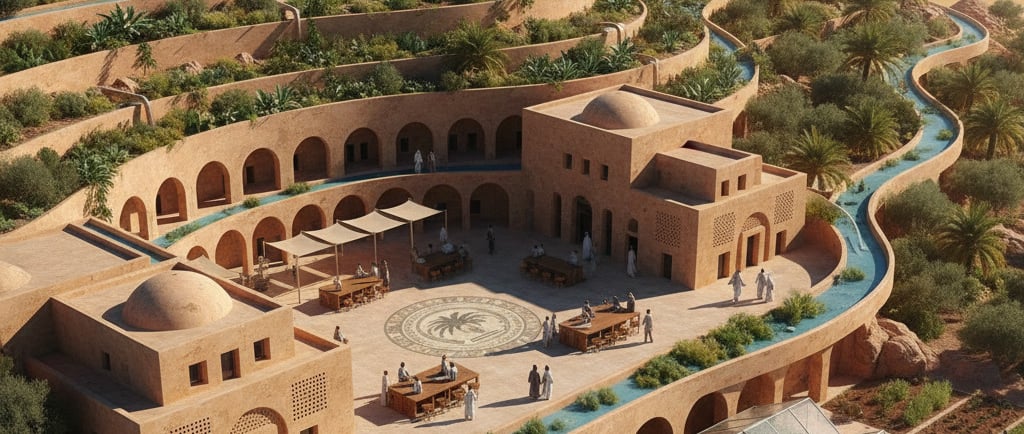
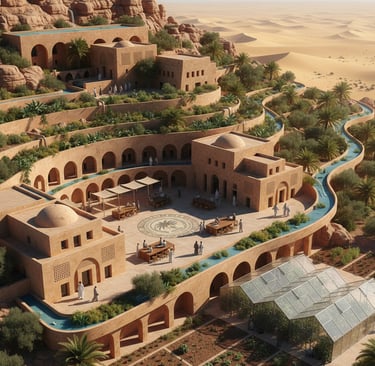
The main campus of the SAU would be a new city in itself, a prime example of the sustainable desert architecture we discussed in Lecture 18. It would be strategically located to provide access to a wide range of the new Saharan ecosystems: agroforestry zones, savanna, riparian corridors, and the unmodified desert for comparative studies.
The university's structure would be radically interdisciplinary, breaking down the traditional silos between departments.
The "Living Laboratory" Concept: The entire reforested Sahara is the university's primary laboratory. Research is not confined to campus buildings. The university will manage a distributed network of long-term ecological research (LTER) sites, experimental farms, and biosphere monitoring stations spread across the continent.
Integration with the AI Core: The university's central computing facility will house the AI core that manages the continent's water, energy, and ecological systems. This provides researchers and students with unparalleled access to the most comprehensive real-time environmental dataset ever created.
Faculty as Practitioners: A significant portion of the faculty will hold dual appointments, serving as both academic researchers and as senior managers within the operational divisions of the Saharan Authority (the project's governing body). A professor of hydrology might also be the chief strategist for the water grid; a professor of fire ecology might also direct the prescribed burning program.
Key Academic Colleges and Research Centers
The SAU would be organized into several core, interdisciplinary colleges:
The College of Pedogenesis and Soil Science:
Focus: The study of the engineered Saharan technosols.
Research Areas: Soil microbiology, biogeochemistry, humus formation, the long-term stability of biochar, and the optimization of the soil food web. This college would be responsible for developing the next generation of microbial inoculants and soil amendments.
The College of Climatology and Atmospheric Science:
Focus: Modeling and monitoring the new Saharan climate.
Research Areas: High-resolution regional climate modeling, the study of the biotic pump mechanism, cloud microphysics, and the analysis of global teleconnections. This college would run the project's primary climate prediction models.
The College of Genetic Engineering and Synthetic Biology:
Focus: The continued adaptation and optimization of the Saharan flora and fauna.
Research Areas: Developing new CRISPR-edited crop varieties for enhanced yield and stress tolerance, engineering microbes for bioremediation and biomanufacturing, and managing the genomic health of the reintroduced animal populations. It would house the project's main seed and gene bank.
The College of Landscape and Restoration Ecology:
Focus: The study and management of the ecosystem on a landscape scale.
Research Areas: Trophic cascade dynamics, fire ecology, conservation corridor design, population genetics of reintroduced species, and the modeling of long-term ecological succession. This college would directly oversee the wildlife and fire management programs.
The College of Sustainable Agriculture and Aquaculture:
Focus: Optimizing food production systems.
Research Areas: Agroforestry system design, integrated pest management, aquaponics and aquaculture optimization, and the development of new crop species. This college would run the experimental farms and provide extension services to the Saharan agricultural communities.
The College of Geo-engineering and Resource Management:
Focus: The technology and engineering underpinning the project.
Research Areas: Advanced desalination and water purification technologies, solar energy systems, AI and robotics for environmental management, and the economics and governance of mega-scale engineering projects.
Education: Training the Next Generation
The SAU will be a global magnet for the brightest students in environmental science, biology, and engineering. Its educational philosophy will be grounded in experiential learning.
Curriculum: The curriculum will be deeply integrated with the project's real-world operations. A student studying hydrology will spend time working in the control room of the water grid. A student of ecology will participate in the satellite tracking of predator-prey dynamics.
Interdisciplinary Problem-Solving: Education will be structured around solving complex, real-world problems. A final-year thesis might require a team of students from genetics, ecology, and engineering to design a solution for a new plant pathogen that has emerged in the agroforestry systems.
Global Extension Program: The university's primary educational outreach will be a global extension program. It will develop curricula, training manuals, and remote learning platforms to transfer the knowledge and techniques developed in the Sahara to farmers, land managers, and policymakers in other arid and semi-arid regions of the world.
Conclusion: The Engine of Innovation and Legacy
The Sahara Reforestation Project is a multi-generational endeavor. Its physical infrastructure will last for centuries; its ecosystem for millennia. The Saharan Agricultural University is the institution designed to ensure the project's intellectual and operational continuity across these vast timescales.
It is the living repository of the project's knowledge, the training ground for its future stewards, and the engine of its continued innovation. While the initial phase of the project is driven by imported technology and expertise, the SAU ensures that, over time, the center of knowledge and innovation will shift to the Sahara itself.
More than any physical structure, the SAU represents the ultimate legacy of the project. It transforms a monumental feat of engineering into a perpetual source of scientific discovery and global environmental solutions. It ensures that the greening of the Sahara is not just a one-time event, but the beginning of a new era of proactive, intelligent, and sustainable planetary stewardship, with its lessons radiating out from the heart of the new green valley to all the arid corners of the Earth.
This lecture concludes our in-depth look at the foundational and maturing phases of the project. Our next series will explore the even more complex and long-term scientific, societal, and philosophical implications as this new world fully develops. Thank you.