Add your promotional text...
Lecture 32: The Geopolitics of Water and Weather
Series: The Sahara Reforestation Project: From Dune Sea to Green Valley Part IV: Advanced Bioscience and Geopolitics
5/11/20266 min read
Introduction: The Unintended Export
Welcome. For the majority of this series, our focus has been contained within the geographical boundaries of the Sahara. We have treated the project as a monumental, yet localized, endeavor of ecological engineering. We have discussed the project's outputs in tangible terms: food, timber, carbon credits, and renewable energy. However, as we explored in our lecture on climate modeling, the most profound and far-reaching consequence of greening the Sahara is not a product we can put on a ship; it is the deliberate alteration of continental-scale weather patterns.
When a project has the potential to make rain fall in one country and cease in another, it transcends the domains of ecology and engineering and enters the complex, high-stakes arena of geopolitics. The question is no longer merely "Can we do this?" but "Who has the right to do this?" and "Who is responsible for the consequences?"
This lecture will address the intricate and volatile international political implications of the Sahara Reforestation Project. We will analyze how the intentional manipulation of the West African Monsoon and the potential downstream effects on the Mediterranean and Middle Eastern climates could become a source of both unprecedented cooperation and catastrophic conflict. Our discussion will focus on the absolute necessity of establishing a new framework of international environmental law and a new form of transnational governance to manage the weather itself.
From Hydro-politics to Atmopolitics: A New Frontier of Conflict
The 20th century was marked by "hydro-politics," conflicts and treaties centered on the control of shared river basins like the Nile, the Tigris-Euphrates, and the Jordan. The Sahara project, by creating new water sources, aims to alleviate many of these tensions. However, in doing so, it opens the door to a new and far more complex domain: "atmopolitics," the politics of atmospheric moisture and rainfall.
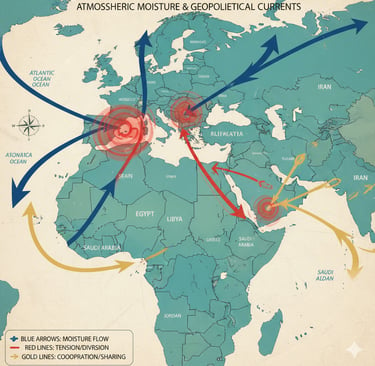
While the project's primary goal is to increase rainfall over North Africa, climate is a zero-sum game in some respects. The atmospheric river of moisture is not infinite. Inducing rain to fall in one location can mean that the moisture is no longer available to fall elsewhere. Our own climate models (as discussed in Lecture 25) have indicated that a strengthened West African Monsoon could have complex and potentially negative downstream effects.
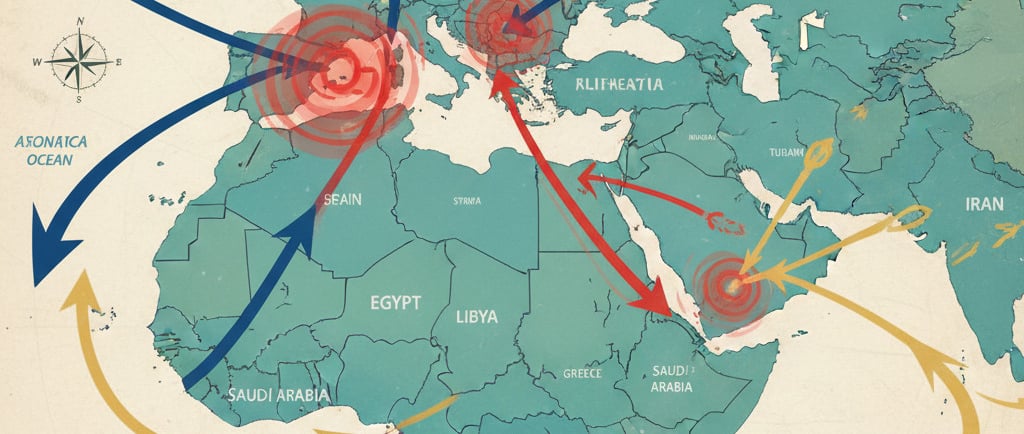
The Mediterranean Basin: Models suggest that the powerful convective engine of a green Sahara could pull significant moisture southward from the Mediterranean Sea. This could lead to a measurable decrease in summer precipitation and increased drought frequency in Southern European nations like Spain, Italy, and Greece, as well as in the Levant region of the Middle East.
The Nile Basin: The headwaters of the Blue Nile are in the Ethiopian Highlands, and its rainfall is governed by the same monsoonal systems. A radical strengthening and northward shift of the monsoon could alter the dynamics of the Ethiopian rainy season, potentially reducing the flow of the Blue Nile, upon which Egypt and Sudan are existentially dependent. While the project would provide Egypt with new water sources from desalination, the geopolitical implications of altering the Nile's natural flow are immense.
The Sahel: The nations of the Sahel, on the southern border of the Sahara, would be the most immediate beneficiaries of a strengthened monsoon. However, a rapid shift in rainfall patterns could also be disruptive, leading to flooding in areas not prepared for it and altering traditional agricultural and pastoral cycles.
These potential impacts mean that the Sahara Reforestation Project cannot be the sole enterprise of the nations within whose borders it lies. It is, by its very nature, an act of international significance with continent-spanning consequences.
The Governance Challenge: Who Owns the Sky?
The existing framework of international environmental law is wholly inadequate to govern a project of this nature. Treaties like the UNFCCC deal with emissions, not the deliberate, large-scale manipulation of regional climate systems. We require a new form of governance.
The project would necessitate the formation of a "Saharan Authority," the international governing body we have mentioned previously. However, the mandate of this authority must extend beyond the project's physical footprint. It would need to be a transnational entity with two key components:
The Operational Consortium: Comprised of the North African nations where the project is physically located (e.g., Morocco, Algeria, Tunisia, Libya, Egypt, Mauritania, etc.). This group would be responsible for the day-to-day management of the project.
The International Oversight Council: A higher body with veto power and regulatory authority, comprised of representatives from all significantly affected nations. This must include not only the North African states, but also the nations of the Sahel, Southern Europe, and the Nile Basin. Global powers (e.g., the G20) who provided the initial funding would also hold seats.
This council's primary function would be to manage the "atmopolitical" externalities of the project.
Treaties and Protocols: The Legal Framework for Weather Modification
The International Oversight Council would be tasked with drafting and enforcing a new body of international law, a "Treaty on Transnational Climate Engineering." Its key provisions would include:
The Principle of Prior Notification and Consultation: No major phase of the project that is predicted to have a significant cross-border climatic impact can be initiated without a formal period of consultation with all potentially affected nations.
Data Transparency Mandate: All climatological data and predictive models generated by the Saharan Agricultural University must be made fully and freely available to the scientific communities of all member nations. This transparency is the foundation of trust.
The Compensation and Mitigation Fund: This is the most critical and contentious provision. A fund, capitalized by a percentage of the project's future revenues (from carbon credits, agriculture, etc.), would be established to compensate nations for verifiably negative climatic impacts. For example:
If Greece can scientifically demonstrate a 10% reduction in agricultural yield due to project-induced summer drying, the fund would provide financial compensation.
The fund would also finance mitigation projects, such as funding the construction of new desalination plants in Southern Europe or water efficiency projects in the Nile Basin to counteract any negative effects.
Dispute Resolution Mechanism: An independent scientific and legal tribunal would be established to adjudicate claims of climatic impact, assess the validity of scientific evidence, and determine appropriate levels of compensation. This body's rulings would need to be binding on the Saharan Authority.
Adaptive Management Clause: The treaty must acknowledge the inherent uncertainty in climate modeling. It would mandate a phased, adaptive approach to the terraforming process. The project would be "throttled" or adjusted in real-time based on observed climatic impacts, not just on predictions. For example, the rate of afforestation might be slowed if unexpected negative consequences begin to emerge.
Geopolitical Scenarios: Cooperation vs. Conflict
The establishment of this framework is a monumental challenge, and its success is not guaranteed. We can envision several potential geopolitical futures:
The Cooperative Scenario (The Ideal): The Sahara project becomes a model for 21st-century international cooperation. The promise of food security, clean energy, and climate mitigation for North Africa, combined with a fair and transparent system for compensating downstream nations, fosters a new era of regional integration between Africa and Europe. The project becomes a shared endeavor for regional stability and prosperity.
The Coercive Scenario (The Risk): The consortium of North African nations, empowered by their control over a new continental climate engine, could potentially use it as a tool of geopolitical leverage. The "threat" of expanding the project to alter rainfall could be used to extract political or economic concessions from neighboring regions. The control of the weather becomes a new form of power politics.
The Fragmentation Scenario (The Failure): Disagreements over water rights, compensation claims, or the project's direction lead to the collapse of the International Oversight Council. The project either stalls or proceeds in a fragmented, uncoordinated manner, leading to escalating international disputes, "weather wars" of litigation and sanctions, and the potential for catastrophic, unmanaged climatic consequences.
Conclusion: The Ultimate Social Contract
The greening of the Sahara forces humanity to confront a question that has, until now, belonged to the realm of mythology: who controls the rain? The technology and ecological science we have discussed provide a pathway to influencing the climate on a continental scale, but they do not provide a framework for doing so justly and peacefully.
The geopolitics of water and weather may be the single greatest non-technical barrier to the project's success. It requires the forging of a new international social contract, one that acknowledges that in the Anthropocene, the large-scale actions of one nation can have profound and direct environmental consequences for another. The legal and governance structures we have outlined—based on transparency, shared authority, and a commitment to compensation—are not optional diplomatic niceties; they are indispensable components of the project's core design.
Without this framework, the project risks becoming a source of unprecedented international conflict. With it, it has the potential to become a powerful catalyst for a new form of global cooperation, one built on the shared stewardship of our planetary climate system. The Sahara Reforestation Project is, therefore, as much a challenge of international diplomacy as it is of science and engineering.
Our next lectures will continue to explore the societal and long-term implications of a world where humanity has taken on such a profound and powerful role. Thank you.