Add your promotional text...
Lecture 33: The "Great Filter" of Dust: Impact on Global Oceans
Series: The Sahara Reforestation Project: From Dune Sea to Green Valley Part IV: Advanced Bioscience and Geopolitics
5/13/20266 min read
Introduction: The Unseen Connection
Welcome. In our recent lectures, we have explored the far-reaching atmospheric and geopolitical consequences of the Sahara Reforestation Project. We have discussed the intentional manipulation of rainfall patterns and the international treaties required to manage these changes. Today, we turn our attention to another, equally profound, global teleconnection—one that links the arid heart of Africa to the biological heart of the Atlantic Ocean and the Amazon Rainforest. This is the connection forged by dust.
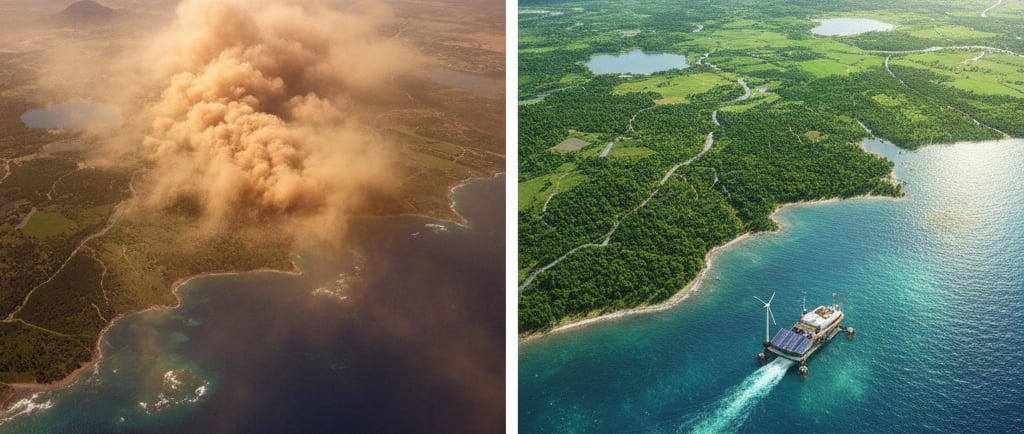
The Sahara, in its current state, is the single largest source of atmospheric mineral dust on Earth. Each year, hundreds of millions of tons of Saharan dust are lifted into the atmosphere by strong winds, forming the Saharan Air Layer, a vast plume of aerosolized particles that travels thousands of kilometers across the Atlantic. This is not inert dust; it is a critical vector for the long-range transport of essential micronutrients.
Our project, by design, will almost completely suppress this dust emission by stabilizing the soil with vegetation. This lecture will analyze the monumental and deeply complex ecological consequences of "shutting off" this global nutrient pump. We will explore how this cessation of dust flux could impact the productivity of the tropical Atlantic's marine food web and the health of the Amazon rainforest, two of the planet's most vital ecosystems. This is a critical examination of a major, unintended negative externality of our terraforming endeavor, and the mitigation strategies we must consider.
The Biogeochemistry of Saharan Dust: A Nutrient Subsidy
To understand the impact of its removal, we must first appreciate the role of Saharan dust as a biogeochemical subsidy.
Composition: Saharan dust is composed of fine mineral particles, rich in clays and oxides. Crucially, it contains elements that are scarce in many marine and terrestrial ecosystems. The most important of these are:
Iron (Fe): An essential micronutrient for all life. It is a key component of enzymes involved in photosynthesis and respiration.
Phosphorus (P): A fundamental macronutrient, a component of DNA, RNA, ATP, and cell membranes. Dust-borne phosphorus can be a significant input, especially to ancient, heavily weathered soils like those of the Amazon.
The Transport Mechanism: The dust originates from specific depressions in the Sahara, such as the Bodélé Depression in Chad, which is a dried-up lakebed rich in diatomite fossils. Strong seasonal winds lift this material high into the troposphere, where it can remain suspended for weeks, transported westward by the prevailing trade winds.
Impact I: The Atlantic Ocean's Pelagic Ecosystem
Vast regions of the open ocean, particularly the tropical Atlantic, are classified as High-Nutrient, Low-Chlorophyll (HNLC) zones. While major nutrients like nitrate may be available, the ecosystem is limited by the scarcity of a single micronutrient: iron.
The "Iron Hypothesis": Postulated by John Martin, this hypothesis states that iron is the primary limiting nutrient for phytoplankton growth in many parts of the ocean. Phytoplankton are the microscopic marine algae that form the base of the entire oceanic food web and are responsible for approximately half of the planet's photosynthesis.
Saharan Dust as a Fertilizer: The deposition of iron-rich Saharan dust onto the surface of the Atlantic is a major natural fertilization event. When this iron dissolves in the surface water, it becomes bioavailable, triggering massive blooms of phytoplankton, particularly nitrogen-fixing cyanobacteria like Trichodesmium.
The Trophic Cascade: These phytoplankton blooms form the base of a productive food web. They are consumed by zooplankton, which are in turn consumed by small fish, and so on, up to the largest marine predators like tuna and whales. The Saharan dust plume is, therefore, directly linked to the biological productivity and fishery health of a vast portion of the tropical and subtropical Atlantic.
The Biological Carbon Pump: Photosynthesis by phytoplankton draws CO2 from the atmosphere into the ocean. When these organisms die, a portion of their organic carbon sinks to the deep ocean, where it can be sequestered for centuries or millennia. This process, known as the "biological carbon pump," is a major component of the global carbon cycle. The iron fertilization from Saharan dust significantly enhances the strength of this pump.
Consequences of "Shutting Off the Pump":
The stabilization of the Saharan soil and the cessation of dust emissions would have immediate and profound consequences for this system.
Reduced Primary Productivity: The lack of iron fertilization would lead to a dramatic decrease in phytoplankton blooms across the tropical Atlantic. The ocean's surface would become clearer, but biologically much less productive.
Fisheries Collapse: The collapse of the phytoplankton base would trigger a negative trophic cascade, leading to a significant reduction in zooplankton populations and, subsequently, a decline in the populations of commercially important fish species that depend on this food web.
Weakened Biological Carbon Pump: A reduction in primary productivity would mean less CO2 is drawn out of the atmosphere by the ocean's biosphere. This would weaken the Atlantic's role as a carbon sink, partially offsetting the gains from the carbon sequestration occurring in the new Saharan forests. This is a critical negative feedback loop that must be accounted for in our global carbon budget.
Impact II: The Amazon Rainforest
The connection between the Sahara and the Amazon is one of the planet's most remarkable teleconnections. The Amazon basin is an ancient, geologically stable landscape. Millions of years of heavy rainfall have intensely weathered its soils, leaching away essential nutrients. The Amazonian ecosystem is, paradoxically, a riot of life growing on some of the most nutrient-poor soils on Earth. It maintains its fertility through an incredibly efficient, tight recycling of nutrients from decaying organic matter. However, this system is not entirely closed; it loses some nutrients, particularly phosphorus, to river runoff.
Saharan Dust as a Phosphorus Source: Saharan dust, which contains phosphorus bound to mineral particles, is transported across the Atlantic and deposited over the Amazon basin. This annual deposition acts as a critical, long-range aerial fertilizer, replenishing the phosphorus that is lost from the ecosystem each year. It has been estimated that the Sahara provides several kilograms of phosphorus per hectare per year, a vital input that helps to sustain the immense productivity of the rainforest.
Consequences of Cessation: The termination of this phosphorus subsidy would have slow but inexorable consequences for the Amazon.
Gradual Decline in Productivity: With the primary external source of phosphorus removed, the Amazonian ecosystem would become increasingly phosphorus-limited. Over decades and centuries, this would likely lead to a gradual decline in Net Primary Productivity, slowing forest growth and potentially altering species composition in favor of plants that are more efficient at scavenging scarce phosphorus.
Reduced Resilience: A nutrient-stressed ecosystem is less resilient to other pressures, such as droughts (which are predicted to increase in the Amazon due to climate change) and deforestation.
Mitigation Strategies: A Geo-engineering Counter-Measure
The negative consequences of shutting off the Saharan dust pump are too significant to ignore. The project's charter must include a proactive mitigation strategy. Since replacing a diffuse, continental-scale dust source is impossible, the strategy must focus on replacing the function of the dust: delivering iron and phosphorus to the target ecosystems. This requires a geo-engineering counter-measure.
Oceanic Fertilization (Iron):
The Strategy: We would need to implement a large-scale, deliberate oceanic iron fertilization program. This would involve a fleet of specialized vessels or autonomous buoys traversing the tropical Atlantic, strategically releasing a solution of iron sulfate (FeSO4) into the iron-limited surface waters.
Technological Challenges: The process must be carefully managed. The iron must be in a bioavailable form and released at the correct depth and rate to trigger a productive phytoplankton bloom without causing an anoxic "dead zone" as the bloom decays. The ecological effects must be meticulously monitored via satellite ocean color imagery and in-situ robotic probes.
Ethical and Governance Issues: Large-scale, intentional ocean fertilization is a form of geo-engineering with its own set of risks and ethical dilemmas. It falls under international legal frameworks like the London Convention/London Protocol, which regulate marine dumping. This mitigation effort would need to be governed by the same International Oversight Council that manages the project's atmospheric impacts.
Amazonian Fertilization (Phosphorus):
The Strategy: Compensating for the lost phosphorus input to the Amazon is even more challenging. The most plausible approach would be a large-scale aerial fertilization program, using a fleet of high-altitude, long-endurance aircraft or airships to disperse a fine, specially formulated phosphatic mineral dust or nutrient solution over the vast Amazon basin.
Ecological Challenges: The formulation must be designed to mimic the slow-release characteristics of natural mineral dust. The delivery must be timed to coincide with the wet season to ensure the nutrients are washed into the ecosystem effectively. The potential for unintended consequences, such as altering the nutrient balance of sensitive aquatic ecosystems within the Amazon, is enormous and requires extensive prior modeling and small-scale testing.
Conclusion: The Interconnectedness of Planetary Systems
This lecture has illuminated one of the most profound and challenging externalities of the Sahara Reforestation Project. Our act of creation in one part of the world—turning a desert green—has the potential to inadvertently cause depletion in two of the planet's other vital organs: the Atlantic's biological pump and the Amazon's nutrient cycle.
This teleconnection via the "great filter" of dust serves as a powerful and humbling lesson in the interconnectedness of the Earth system. It demonstrates that no geo-engineering project, no matter how well-intentioned, can be considered in isolation. The project's success is not just measured by the greening of the Sahara, but by our ability to responsibly manage the global ripples that this transformation will create.
The proposed mitigation strategies—deliberate ocean iron fertilization and aerial phosphatic dusting of the Amazon—are themselves geo-engineering projects of immense scale and complexity, fraught with their own risks and ethical considerations. They underscore a fundamental truth: once we begin to intentionally manage one major component of the Earth system, we may find ourselves inescapably committed to managing the others that are linked to it. The stewardship of the new Sahara is, in fact, the stewardship of a newly re-wired planetary network.
Our next lectures will continue to explore these complex, long-term feedback loops and the societal structures needed to manage them. Thank you.