Add your promotional text...
Lecture 35: The Animal Microbiome: Adapting Livestock to Saharan Forage
Series: The Sahara Reforestation Project: From Dune Sea to Green Valley Part IV: Advanced Bioscience and Geopolitics
5/18/20266 min read
Introduction: The Holobiont in the New Savanna
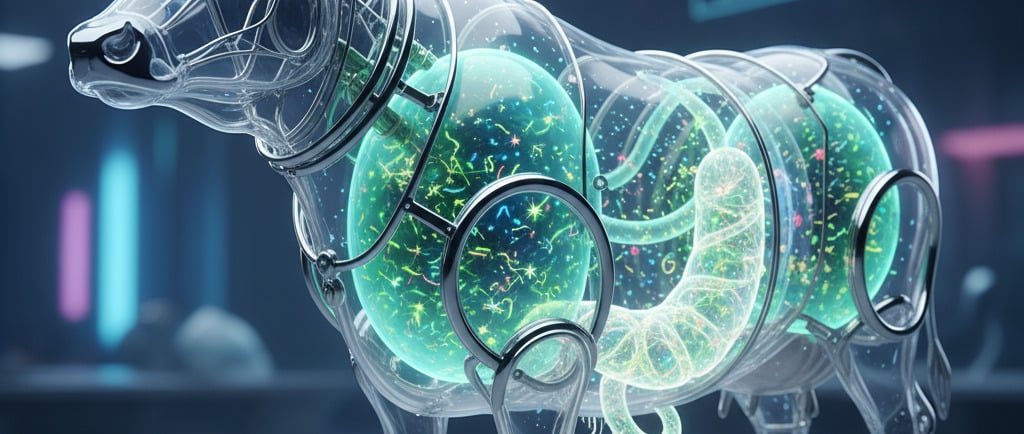
Welcome. In our discussions of reintroducing animal life to the Sahara, we have focused on the macroscopic organism—the genetics of the Oryx, the grazing patterns of cattle, the protein conversion of insects. However, to view an animal, particularly a herbivore, as a standalone entity is to fundamentally misunderstand its biology. Every animal is a "holobiont," a complex ecological unit composed of the host organism and its vast, symbiotic microbial communities. The most critical and metabolically active of these communities is the gut microbiome.
This is especially true for ruminant and hindgut-fermenting herbivores, the very animals we will rely upon for managing our new savanna ecosystems and for providing a source of livestock protein. Their ability to survive and thrive is not solely a function of their own genetics, but of the capabilities of the trillions of microbes residing in their digestive tracts. These microbes are the true engines of digestion, breaking down tough plant fibers that the animal's own enzymes cannot.
This lecture will delve into the science of the animal microbiome as a critical frontier for adaptation in the Sahara Reforestation Project. We will explore how the gut microbiomes of our reintroduced livestock must be specifically adapted, or even engineered, to efficiently digest the unique, often chemically-defended, forage of the new Saharan flora. Our focus will be on the use of microbiome analysis, fecal microbiota transplants, and synthetic probiotics to accelerate the adaptation of our livestock, ensuring their health, productivity, and harmonious integration into the nascent ecosystem.
The Challenge: The Indigestible Landscape
The plants we have selected to pioneer the Sahara are, by necessity, tough. They are survivors, and their survival strategies often involve the production of complex, difficult-to-digest structural materials and chemical defenses.
Lignocellulose: Arid-adapted grasses and shrubs often have a high content of lignin and cellulose. Lignin is a complex polymer that provides structural rigidity but is almost entirely indigestible to most animals. Cellulose is a polysaccharide that can only be broken down by specific microbial enzymes (cellulases) that vertebrates do not produce.
Secondary Metabolites: To deter herbivory, many desert plants produce a cocktail of "secondary metabolites." These can include tannins, which bind to proteins and make them indigestible; alkaloids, which can be toxic; and various phenolic compounds.
Nutrient Scarcity: The forage may also be low in easily accessible protein and high in fiber, demanding a highly efficient digestive system to extract sufficient nutrition.
A domestic cow or sheep transplanted from a lush European pasture would struggle to survive on such a diet. Its gut microbiome is simply not equipped with the right microbial toolkit to handle this type of forage. Therefore, we cannot simply introduce the animal; we must co-manage its microbiome.
The Ruminant Gut: A Natural Bioreactor
To understand our intervention, we must first appreciate the biological system we are targeting. Ruminants, such as cattle, sheep, and goats (and our reintroduced Oryx and Addax), possess a complex, multi-chambered stomach, with the rumen being the most important.
The Rumen Ecosystem: The rumen is a large, anaerobic fermentation vat, teeming with a dense and diverse community of bacteria, archaea, protozoa, and fungi. When the animal eats, the plant matter enters the rumen.
Microbial Fermentation: Here, the microbes go to work. Anaerobic bacteria ferment the cellulose into volatile fatty acids (VFAs), such as acetate, propionate, and butyrate. These VFAs are absorbed through the rumen wall and serve as the animal's primary source of energy—up to 70% of its total energy supply.
Microbial Protein: The microbes themselves reproduce rapidly. They are then washed out of the rumen into the rest of the digestive tract, where they are digested by the animal. This "microbial protein" is the main source of amino acids for the host.
The animal, in effect, does not digest the grass; it farms microbes, and then digests the microbes and their waste products. The entire system's efficiency is dictated by the composition and function of this internal microbial community.
Strategy I: Bioprospecting the Adapted Microbiome
Our first step is to identify the optimal microbial toolkit. We will not invent it; we will find it in animals that have already spent millennia adapting to these exact challenges.
The Source Organisms: We will engage in "microbiome bioprospecting" by sampling the gut microbiota of the most resilient native and feral herbivores of the North African and Arabian deserts. This includes:
Camels (Dromedaries): The undisputed masters of desert survival. Their gut microbiome is known to be exceptionally efficient at water absorption and the digestion of extremely fibrous, thorny, and saline plants.
Native Goats and Sheep: Hardy local breeds that have been selected for generations to survive on sparse, tough forage.
Wild Herbivores: Remnant populations of Addax, Dorcas gazelles, and other wild ungulates.
The Technology (Metagenomics): We will use deep metagenomic sequencing to analyze the collected samples. This technique allows us to sequence all the DNA in the community without needing to culture the individual microbes (many of which are unculturable). This provides us with a complete "parts list" of the adapted microbiome:
Taxonomic Profile: Which species of bacteria, archaea, and fungi are present?
Functional Profile: More importantly, what genes do they possess? We will create a comprehensive catalog of genes for cellulases, lignin-degrading enzymes, and pathways for detoxifying specific plant secondary metabolites like tannins.
This genomic database becomes our blueprint for an "elite" desert herbivore microbiome.
Strategy II: Microbiome Transplantation and Seeding
Once we have identified the key players and functions of an adapted microbiome, we need to transfer this capability to our new livestock populations.
Fecal Microbiota Transplant (FMT): This is the most direct and powerful method.
The Process: Fecal matter from healthy, adapted donor animals (e.g., camels) is collected, processed to create a microbial slurry, and then introduced into the rumen of the recipient animal (e.g., a calf from our high-yield cattle breeding program). This process, known as transfaunation, effectively "seeds" the recipient's gut with a complete, pre-adapted microbial ecosystem.
Application: All young livestock born into the Sahara project would receive a standardized FMT inoculation early in life to ensure they establish the optimal gut community for the local forage.
Maternal Seeding: We can also leverage natural transmission. Ensuring that young animals are raised with and have contact with well-adapted adult animals facilitates the natural transfer of the microbiome.
Strategy III: Synthetic Probiotics and Custom Consortia
While FMT is effective, it is a "black box" approach—we are transferring the entire community. Synthetic biology (as discussed in Lecture 31) allows for a more precise, engineered approach.
Defined Microbial Consortia: From our metagenomic database, we can identify a "minimum viable ecosystem"—a small collection of 10-20 key microbial species that perform the most critical functions (e.g., a hyper-efficient cellulase producer, a tannin-detoxifying specialist, a VFA-optimizing fermenter). These specific species can then be cultured in the lab and combined to create a defined, high-performance probiotic "starter culture."
Engineered Probiotics: We can go a step further and use synthetic biology to enhance the capabilities of a single, robust probiotic bacterium (e.g., a specific strain of Lactobacillus or Bacillus that is easy to grow and administer). We could engineer this bacterium to:
Express a particularly powerful cellulase gene discovered in a rare, unculturable microbe.
Produce enzymes that neutralize specific plant toxins found in the Saharan flora.
Synthesize essential amino acids that might be lacking in the forage.
These synthetic probiotics could be administered as a feed supplement, continuously reinforcing and optimizing the function of the animal's gut microbiome.
Monitoring and Management: The Gut as a Sensor
The animal's gut is not just a target for intervention; it is also a powerful indicator of ecosystem health.
Real-Time Monitoring: We can develop non-invasive sensors (e.g., in animal collars or water troughs) that can detect changes in the volatile compounds in an animal's breath or the metabolites in its urine. These signals can be used as real-time proxies for the metabolic state of the rumen, providing an early warning of digestive stress or a shift in forage quality.
Feedback to Landscape Management: This data would be fed back into the AI-powered ecosystem management system. For example, if the monitoring system detects signs of digestive stress across a herd, it might indicate that the forage in their current virtual paddock is declining in quality. The AI could then prioritize rotating the herd to a fresh paddock with more nutritious vegetation.
Conclusion: The Holobiont as the Unit of Adaptation
This lecture has reframed our approach to introducing livestock into the new Sahara. We have moved beyond viewing the animal as an isolated genetic entity and have embraced the concept of the holobiont—the animal plus its microbiome—as the true unit of selection and adaptation.
The forage of the new Sahara is a unique and challenging resource. To unlock its full nutritional potential, we must ensure that our livestock are equipped with an equally specialized microbial toolkit. Through a strategy of bioprospecting the microbiomes of desert-adapted natives, seeding our new herds via microbiota transplants, and augmenting their function with precision-engineered synthetic probiotics, we can dramatically accelerate their adaptation.
This focus on the microbiome is a cornerstone of sustainable livestock production in our engineered ecosystem. It reduces the need for high-input supplementary feeds, improves the health and welfare of the animals, and ensures that the energy and nutrients captured by our resilient flora are efficiently transferred up the food chain. The management of the unseen world within the gut is as critical as the management of the visible world of the savanna.
Our next lectures will continue to explore the advanced biological and ethical frontiers of this new world. Thank you.