Add your promotional text...
Lecture 37: The Energy-Water-Food Nexus in the New Sahara
Series: The Sahara Reforestation Project: From Dune Sea to Green Valley Part IV: Advanced Bioscience and Geopolitics
5/22/20266 min read
Introduction: The Trilemma of Sustainability
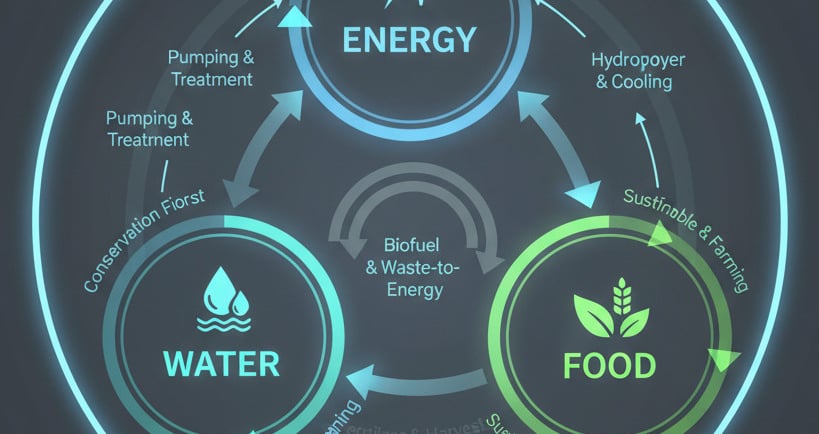
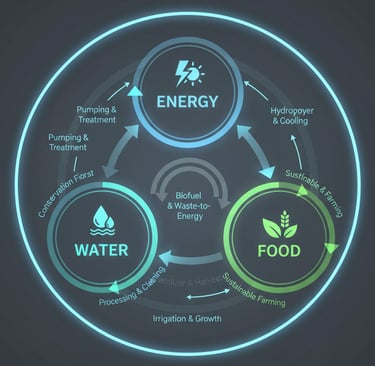
Welcome. Throughout this series, we have dissected the Sahara Reforestation Project by examining its individual components in great detail. We have discussed the engineering of water production, the biology of soil creation, the design of agricultural systems, and the establishment of energy infrastructure. While this modular approach is necessary for analytical clarity, it risks obscuring a fundamental truth: these systems do not operate in isolation. They are profoundly and inextricably interconnected. The production of water requires immense energy; the production of food requires immense water; and the production of bio-energy is derived from the agricultural system.
This intricate web of interdependencies is known as the Energy-Water-Food (EWF) Nexus. Understanding and managing this nexus is the ultimate challenge of systems-level engineering and governance for our project. A failure in one domain will inevitably cascade into the others, while an optimization in one can create synergistic benefits across the entire system.
This lecture will provide a systems-level analysis of the EWF nexus as it is uniquely constituted in our terraformed Sahara. We will move beyond the individual components to model the flows of energy and resources between them. Our goal is to conceptualize the entire project not as a collection of separate infrastructures, but as a single, integrated, continent-scale industrial and ecological metabolism, and to explore the strategies required to ensure its long-term resilience and stability.
Defining the Components of the Saharan EWF Nexus
Let's first define the three core nodes of our nexus and their primary relationships:
The Energy System:
Primary Inputs: Solar insolation.
Primary Technologies: Concentrating Solar Power (CSP) with thermal storage, large-scale Photovoltaics (PV), and supplemental bio-energy from anaerobic digesters.
Primary Outputs: Electricity (for pumps, lighting, cities) and high/low-grade heat (for desalination and industrial processes).
The Water System:
Primary Inputs: Seawater, fossil aquifer water, recycled wastewater, atmospheric water vapor.
Primary Technologies: Reverse Osmosis (RO), Multi-Stage Flash (MSF), the continental water grid (pipelines, canals), wastewater treatment plants, and Atmospheric Water Generators (AWG).
Primary Outputs: Freshwater for agriculture, industry, and domestic use.
The Food (and Biomass) System:
Primary Inputs: Freshwater, nutrients, CO2, solar energy.
Primary Technologies: Agroforestry systems, Controlled Environment Agriculture (CEA) modules, aquaculture, and forestry.
Primary Outputs: Food, animal fodder, timber, and lignocellulosic biomass for bio-energy and biomaterials.
Analyzing the Interlinkages: A Flow of Dependencies
The critical insights of nexus thinking come from mapping the flows between these nodes.
Energy for Water: This is the most significant and demanding linkage in our system.
Desalination: As established in Lecture 2, the production of 100 billion cubic meters of water via SWRO requires ~350 TWh of electricity annually.
Water Transport: The continental water grid, with its thousands of kilometers of pipelines and numerous high-lift pumping stations, represents another massive energy consumer, potentially rivaling desalination in its demands.
Treatment and Recycling: All wastewater treatment and recycling processes also require a continuous energy supply.
Implication: The viability of the Water System is entirely dependent on the massive, continuous, and reliable output of the Energy System.
Water for Energy: While less direct than the reverse, this linkage is still critical.
CSP Operation: Concentrating Solar Power plants require water for their steam cycle (Rankine cycle) and, most significantly, for cooling the condensers. In an arid environment, this water must be sourced from the desalination grid. Advanced dry-cooling technologies can reduce but not eliminate this demand.
Panel Cleaning: The efficiency of both PV and CSP mirrors is dramatically reduced by dust accumulation. Regular, automated cleaning with purified water is essential.
Biomass Production: The bio-energy component of the Energy System is entirely dependent on the water supplied to the agricultural and forestry systems to grow the feedstock.
Implication: The efficiency and reliability of the Energy System are, in part, dependent on a stable supply of water from the Water System.
Water for Food: This is the most intuitive linkage.
Irrigation: The entire agricultural and forestry output of the project is predicated on the delivery of precisely managed irrigation water. Food production is directly proportional to water availability.
Aquaculture: The filling and maintenance of lakes and aquaculture ponds require vast initial and ongoing water inputs.
Food Processing: Cleaning, processing, and packaging of food products all require significant water inputs.
Implication: Food security in the new Sahara is a direct function of the Water System's performance.
Food/Biomass for Energy: This represents a critical feedback loop for energy diversification.
Bio-gas: Organic waste from cities and farms is fed into anaerobic digesters, producing methane. This biogas provides a dispatchable energy source, crucial for balancing the grid when solar is unavailable (e.g., during extended dust storms).
Biofuels/Syngas: Dedicated energy crops or forestry waste can be used in pyrolysis reactors or gasifiers to produce liquid biofuels or syngas, further contributing to energy security and providing feedstock for chemical synthesis.
Implication: The Food/Biomass system provides a vital energy storage and diversification service to the Energy System, enhancing its resilience.
Energy for Food: Modern, high-tech agriculture is energy-intensive.
Fertilizer Production: The synthesis of nitrogen fertilizers (via the Haber-Bosch process), if required to supplement biological fixation, is an extremely energy-intensive process.
Mechanization: The autonomous tractors, planters, harvesters, and drones that manage the agroforestry systems are all electric and require a constant power supply.
CEA Modules: The enclosed farms, with their advanced lighting, climate control, and water pumping systems, are major localized energy consumers.
Implication: Agricultural productivity is directly dependent on the reliability and affordability of the energy supplied by the Energy System.
Nexus Management: The Role of the AI Core
Managing these complex, interconnected flows in real-time is far beyond human capacity. This is the ultimate role of the AI Core, housed at the Saharan Agricultural University. The AI does not manage three separate systems; it manages a single, unified EWF nexus model.
Integrated Optimization: The AI's primary function is multi-objective optimization. It doesn't just seek to minimize water use; it seeks to optimize the overall nexus. For example:
It might schedule energy-intensive desalination and pumping to coincide with periods of excess solar generation.
If it predicts a heatwave (increasing water demand for crops and energy demand for cooling), it might preemptively draw down reservoir levels and charge thermal storage in the CSP plants.
If a partial failure occurs in the solar grid, it might re-route power, temporarily reduce water allocation to lower-priority forestry zones, and increase biogas production to cover the shortfall.
Price Signal Simulation: The AI would operate an internal "market" for energy and water. The "price" of water in a given region would dynamically change based on the energy cost to produce and deliver it. This allows for true cost-benefit analysis of different agricultural activities and incentivizes the most efficient use of resources across the entire system.
Vulnerability Analysis and Resilience Planning: The AI continuously runs simulations on the nexus model to identify single points of failure and cascading failure risks. For example, "What is the system-wide impact of a 7-day failure of Desalination Plant Complex Alpha?" The results of these simulations inform the strategic planning of redundancies, such as building extra pipeline interconnectors or sizing biogas storage facilities.
Synergies and Trade-offs within the Nexus
By viewing the project through the lens of the EWF nexus, we can more clearly identify both powerful synergies and difficult trade-offs.
Key Synergy: The Floatovoltaic Canal: Covering the main water transport canals with floating solar panels is a perfect example of a nexus-positive intervention. It simultaneously:
Reduces Water Loss: By shading the canal, it lowers evaporation (benefit to Water System).
Generates Energy: Produces electricity right where it's needed to power pumps (benefit to Energy System).
Improves Water Quality: By reducing sunlight, it can limit algal blooms in the canals (benefit to Water System).
Key Trade-off: Bio-energy vs. Food vs. Carbon Sequestration: The allocation of biomass presents a fundamental trade-off. Should a hectare of land be used to grow a food crop, an energy crop (for biofuel), or a long-lived tree (for carbon sequestration)? The answer will vary in space and time and will be a key strategic decision for the Saharan Authority, guided by the AI's optimization models based on global food prices, energy needs, and the price of carbon credits.
Conclusion: A Blueprint for Industrial Ecology
The Energy-Water-Food nexus is the conceptual framework that elevates the Sahara Reforestation Project from a collection of impressive but disparate engineering feats into a coherent, functioning system of industrial and ecological metabolism. It forces us to recognize that there is no "cheap" water without abundant clean energy, and no sustainable food production without intelligent management of both.
The successful management of this nexus is the ultimate test of our ability to design a sustainable civilization. The AI core, acting as the central governor, allows for the real-time optimization of these complex interdependencies, ensuring that the system as a whole operates with maximum efficiency and resilience.
By designing the project with the EWF nexus as a core organizing principle from its inception, we are creating more than just a green desert. We are creating a living blueprint for a circular, sustainable, and technologically advanced society, a model where the outputs of one system become the vital inputs of another, with the sun as the ultimate and inexhaustible power source.
Our next lectures will continue to build upon this systems-level view, exploring the societal and cultural fabrics that will be woven into this new, engineered world. Thank you.