Add your promotional text...
Lecture 39: The Aesthetics of a Designed Ecosystem
Series: The Sahara Reforestation Project: From Dune Sea to Green Valley Part IV: Advanced Bioscience and Geopolitics
5/27/20266 min read
Introduction: The Unspoken Dimension
Welcome. For the entirety of this series, our discourse has been one of rigorous functionality. We have approached the Sahara Reforestation Project as a grand problem of engineering, biology, and logistics. Our vocabulary has been one of efficiency, productivity, resilience, and sustainability. We have designed a planetary-scale machine for living. But in focusing so intently on the function of this new world, we have neglected a dimension that is equally critical to its long-term success and to the well-being of its human inhabitants: its aesthetics.
Is the new Sahara beautiful? Is it inspiring? Does it possess a "spirit of place," a genius loci? These are not trivial, decorative questions. They are fundamental to the human experience. An ecosystem that is merely productive but fails to inspire awe, wonder, and a deep sense of belonging is an incomplete creation.
This lecture will address the deliberate integration of landscape architecture and ecological aesthetics into the design of our new Saharan biosphere. We will move beyond a purely functionalist perspective to explore how we can consciously design a landscape that is not only scientifically sound but also profoundly beautiful, meaningful, and experientially rich. We will discuss the principles of designing for aesthetic experience, the creation of cultural landmarks within the new nature, and the ultimate goal of fostering a deep, emotional connection between the new Saharan people and their unique, engineered world.
The Rationale for Ecological Aesthetics: Beyond Utilitarianism
Why should a project of such immense practical challenge concern itself with beauty? The rationale is grounded in both psychology and long-term ecological stewardship.
The Biophilia Hypothesis: As proposed by E.O. Wilson, the biophilia hypothesis suggests that humans have an innate, genetically-determined tendency to focus on and affiliate with nature and other life forms. A landscape that satisfies this deep-seated need—one that is rich in prospect, refuge, mystery, and complexity—is one that will promote human psychological well-being, reduce stress, and foster creativity.
Fostering a Stewardship Ethic: People will not fight to protect that which they do not love. A purely utilitarian, monotonous landscape of perfectly spaced agricultural trees and sterile canals is unlikely to inspire a deep cultural or emotional bond. A beautiful, varied, and awe-inspiring landscape, however, can foster a powerful sense of identity and place, which in turn becomes the foundation for a multi-generational stewardship ethic. To ensure the long-term care of this new world, its inhabitants must feel that it is not just a resource, but their sacred home.
Economic Value: As discussed in our lecture on economic viability, aesthetics have a direct economic corollary. A unique and beautiful landscape is the basis for a thriving eco-tourism industry, attracting visitors and generating revenue that supports the project's conservation goals.
Principles of Landscape Design on a Continental Scale
The field of landscape architecture provides a set of principles that can be scaled up from a garden or a park to an entire continent. For the Sahara, these principles must be integrated with the functional demands of the ecosystem.
Legibility and "Imageability": Drawing on the work of urban planner Kevin Lynch, the landscape should be "legible"—it should have a clear, understandable structure. We will deliberately design distinct regions, memorable landmarks, and clear pathways. The great reactivated river corridors will serve as the primary "paths." The new lakes and mountain forests will be major "districts." Unique geological formations or massive bio-architectural structures will serve as "landmarks." This creates a mentally navigable and coherent world.
Prospect and Refuge: This is a fundamental concept in landscape aesthetics, rooted in our evolutionary history. The landscape should offer a balance of "prospect" (wide, open views from a safe vantage point, like the edge of a plateau overlooking a new savanna) and "refuge" (small, enclosed, protected spaces, like a dense grove of trees or a secluded river bend). We will design for these experiences, creating scenic overlooks and intimate, enclosed natural spaces.
Complexity and Mystery: A successful landscape is one that invites exploration and reveals itself slowly. We will avoid vast, uniform monocultures in favor of a complex mosaic of ecosystems. The layout of forests and grasslands will be designed to create a sense of mystery, with winding paths and views that are partially obscured, encouraging movement and discovery.
The Aesthetic Toolkit: Weaving Artistry with Ecology
Our engineering and biological tools are also our aesthetic tools. The artistry lies in how we deploy them.
The Art of Water: Water is the most powerful aesthetic element.
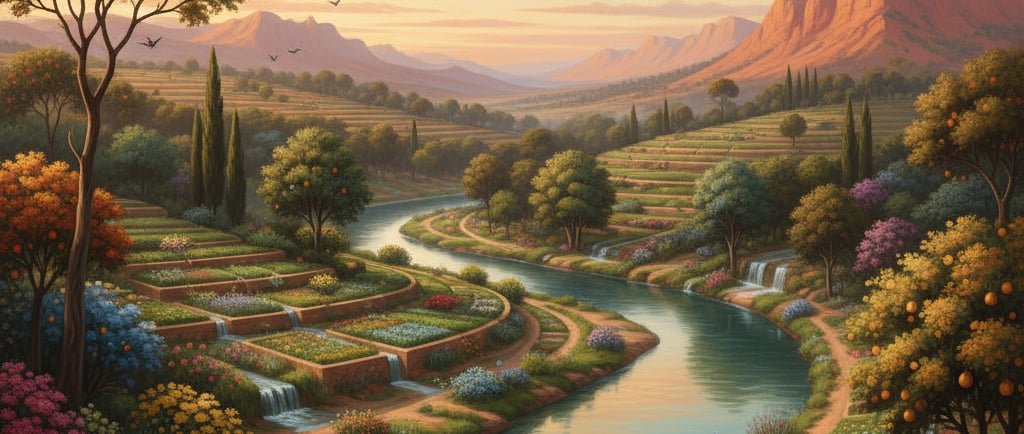
Channel Design: Our engineered river channels will not be utilitarian concrete ditches. Their meandering patterns, pool-riffle sequences, and rocky grade-control structures will be designed to mimic the aesthetic qualities of natural, beautiful rivers, creating the sight and sound of living water.
Lake Shores: The shorelines of our new lakes will not be simple, uniform rings. They will be sculpted with bays, peninsulas, and islands, creating a complex and visually interesting interface between land and water. The placement of wetlands and reed beds will be designed for both ecological function and visual texture.
Fountains and Cascades: In the new urban centers, water features will be a central design element, providing evaporative cooling, the psychological comfort of the sound of water, and a tangible connection to the vast hydrological system that sustains the city.
The Palette of the Flora: Our choice of plants is an act of painting on a continental canvas.
Color and Texture: Beyond their functional traits, we will select species for their aesthetic qualities. The planting schemes will be designed to create visual interest through the year, using trees with striking bark, shrubs with colorful flowers, and grasses that turn golden in the dry season. We will deliberately create contrasts in texture, from the fine, feathery leaves of an Acacia to the broad, architectural fronds of a palm.
The "Sakura" Effect: We can engineer specific corridors or groves to be planted with a dominant, spectacularly flowering species (like a drought-adapted version of a Bauhinia or Tabebuia). This would create an annual blossoming event, a cultural festival, and a landmark of continental significance, akin to the cherry blossoms of Japan.
Sculpting with Landforms:
Terracing: In the montane regions (Hoggar, Tibesti), the necessary agricultural terracing will be designed with an aesthetic sensibility, following the contours of the land to create beautiful, flowing patterns, reminiscent of ancient rice paddies.
Framing Views: The alignment of forest edges and agricultural alleys will be designed to frame and enhance views of significant natural landforms, such as mountain peaks or unique geological formations.
Creating Cultural and Aesthetic Landmarks
A landscape becomes a "place" when it is imbued with human meaning. We will deliberately create focal points that are both ecologically functional and culturally significant.
The Great Observatories: Atop high plateaus with clear skies, we will build astronomical observatories. These will be centers of science, but also places of pilgrimage and wonder, connecting the new Saharan culture to the cosmos. The surrounding landscape will be designed to feel pristine and elemental.
The Cathedral Groves: In specific locations, we will plant and manage groves of the most massive and long-lived trees (like the Baobab). These groves, allowed to mature over centuries, will become natural cathedrals, sacred spaces for contemplation and connection to the deep time of the ecosystem.
The Paleolake Memorials: At the sites of major paleolake sediment core drilling—the places where we recovered the genetic memory of the Green Sahara—we will create educational and memorial sites. These would be centers for the Saharan Agricultural University, but also public parks that tell the story of the land's deep history.
Land Art: A project of this scale invites an art form of equal scale. We would commission international and local artists to create massive works of "land art," using the earth, rocks, and even vegetation itself as their medium, creating a permanent outdoor gallery across the continent.
Conclusion: The Synthesis of Science and Art
The aesthetics of our designed ecosystem are not a superficial gloss applied after the functional work is done. They are an integral part of the design process from the very beginning. The decision to make a river meander is both a geomorphological necessity and an aesthetic choice. The decision to plant a diverse, multi-layered forest is both an ecological imperative and an act of creating visual complexity and beauty.
By consciously applying the principles of landscape architecture and ecological aesthetics, we ensure that we are building more than just a large farm. We are creating a home. We are designing a landscape that is not only productive and resilient, but one that is also capable of inspiring a profound sense of wonder, fostering a deep cultural identity, and nurturing the human spirit.
The ultimate success of the Sahara Reforestation Project will be measured not only in tons of carbon sequestered or bushels of grain harvested, but in the moment a child born in a new Saharan city looks out over a savanna filled with Oryx, towards a river shimmering in the distance, under a sky filled with clouds we helped to create, and feels an unshakeable sense of awe and belonging. At that moment, science and art will have achieved their perfect synthesis.
Our next lectures will continue to explore the societal, legal, and long-term implications of this new world. Thank you.