Add your promotional text...
Lecture 4: The Water Grid: A Continental Plumbing System
Series: The Sahara Reforestation Project: From Dune Sea to Green Valley Part I: The Foundation - Analysis and Initial Interventions
3/6/20266 min read

Introduction: The Arteries of a New Sahara
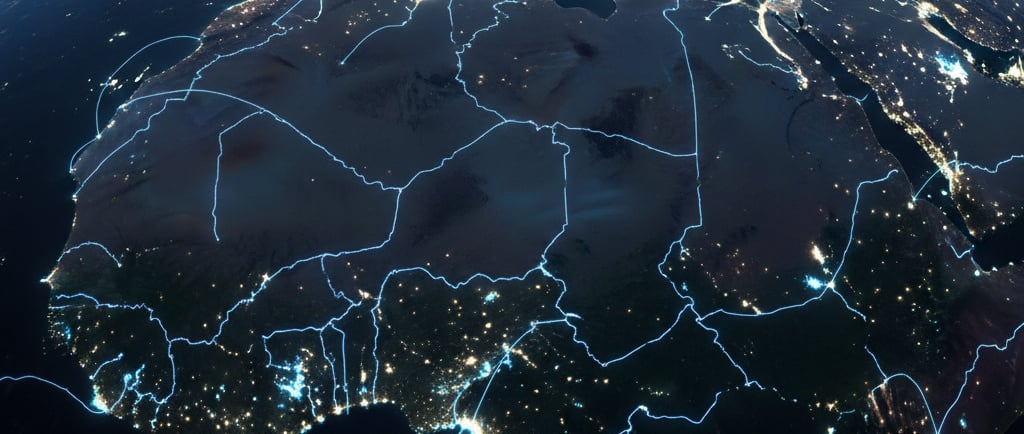
Welcome. In our preceding lectures, we have established the theoretical foundations for a water supply capable of sustaining a continental-scale transformation of the Sahara. We have explored the production of new water via mega-scale coastal desalination and the extraction of ancient water from the vast fossil aquifers beneath the desert. These two strategies provide the requisite volume, but a source of water is inert without a means of conveyance. The water generated on the coasts of the Mediterranean and extracted from the deep south must be transported thousands of kilometers inland to the designated reforestation and agricultural zones. This requires the construction of a circulatory system for a nascent ecosystem—a continental plumbing system.
This lecture will detail the colossal engineering project of creating the Saharan Water Grid. We will move from the theoretical physics of fluid dynamics to the practical engineering of pipelines, canals, and pumping stations on an unprecedented scale. We will analyze the material science challenges, the immense energy costs associated with overcoming friction and elevation, and the strategic design of a resilient, intelligent network. This grid is not merely a collection of pipes; it is the vascular system that will carry the lifeblood of this entire terraforming endeavor.
The Physics of Large-Scale Water Transport: Overcoming Gravity and Friction
Transporting water over vast distances is fundamentally a battle against two physical forces: gravity and friction. The total energy required to move a fluid is quantified by the Bernoulli equation, which, for our purposes, is dominated by the concepts of "static head" and "head loss."
Static Head: This represents the energy required to lift the water against gravity. It is the difference in elevation between the source (e.g., a coastal desalination plant at sea level) and the destination. Large portions of the Sahara, such as the Hoggar and Tibesti Mountains, rise to elevations of over 2,000-3,000 meters. Lifting billions of cubic meters of water to these heights represents an enormous potential energy requirement. The power needed is a direct function of the mass flow rate, the acceleration due to gravity, and the change in height.
Head Loss due to Friction: As water flows through a pipe or canal, it experiences frictional drag against the conduit's surfaces. This friction results in a continuous loss of pressure (head loss) along the length of the conduit. This head loss is a function of several variables, described by the Darcy-Weisbach equation: the length and diameter of the pipe, the velocity of the water, and the friction factor of the pipe's interior surface. For a continental-scale grid with thousands of kilometers of pipelines, the cumulative head loss due to friction is a dominant factor, arguably greater than the static head for many transport routes.
To overcome both static head and head loss, energy must be continuously added to the system via pumping stations. The primary engineering challenge of the Water Grid is to design a system that minimizes this total energy requirement through a strategic combination of conduit design, routing, and operational management.
Component I: The Arterial Pipelines
The primary arteries of the Water Grid will be a network of large-diameter pipelines, the most efficient method for transporting massive volumes of water under high pressure over long distances with minimal evaporative loss.
Material Science: The choice of pipe material is critical for a project with a multi-century lifespan.
Pre-stressed Concrete Cylinder Pipe (PCCP): Used in Libya's Great Man-Made River, PCCP is robust and can be manufactured in-situ to very large diameters (e.g., 4 meters). It is a proven technology for this scale.
Steel Pipe: Offers high strength but is susceptible to corrosion, requiring extensive interior and exterior coatings (e.g., fusion-bonded epoxy, cement-mortar lining) and cathodic protection systems.
Glass-Reinforced Plastic (GRP) / Composites: Lighter than concrete or steel, highly resistant to corrosion, and with a very smooth interior surface (low friction factor), which reduces pumping costs over the pipeline's life. Advances in composite manufacturing would likely make this a leading candidate.
Diameter and Flow Velocity: There is a critical trade-off between pipe diameter and energy consumption. For a given flow rate, a larger diameter pipe results in lower water velocity. Since head loss is proportional to the square of the velocity, doubling the pipe diameter can reduce frictional head loss by a factor of approximately 32. However, larger pipes have exponentially higher material and construction costs. The design of the arterial grid will involve a complex economic optimization, balancing the upfront capital cost of larger pipes against the long-term operational cost of electricity for pumping. Diameters for the main arterial lines would likely be in the range of 4 to 8 meters.
Pumping Stations: To overcome head loss and changes in elevation, a series of in-line pumping stations would be required, perhaps every 100-200 kilometers along a flat route. These would be massive installations, each consuming hundreds of megawatts of power. They would be powered by dedicated solar PV or CSP plants, or by a new trans-Saharan high-voltage power grid built in parallel with the water grid. The pumps themselves would be multi-stage centrifugal pumps, engineered for extreme reliability and efficiency.
Component II: Open-Air Canals and Engineered Rivers
For distributing water within a designated green zone (where local humidity will be higher) or for moving truly colossal volumes across relatively flat terrain, open-air canals present a lower-cost alternative to pipelines.
Design and Construction: These would not be simple ditches. To minimize water loss through seepage, the canals would need to be lined with impermeable materials, such as geomembranes, compacted clay liners, or concrete. Their trapezoidal cross-section would be optimized to balance flow capacity with the wetted perimeter to reduce friction.
The Evaporation Challenge: The primary drawback of open canals in an arid environment is water loss due to evaporation. While this loss would be significant initially, the strategy is that the canals themselves, along with the vegetation they support, will create a cooler, more humid microclimate along their corridor, gradually reducing the local evaporation rate. In the early phases, canals might be covered with modular floating solar panels ("floatovoltaics"), which would serve the dual purpose of generating power and significantly reducing evaporation by shading the water surface.
Ecological Function: Over time, these canals would be engineered to evolve into living rivers. The establishment of riparian vegetation along their banks would stabilize the soil, further reduce evaporation through shading, and create vital ecological corridors, forming the backbone of the new Saharan ecosystem. Flow rates would be managed to mimic natural seasonal variations, supporting a diverse aquatic and terrestrial biology.
Component III: The Energy Infrastructure
The energy requirement for the Water Grid is as monumental as the water volume itself. Lifting and pushing 100 billion cubic meters of water per year across a continent is a task that would consume a significant fraction of the entire project's energy budget.
Distributed Solar Power: Each major pumping station along the pipeline routes would be co-located with its own dedicated utility-scale solar power plant, likely a combination of PV for daytime operation and CSP with thermal storage for 24/7 reliability. This distributed energy model avoids the transmission losses of a centralized power source.
Gravity as a Power Source: The grid would be intelligently routed to leverage gravity wherever possible. Water pumped to a high-elevation reservoir can then flow downhill for hundreds of kilometers, potentially passing through turbines at "pressure-reducing stations" to regenerate a portion of the electricity consumed in the initial lift. This "pumped-hydro storage" concept, on a continental scale, would be a key element of the grid's energy management.
Smart Grid Operation: The entire network of pipelines, canals, pumps, valves, and reservoirs would be controlled by a sophisticated AI-powered Supervisory Control and Data Acquisition (SCADA) system. This "smart water grid" would use real-time data from thousands of sensors (flow meters, pressure sensors, soil moisture probes) and predictive weather models to optimize its operation. It would schedule pumping to coincide with peak solar energy production, pre-emptively fill reservoirs ahead of demand spikes, and automatically detect and isolate leaks, ensuring maximum efficiency and resilience.
Strategic Routing and Network Design
The layout of the Water Grid would not be a simple hub-and-spoke model. It would be a resilient, interconnected network, designed with redundancy to withstand potential failures or maintenance shutdowns.
Primary Arterial Corridors: Two main axes would form the backbone. An East-West corridor running parallel to the Mediterranean coast, fed by multiple desalination plants. A North-South corridor, originating from the coastal grid and the Nubian Aquifer wellfields, pushing deep into the interior towards the Sahel.
Regional Distribution Networks: From these main arteries, smaller-diameter pipelines and canals would branch off to supply specific agricultural zones, reforestation areas, and new urban centers.
Terminal Reservoirs: Each distribution network would terminate in large, strategically located reservoirs. These would likely be created in natural depressions or canyons (if available) or constructed as massive, lined, off-stream reservoirs. These reservoirs serve as critical buffers, ensuring a continuous water supply even if there are temporary interruptions in the main arterial flow, and they would become the nuclei of new, large-scale lake ecosystems.
Conclusion: An Unprecedented Feat of Geo-engineering
The Saharan Water Grid represents an engineering challenge on a scale that is difficult to overstate. It requires the construction of a pipeline and canal network that would dwarf all existing systems combined, powered by a renewable energy infrastructure equivalent to that of a major industrialized nation. The capital investment would be measured in the trillions of dollars, and the construction timeline would span decades, if not a century.
However, the scientific and engineering principles are sound. The physics of fluid dynamics, the material science of modern composites, the efficiency of solar power, and the intelligence of AI-powered control systems provide us with the necessary toolkit. While the scale is daunting, the concept is not science fiction.
With this lecture, we have now connected our water sources to the areas of demand. We have established the arteries through which the desert will receive its lifeblood. The stage is now set for the first true biological intervention on a grand scale. Our next lecture, "Soil Creation I: The Microbial Beachhead," will detail the process of transforming the sterile Saharan sand, now irrigated by this grid, into a living soil, marking the true beginning of the greening process. Thank you.