Add your promotional text...
Lecture 42: The Ecology of Saharan Wetlands II - Freshwater Oases and Riparian Zones
Series: The Sahara Reforestation Project: From Dune Sea to Green Valley Part V: Mature Ecosystems and Global Interconnections
6/3/20266 min read
Introduction: Corridors and Islands of Freshwater Life
Welcome. In our previous lecture, we explored the transformation of the Sahara's saline depressions into productive, hypersaline wetlands. Today, we turn our attention to the complementary and equally vital freshwater ecosystems that will form the backbone of the new Saharan biosphere. While the saline wetlands are vast, isolated basins, the freshwater systems will take two primary forms: the linear, dynamic corridors of riparian zones along our engineered rivers, and the concentrated, life-giving "islands" of oases fed by emerging groundwater.
These ecosystems are the most direct analogues to the life-sustaining habitats of the ancient Green Sahara. They will be the epicenters of biodiversity, the primary conduits for species dispersal, and the most tangible symbols of the desert's transformation.
This lecture will detail the process of ecological engineering required to establish these complex freshwater ecosystems. We will discuss the principles of managed ecological succession for building a resilient riparian forest, from the fast-growing pioneer species that stabilize the riverbanks to the mature, multi-layered canopy that follows. We will then model the development of new oases and detail the bottom-up assembly of a complete aquatic and semi-aquatic food web, from the foundational invertebrates to the first amphibians to inhabit the new Sahara.
The Riparian Zone: The Living Skin of the River
As we established in our lecture on river engineering (Lecture 21), a river is not merely a channel of water; it is a complex ecosystem defined by its interaction with the adjacent land. This interface, the riparian zone, is the river's living skin, and its health is paramount to the stability of the entire fluvial system. Our strategy for its creation is one of "assisted succession," guiding the natural developmental sequence of a plant community.
Phase I: The Pioneers - The Bank Stabilizers (Years 0-10)
Ecological Goal: The immediate and overriding goal following the excavation of our river channels is bank stabilization. The bare, unconsolidated soil of the newly formed riverbanks is highly vulnerable to erosion from the river's own flow.
Biological Toolkit: We will deploy a suite of fast-growing, water-loving (hydrophilic) pioneer species with dense, fibrous root systems. These are the first responders.
Grasses, Sedges, and Rushes: Species like Phragmites (Common Reed) and various sedges (Cyperus) will be planted along the water's edge. Their dense rhizome mats form an incredibly tough, living geotextile that binds the soil and dissipates wave energy.
Pioneer Trees: Simultaneously, we will plant fast-growing, flood-tolerant trees like Willows (Salix) and Tamarisk (Tamarix). Their rapid root growth provides deeper structural reinforcement to the banks. They are adapted to colonizing disturbed, sandy riverbanks and can tolerate periodic inundation.
Bio-engineering Techniques: Planting will be assisted by bio-engineering techniques such as the installation of fascines (bundles of live branches) and wattles, which provide immediate physical protection while the plants take root.
Phase II: The Intermediate Species - The Soil Builders and Structurers (Years 10-50)
Ecological Goal: As the pioneer species stabilize the banks and begin to accumulate a layer of organic matter, the environment becomes suitable for a more diverse array of species. The goal of this phase is to build soil, increase structural complexity, and begin forming a true canopy.
Biological Toolkit: We introduce a mix of secondary successional trees and shrubs that are slightly less flood-tolerant but are crucial for ecosystem development.
Nitrogen-Fixing Trees: Species like Alder (Alnus) are adapted to moist, riverside conditions and have symbiotic relationships with nitrogen-fixing bacteria, continuously enriching the soil.
Mid-Canopy Trees: Species like the African Poplar (Populus euphratica) and River Red Gum (Eucalyptus camaldulensis - a non-native but highly effective and tested arid-zone riparian tree) are introduced. These grow taller than the pioneers, beginning to form a distinct canopy layer that provides shade.
Phase III: The Climax Community - The Mature Riparian Forest (Years 50+)
Ecological Goal: The final phase is the establishment of a mature, multi-layered, and self-sustaining forest community that is resilient to natural disturbances.
Biological Toolkit: We introduce the slow-growing, long-lived, and often more shade-tolerant species that will dominate the mature forest.
Canopy Dominants: Species like the Sycamore Fig (Ficus sycomorus), a keystone species in many African riverine ecosystems, providing food for a vast array of wildlife. Date Palms (Phoenix dactylifera) will be planted in suitable locations.
Understory Development: A diverse understory of shade-tolerant shrubs, ferns, and herbaceous plants is planted or allowed to colonize naturally. This creates the vertical structural complexity that is the hallmark of a healthy forest, providing a multitude of ecological niches.
This phased approach mimics natural succession but compresses the timeline through deliberate planting and management, creating a mature riparian ecosystem in a century rather than the several centuries it might take naturally.
The Oasis: Islands of Concentrated Life
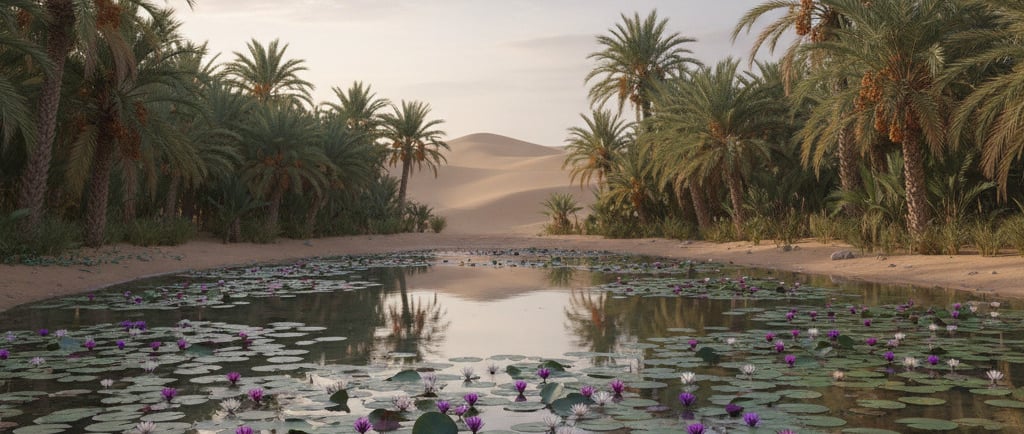
Oases are distinct from riparian zones. They are isolated or semi-isolated wetlands that form where the rising groundwater table intersects the surface, creating permanent springs or seeps. They will be the biological and social hearts of the new Sahara.
Formation and Morphology: Oases will emerge along the traces of the reactivated paleochannels and in other low-lying depressions. Their initial form will be a marsh or a shallow, open-water pond. Our engineering role will be to gently shape these emerging features to maximize their ecological value, perhaps by deepening the central pool and creating gently sloped shorelines.
The Classic Oasis Zonation: We will model their planting on the classic, highly productive structure of natural oases, which is a form of multi-layered agroforestry.
The Aquatic Zone: The central pond will be populated with submerged and floating aquatic plants, such as water lilies (Nymphaea) and pondweeds (Potamogeton).
The Marsh Zone: The saturated soils at the pond's edge will be planted with reeds and sedges, creating a dense marsh that acts as a natural biofilter, purifying the water.
The First Ring (Gardens): In the moist soil just beyond the marsh, intensive, multi-crop agriculture will be practiced, growing vegetables and grains.
The Second Ring (Orchards): Further out, a ring of fruit trees, such as figs, pomegranates, and citrus, will be planted. These are slightly less water-demanding than the garden crops.
The Third Ring (Palms): The iconic outer ring will be composed of dense groves of Date Palms (Phoenix dactylifera). Their tall canopy provides a crucial microclimate-moderating effect, creating a cooler, more humid, and shaded environment for the entire oasis ecosystem below, while also producing a high-energy food staple.
Assembling the Aquatic and Semi-Aquatic Food Web
Both the rivers and the oases must be populated with a functional animal community. This will be a bottom-up process, introducing trophic levels in a carefully managed sequence.
The Foundation: Invertebrates: The first animal introductions will be a diverse suite of freshwater invertebrates.
Primary Consumers: We will inoculate the water with zooplankton (Daphnia, copepods), snails, and the larvae of insects like mayflies and caddisflies. These are the grazers that feed on the algae and detritus.
Shredders and Decomposers: Aquatic worms, scuds (Amphipoda), and certain insect larvae will be introduced to break down submerged leaf litter and other organic matter, playing the same role in the water that their terrestrial counterparts play in the soil.
Predatory Invertebrates: Dragonfly nymphs and diving beetles will be introduced to control the populations of the smaller invertebrates.
The Next Trophic Level: Amphibians:
Amphibians are excellent indicators of ecosystem health due to their permeable skin and biphasic (aquatic and terrestrial) life cycle. We will reintroduce native, drought- and heat-tolerant species of frogs and toads.
Their tadpoles will become a key herbivorous and detritivorous component of the aquatic food web, while the adults will help to control insect populations along the riverbanks and in the oases.
The Vertebrate Apex: Fish and Birds:
Fish: As detailed in our lecture on aquaculture, we will stock the rivers and lakes with native, hardy fish species, starting with herbivores and detritivores like Tilapia. These will be followed by the introduction of native predatory fish to create a balanced aquatic food web.
Waterfowl and Shorebirds: The establishment of these wetlands will naturally attract a vast array of migratory and resident birds. We will manage the habitats to support them, ensuring the presence of nesting sites for species like herons, egrets, and kingfishers.
Conclusion: The Lifeblood and the Heartbeat
The establishment of freshwater riparian zones and oases is the process by which we give our new Sahara a vibrant, beating heart and a living circulatory system. These ecosystems are far more than just conduits or pools of water; they are the epicenters of biological activity and the corridors of life that will enable the populating of the entire continent.
The riparian forests, engineered through assisted succession, will lock our rivers into their channels, creating stable, shaded, and clean waterways. The oases, modeled on ancient, time-tested designs, will become centers of immense productivity and the nuclei of human settlement. The bottom-up assembly of the aquatic and semi-aquatic food web will transform these water bodies from sterile features into complex, self-regulating ecosystems.
Together, these freshwater wetlands represent the culmination of our primary terraforming effort. They are the tangible realization of the promise of the "Green Sahara." With these systems in place, the landscape is no longer just a collection of planted trees; it is a dynamic, interconnected, and living biosphere.
Our next lectures will begin to explore the final trophic levels and the complex management strategies required to maintain this new world in a state of dynamic equilibrium. Thank you.