Add your promotional text...
Lecture 43: Montane Ecosystems: Greening the Hoggar and Tibesti Mountains
Series: The Sahara Reforestation Project: From Dune Sea to Green Valley Part V: Mature Ecosystems and Global Interconnections
6/5/20266 min read
Introduction: The Sky Islands of the Sahara
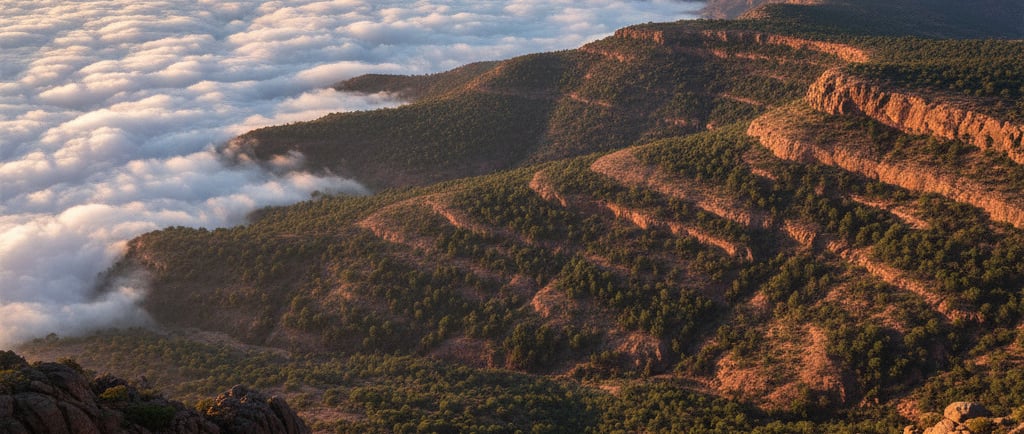
Welcome. Our exploration of the new Saharan biosphere has thus far focused on the vast, low-lying plains, savannas, and basins. Today, we elevate our perspective, literally and figuratively, to the great mountain ranges that punctuate the Saharan landscape: the Hoggar (Ahaggar) Mountains in Algeria and the Tibesti Mountains on the border of Chad and Libya. These volcanic massifs, rising to nearly 3,000 and 3,500 meters respectively, are not merely geological obstacles; they are unique and critical components of our terraforming strategy.
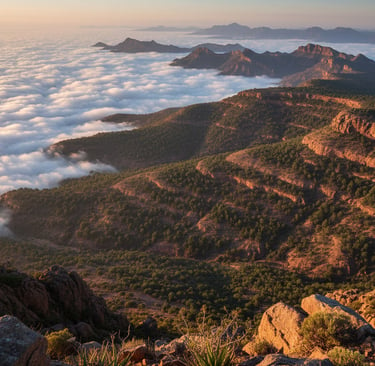
These ranges function as "sky islands"—isolated, high-altitude habitats with climatic conditions radically different from the surrounding lowland desert. Their elevation creates a cooler, moister environment, making them potential refugia for biodiversity and crucial engines of regional water cycling.
This lecture will detail the specialized approach required to reforest these Saharan mountain ranges. We will discuss the immense engineering challenge of soil creation on steep, rocky slopes through large-scale terracing. We will explore the unique palette of plant species selected for this environment, including relict, cold- and drought-tolerant species like the Saharan Cypress and Olive. Finally, and most critically, we will analyze the meteorological phenomenon of orographic precipitation and how establishing these montane forests can create a self-sustaining system that actively "combs" moisture from the atmosphere, generating its own rainfall and becoming a vital headwater source for the new Saharan rivers.
The Unique Environment of the Saharan Sky Islands
To engineer these ecosystems, we must first understand their distinct environmental parameters. Compared to the surrounding desert plains, the Hoggar and Tibesti mountains are characterized by:
Lower Temperatures: Due to the adiabatic lapse rate, air temperature decreases with altitude, typically by 6.5°C per 1,000 meters. This means that the high plateaus and peaks of these mountains are significantly cooler than the scorching desert below, creating conditions suitable for more temperate plant species. Frost and even occasional snow are not unknown at the highest elevations.
Higher Precipitation (Even Today): These ranges already receive slightly more rainfall than the surrounding desert (100-200 mm/year vs. <25 mm). Their elevation forces air masses to rise, cool, and condense, creating localized precipitation. This existing, albeit meager, hydrological cycle is the seed we aim to cultivate.
Complex Topography: The landscape is one of steep slopes, deep canyons (wadis or enneris), and high plateaus (tassilis). This topography creates a vast diversity of microclimates, with shaded, moist canyons contrasting with exposed, windswept ridges.
Absence of Soil: The primary challenge is the near-total lack of soil on the steep, rocky slopes, which have been scoured by millennia of wind and water erosion. The substrate is primarily exposed volcanic rock and scree.
These mountains are also living museums, harboring relict populations of Mediterranean and Afro-montane flora and fauna that have survived as isolated pockets since the last Green Sahara period. These remnant populations, such as the Saharan Cypress and Olive, provide an invaluable genetic blueprint for our restoration efforts.
Phase I: Engineering the Substrate - The Great Terracing Project
Before a single tree can be planted on the mountain slopes, we must first create a substrate in which it can grow. This will be one of the most visually dramatic engineering feats of the entire Sahara project.
The Principle of Terracing: Terracing is an ancient agricultural technique that transforms steep slopes into a series of level, step-like benches. For our purposes, terracing serves three critical functions:
Soil Creation and Retention: The level surface of the terrace allows us to deposit our engineered technosol (the biochar-compost-sand mixture) and, crucially, prevents it from being immediately washed away by erosion.
Water Capture and Infiltration: The terraces act as a series of small, linear reservoirs. They capture rainfall and irrigation water, preventing rapid runoff and allowing it to slowly infiltrate into the soil profile, recharging the local groundwater.
Slope Stabilization: The terrace walls, constructed from local rock, provide structural stability to the entire mountainside.
Construction: The scale of this task necessitates a fleet of semi-autonomous, specialized robotic construction vehicles. These machines, capable of operating on steep grades, would systematically work their way up the mountainsides, cutting into the slope and using the excavated rock to build the retaining walls for the terrace below. The process would follow the natural contours of the land to create a stable and aesthetically pleasing structure.
Soil Deposition: Following terrace construction, a layer of our engineered technosol, manufactured in the lowlands, would be transported and deposited onto the terraces, creating an initial growing medium of 50-100 cm in depth.
Phase II: Selecting the Montane Flora - A Relict and Adapted Palette
The plant species for these sky islands must be adapted to a unique combination of stresses: drought, cold (including frost), and high UV radiation.
Resurrecting the Relicts: Our primary candidates are the remarkable relict species that still cling to existence in these mountains.
Cupressus dupreziana (Saharan Cypress): Found only in a tiny, isolated population on the Tassili n'Ajjer plateau, this is one of the world's rarest trees. It is exceptionally drought- and heat-tolerant. We would use a combination of conservation genetics to expand the existing population and genetic engineering to enhance its frost tolerance for higher elevations.
Olea europaea subsp. laperrinei (Saharan Olive): A wild olive subspecies adapted to the Hoggar and Tibesti mountains. It is a vital genetic resource for developing olive cultivars that can withstand extreme environmental fluctuations.
Saharan Myrtle (Myrtus nivellei): Another relict species from the high plateaus, valued for its hardiness and aromatic properties.
Introducing Analogous Temperate Species: We would supplement these native relicts with species from other high-altitude, arid, or Mediterranean mountain ecosystems around the world.
Junipers (Juniperus species): Various species of juniper are incredibly tough, tolerating cold, drought, and poor soils. They would be a key component of the high-altitude woodlands.
Pines (Pinus halepensis - Aleppo Pine): A hardy, drought-tolerant Mediterranean pine that can colonize rocky, nutrient-poor slopes.
Oaks (Quercus ilex - Holm Oak): A resilient, evergreen oak from the Mediterranean basin, which provides a dense canopy and valuable acorns for wildlife.
Phase III: Harnessing Orographic Precipitation
This is the ultimate goal of reforesting the mountains. Orographic lift occurs when an air mass is forced to move from a low elevation to a high elevation as it moves over rising terrain. As the air rises, it cools adiabatically, which can cause it to reach its dew point, leading to condensation and the formation of clouds and precipitation.
The Current State: Even today, the mountains generate some orographic precipitation, but the effect is limited by the very low humidity of the incoming desert air.
The Afforestation Feedback Loop: Our strategy creates a powerful positive feedback loop.
Initial Irrigation: We first establish the montane forests using water pumped up from the main water grid.
Increased Transpiration: As the forests mature, they begin to release enormous quantities of water vapor through transpiration.
Local Humidity Increase: This significantly increases the moisture content of the air mass immediately surrounding the mountains.
Enhanced Orographic Precipitation: Now, when this moister air is forced to rise over the mountains, it reaches its dew point at a lower altitude and with greater intensity, leading to a dramatic increase in cloud cover, fog drip, and rainfall on the windward slopes.
Self-Sustainment: Eventually, the amount of precipitation generated by this "forest-powered" orographic effect will become sufficient to sustain the montane ecosystem, allowing the artificial irrigation to be significantly reduced or even ceased.
"Cloud Combing": The forest canopy, particularly that of conifers, is also highly effective at "combing" moisture directly out of the air from fog and low-lying clouds—a process called horizontal precipitation. The water droplets collect on the needles and drip down to the forest floor, providing a significant water input even when it is not actively raining.
The Ecological Role of the Montane Headwaters
The reforested sky islands become the "water towers" of the new Sahara.
Headwater Sources: The increased rainfall and fog drip will generate a perennial water supply. This water will collect in streams and rivers that originate in the mountains and flow down to the plains below.
Regulating the Lowlands: These new, naturally-fed rivers will become vital tributaries for our main engineered river systems, providing a stable, high-quality water source that is not dependent on the energy-intensive desalination grid. They will help to regulate the flow of the lowland rivers, sustaining them through the dry season.
Biodiversity Refugia: The cooler, wetter conditions of the mountains will support a completely different suite of species than the hot savannas below. They will serve as critical refugia for temperate species and as centers of endemism, where unique, locally-adapted species may evolve.
Conclusion: From Barren Peaks to Living Water Towers
The greening of the Hoggar and Tibesti mountains is a specialized but indispensable component of the entire Sahara Reforestation Project. It is an endeavor that requires immense initial engineering to create the very substrate for life through terracing. But once established, the biological system begins to take over the work.
By planting a carefully selected community of relict and adapted species, we create a forest that does more than just grow; it actively engineers its own climate. This montane ecosystem harnesses the physics of orographic lift, enhanced by its own transpiration, to generate a sustainable, natural water supply.
These reforested sky islands are transformed from barren, rocky peaks into living water towers, the verdant headwaters of the new Saharan river systems. They are anchors of biodiversity, engines of regional hydrology, and a profound testament to the power of a strategically designed ecosystem to create the very conditions it needs to thrive.
Our next lectures will continue to explore the intricate web of life we are creating, moving to the complex societal and ethical dimensions of this new world. Thank you.