Add your promotional text...
Lecture 44: The New Savanna: Designing a Resilient Grassland Ecosystem
Series: The Sahara Reforestation Project: From Dune Sea to Green Valley Part V: Mature Ecosystems and Global Interconnections
6/8/20266 min read
Introduction: The Grassy Heart of the New Sahara
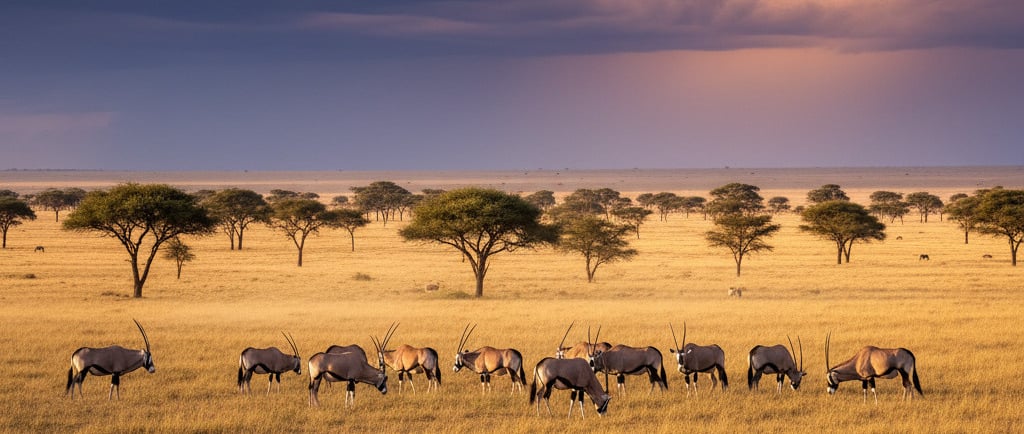
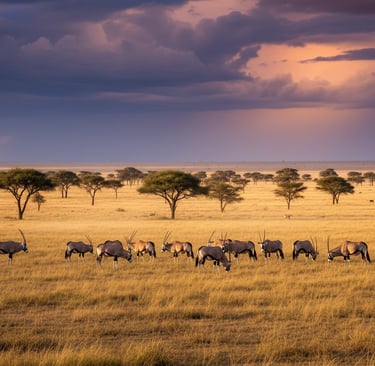
Welcome. While our discourse has often highlighted the ambitious goal of "reforestation," it is a misconception to envision the entire Sahara transformed into a dense, closed-canopy forest. The ecological and climatological reality of our new Sahara—with its seasonal rainfall and high solar insolation—will favor the establishment of a different, yet equally complex and productive biome: the savanna. These vast, open grasslands, interspersed with scattered trees, will form the ecological heartland of the terraformed continent.
This lecture will provide a detailed ecological blueprint for the design and management of this new Saharan savanna. We will move beyond simply planting trees and grasses to explore the intricate, co-evolved relationships that define a resilient grassland ecosystem. Our focus will be on the four key interacting components: the foundational perennial grasses and their photosynthetic strategies; the scattered, keystone tree canopies; the regulatory pressure of large grazing herbivores; and the indispensable, regenerative role of fire. This is not about creating a simple pasture; it is about engineering a dynamic, self-regulating, and biodiverse ecosystem.
Component I: The Foundation - The Grasses (Poaceae)
The defining feature of a savanna is its continuous layer of grass. The selection and establishment of this graminoid foundation is the first and most critical step.
Photosynthetic Pathways: C3 vs. C4 - A Critical Choice:
C3 Photosynthesis: This is the ancestral and most common photosynthetic pathway, used by trees, shrubs, and cool-season grasses. It is efficient in cool, moist conditions but suffers from a process called photorespiration in high heat and light, where the enzyme RuBisCO mistakenly binds to oxygen instead of CO2, wasting energy and reducing efficiency.
C4 Photosynthesis: This is a more evolutionarily advanced pathway that has evolved independently in many plant families, most notably in tropical and subtropical grasses. C4 plants have a specialized leaf anatomy (Kranz anatomy) and an additional biochemical step that acts as a "CO2 pump," concentrating CO2 around the RuBisCO enzyme. This virtually eliminates photorespiration.
The Saharan Context: The new Saharan climate, characterized by high temperatures, high light intensity, and seasonal water stress, is a textbook C4 environment. C4 grasses are significantly more productive and water-use efficient under these conditions than their C3 counterparts. Therefore, the backbone of our new savanna will be a diverse portfolio of C4 perennial grasses native to African savannas, such as species of Andropogon (Bluestems), Panicum (Switchgrasses), and Cenchrus (Buffelgrasses).
The Importance of Perennials and Root Systems: We will exclusively use perennial grasses, not annuals.
Ecological Function: Perennial grasses invest in massive, deep root systems that can reach several meters into the soil. These roots allow the plant to survive the long dry season and resprout quickly with the first rains. More importantly, this dense, fibrous root mass is the primary engine of soil organic carbon sequestration in grasslands. The continuous turnover of fine roots builds deep, rich, carbon-heavy topsoil (like the Mollisols of the American prairies), improves soil structure, and enhances water infiltration.
Component II: The Structural Keystone - The Scattered Trees
A pure grassland is a simple ecosystem. The introduction of scattered trees transforms it into a structurally complex savanna, creating a multitude of new ecological niches.
Species Selection: The trees will primarily be drought-tolerant, nitrogen-fixing species, with an open canopy that does not completely shade out the C4 grasses below. The archetypal genus for this role is Acacia (now often reclassified into Vachellia and Senegalia).
Functional Roles: These trees act as "islands of fertility." They fix atmospheric nitrogen, enriching the soil beneath their canopy. Their deeper roots can "pump" nutrients from lower soil profiles to the surface via leaf litter. Their canopy provides shade, creating a cooler, more humid microclimate that serves as a refuge for animals during the heat of the day.
Spatial Arrangement: A Managed Randomness: The trees will not be planted in uniform rows like an orchard. They will be distributed in a scattered, clumpy pattern that mimics natural savannas. This "managed randomness" is critical. The mosaic of open grassy patches, dense thickets, and solitary trees creates a heterogeneous landscape that maximizes biodiversity, providing habitats for both grassland specialists and woodland-edge species.
Component III: The Primary Regulators - The Large Grazing Herbivores
As established in Lecture 16, a savanna without grazers is an incomplete and unstable system, prone to being choked by dead biomass. The co-evolutionary relationship between grasses and large herbivores is the central dynamic of this biome.
The Grazer Guild: The herbivore community will be dominated by bulk-feeders, or grazers, such as the reintroduced Scimitar-horned Oryx and potentially specialized cattle breeds. Their role is to consume the vast annual production of grass biomass.
The Impact of Grazing: Managed, rotational grazing has several vital effects:
Fuel Load Reduction: By consuming dry grass, herbivores are the primary mechanism for reducing the fuel load, which lowers the intensity of wildfires.
Stimulation of Growth: Many C4 grasses are adapted to grazing and respond to being eaten by increasing their growth rate (tillering).
Nutrient Cycling: Grazers accelerate the decomposition of grass, converting it into nutrient-rich dung and urine that are rapidly reincorporated into the soil by dung beetles and microbes.
Maintaining Openness: By grazing and trampling young tree seedlings, the herbivores help to prevent woody encroachment and maintain the open, grassy character of the savanna.
The dynamic interplay between the rate of grass growth and the intensity of grazing, managed through our virtual fencing system, is the primary tool for controlling the savanna's energy flow.
Component IV: The Regenerative Force - The Role of Fire
Fire is not a disaster in a savanna; it is an essential, rejuvenating process that has shaped these ecosystems for millions of years. Our fire management strategy (Lecture 29) will be most actively and deliberately applied in the savanna biome.
Ecological Functions of Fire in a Savanna:
Removal of Moribund Biomass: Fire is the most efficient mechanism for clearing away the old, dead grass (thatch) that was not consumed by herbivores. This removal of the thatch layer allows sunlight to reach the soil, stimulating the germination of seeds and the resprouting of perennial grasses.
Nutrient Mineralization: Fire rapidly mineralizes the nutrients (phosphorus, potassium, calcium) locked in the dry biomass, releasing them in a pulse of ash that acts as a potent fertilizer for the next wave of growth.
Controlling Woody Encroachment: Low-intensity, fast-moving grass fires are highly effective at killing the seedlings and saplings of woody shrubs and trees that are not fire-adapted. This is the primary natural force that prevents a savanna from transitioning into a closed woodland.
Cue for Germination and Flowering: Many savanna plant species have evolved to require the heat or smoke from a fire as a cue for their seeds to germinate or for the mature plants to flower.
The Fire-Grazer Interaction: Fire and grazing are not independent forces; they interact. Areas that have been recently grazed have a lower fuel load and will burn less intensely, or not at all. Areas that have been rested from grazing will accumulate more fuel and burn more intensely. After a fire, the new, nutrient-rich flush of grass is highly attractive to grazers. By managing fire patterns (using prescribed burns), we can actively influence and direct the grazing patterns of the herbivore herds, and vice versa. This dynamic interaction is the key to creating a complex and shifting landscape mosaic.
Synthesizing the System: A Dynamic Equilibrium
The resilience of the new Saharan savanna lies not in any single component, but in the dynamic equilibrium established between these four interacting elements.
Grasses and Trees compete for light, water, and nutrients.
Herbivores suppress both grasses (through grazing) and trees (through browsing and trampling).
Fire suppresses trees (killing seedlings) and rejuvenates grasses.
Our role as ecosystem managers is not to suppress these tensions, but to modulate them. Through our management of herbivore densities (via virtual fencing) and fire frequency (via prescribed burns), we can "steer" the ecosystem along a spectrum, from open grassland to dense savanna woodland, depending on the specific ecological or economic goals for a given area.
Conclusion: Engineering a Co-evolved System
This lecture has detailed the ecological design of the vast savanna biome that will form the heart of the new Sahara. It is an ecosystem built upon a foundation of highly productive, water-efficient C4 grasses. But its true character and resilience emerge from the complex, co-evolved dance between four key players.
The grasses provide the fuel. The trees provide structure and fertility. The herbivores regulate the fuel load and stimulate growth. And fire cleanses, rejuvenates, and maintains the balance of power between grass and wood. We are, in effect, taking the components that co-evolved over millions of years in Africa's natural savannas and re-assembling them in a new context, using technology to guide and accelerate the establishment of their ancient, dynamic equilibrium.
The successful creation of this vast, productive, and self-regulating savanna is a testament to an ecological engineering philosophy that works with natural processes, rather than against them. It is the engine of our project's large-scale carbon sequestration and the foundation of its future biological productivity.
Our next lectures will continue to explore the other specialized ecosystems and the advanced societal frameworks that will define this new world. Thank you.