Add your promotional text...
Lecture 45: Coastal Ecosystems: Mangrove Forests and Dune Stabilization
Series: The Sahara Reforestation Project: From Dune Sea to Green Valley Part V: Mature Ecosystems and Global Interconnections
6/10/20266 min read
Introduction: The Littoral Zone - Where the Project Meets the Sea
Welcome. Our grand design for a green Sahara has, by necessity, focused predominantly on the terrestrial interior. We have engineered river systems, savannas, and montane forests, all sustained by a hydrological grid originating from the coast. Today, we turn our attention to that critical interface, the littoral zone, where our terraformed continent meets the Atlantic Ocean and the Mediterranean Sea. This is a zone of immense physical energy—of waves, tides, and salt spray—and it requires a specialized and robust ecological engineering strategy.
A simple, abrupt transition from our new terrestrial ecosystems to the open ocean would be unstable and vulnerable. We must design a resilient coastal buffer. This lecture will detail the establishment of two critical, interlinked coastal ecosystems: mangrove forests in the newly formed river estuaries, and stabilized dune systems along the sandy shorelines.
We will analyze the profound ecological and engineering functions of these systems. Mangroves will serve as our biological sea walls, nurseries for marine life, and unparalleled "blue carbon" sinks. Stabilized dune systems will form a protective barrier against coastal erosion and salt intrusion. Together, they constitute a living, self-repairing coastal defense system, safeguarding the terrestrial gains we have made further inland.
The New Saharan Coastline: A Changed Environment
The establishment of new, perennial rivers flowing from the Sahara's interior to the sea will fundamentally alter the coastal geomorphology. For the first time in millennia, these rivers will carry freshwater and sediment to the coast, creating the essential conditions for the formation of estuaries. An estuary is a semi-enclosed coastal body of brackish water with one or more rivers or streams flowing into it, and with a free connection to the open sea. These new estuaries, with their mix of fresh and salt water and their accumulating sediment, are the target habitats for our mangrove afforestation program.
Mangrove Forests: The Keystone Ecosystem of the Intertidal Zone
Mangroves are a group of salt-tolerant trees and shrubs (halophytes) that thrive in the intertidal zones of tropical and subtropical coastlines. They are masters of a challenging environment, characterized by anoxic (oxygen-poor) soils and fluctuating salinity. Their introduction is a cornerstone of our coastal strategy.
Biological Adaptations of Mangroves: We will select a portfolio of mangrove species (e.g., from the genera Rhizophora, Avicennia, Laguncularia) based on their specific adaptations:
Salt Tolerance: Mangroves employ several strategies, including salt-excluding roots and salt-excreting glands on their leaves.
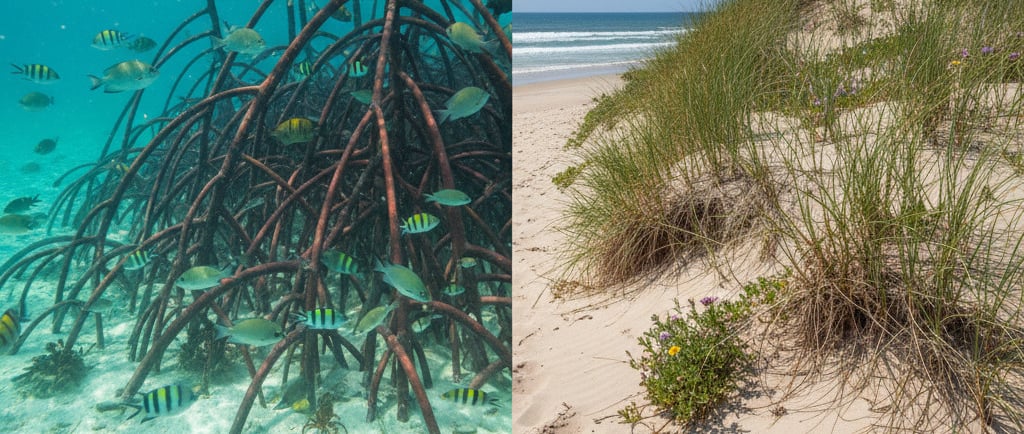
Anoxic Soils: They have evolved specialized root structures to "breathe" in the waterlogged, oxygen-poor mud. Rhizophora (Red Mangroves) have distinctive prop roots that arch above the water, while Avicennia (Black Mangroves) have pneumatophores—vertical, snorkel-like roots that project upwards from the mud to absorb oxygen.
Reproduction: Many mangroves are viviparous, meaning their seeds (propagules) germinate into seedlings while still attached to the parent tree. These buoyant, dart-like seedlings can float for long periods, eventually lodging in the mud to take root.
Ecological Engineering Functions: The establishment of dense mangrove forests provides a suite of critical ecosystem services:
Coastal Protection and Land Accretion: The dense, complex network of prop roots and pneumatophores is an incredibly effective natural wave break. It dissipates the energy of storm surges and daily wave action, dramatically reducing coastal erosion. By slowing the flow of water, the roots also trap suspended sediment carried by the rivers and tides, gradually building up the land and accreting new coastline.
Nurseries for Marine Life: The intricate, submerged root structure provides a complex, protected habitat for a vast array of juvenile marine organisms. Mangrove estuaries are the nurseries for countless species of commercially and ecologically important fish, crustaceans (crabs, shrimp), and mollusks. The health of vast offshore fisheries is directly dependent on the health of these coastal nurseries.
Water Quality Improvement: Mangrove ecosystems are powerful bio-filters. Their dense root systems and the associated microbial communities trap pollutants and absorb excess nutrients (nitrogen, phosphorus) from the river water before it enters the open ocean, preventing coastal eutrophication and harmful algal blooms.
Biodiversity Hotspots: Mangrove forests support a rich biodiversity, not just below the water, but above it as well, providing critical habitats for a wide range of coastal and migratory birds.
The "Blue Carbon" Sink: A Potent Climate Mitigation Tool
Perhaps the most significant global benefit of establishing Saharan mangrove forests is their unparalleled capacity for carbon sequestration. This is known as "blue carbon."
Mechanism of Sequestration: While terrestrial forests store most of their carbon in their woody biomass, mangrove ecosystems sequester the vast majority of their carbon in the soil. The waterlogged, anoxic conditions of the mangrove mud dramatically slow down the decomposition of organic matter (dead roots, leaves, trapped sediment).
Magnitude: On a per-hectare basis, mangrove soils can store up to five times more carbon than most terrestrial forests, including tropical rainforests. The carbon accumulates in deep layers of peat and mud over millennia.
Global Significance: By creating hundreds or thousands of square kilometers of new mangrove habitat along the Saharan coast, the project will be establishing one of the most efficient and long-term carbon sinks on the planet. This blue carbon component will be a critical and highly valuable part of our overall carbon sequestration portfolio, as quantified by our MRV system (Lecture 24).
Strategy II: Coastal Dune Stabilization
Between the new mangrove estuaries, there will be long stretches of sandy coastline, vulnerable to wind erosion and inland salt spray. We must engineer a stable coastal dune system to act as a natural, self-repairing sea wall.
The Threat of Mobile Dunes: Unvegetated coastal dunes are mobile. Strong onshore winds can blow sand inland, burying coastal habitats and infrastructure and carrying salt spray that can damage inland agriculture.
The Bio-engineering Approach: We will use a successional planting strategy to build and stabilize a foredune system.
Phase I (The Binders - Embryo Dunes): The process begins on the upper beach with the planting of salt-tolerant, fast-growing pioneer grasses that are adapted to sand burial. Species like Ammophila arenaria (Marram Grass) are exemplary. Their sprawling, rhizomatous root systems form a dense web that traps wind-blown sand. As sand accumulates, the grass grows up through it, gradually building a small "embryo dune."
Phase II (The Stabilizers - Foredunes): As the embryo dunes grow and coalesce into a larger, more stable foredune ridge, they create a more protected environment on their leeward side. Here, we can introduce a more diverse community of secondary stabilizing plants, including creeping groundcovers, herbaceous perennials, and eventually, salt-tolerant shrubs.
Phase III (The Dune Scrub/Woodland): In the most protected areas behind the main foredune ridge (the "dune slack"), we can establish a dense thicket of salt- and wind-tolerant shrubs and low-growing, gnarled trees (like salt-tolerant varieties of pine or juniper). This final layer provides the ultimate barrier against salt spray intrusion.
Functions of the Stabilized Dune System:
Physical Barrier: The foredune acts as a physical barrier, absorbing the energy of storm surges and preventing coastal flooding.
Sand Reservoir: The dune system is a dynamic reservoir of sand that can naturally buffer the coastline, eroding during major storms and rebuilding during calmer periods.
Salt Spray Interception: The vegetation traps airborne salt spray, preventing it from damaging the more sensitive agricultural and ecological zones further inland.
Freshwater Lens Protection: In many coastal areas, a lens of fresh groundwater floats on top of the denser saltwater below. A stable dune system helps to protect this fragile freshwater resource from saltwater intrusion.
Conclusion: The Living Coastal Interface
This lecture has detailed the design of a living, resilient interface between our terraformed Sahara and the sea. The strategy moves beyond hard engineering solutions like concrete sea walls and groynes, which are expensive, static, and prone to failure, in favor of a dynamic, self-repairing, bio-engineered system.
The mangrove forests established in the new estuaries will serve as the ecological and economic powerhouses of the coast. They will protect the shoreline, nurture oceanic biodiversity, purify the water, and sequester vast quantities of blue carbon, making them a critical asset for both the local ecosystem and the global climate. In parallel, the engineered dune systems, built and stabilized by a succession of hardy plants, will provide a robust, flexible defense against the physical forces of the ocean and wind.
Together, these coastal ecosystems form a vital protective membrane for the new Sahara. They manage the complex interplay of freshwater and saltwater, of sediment and wave, of wind and sand. They are the final, crucial component in the landscape-scale design, ensuring that the world we are building in the interior is secure and buffered at its most dynamic and energetic frontier.
Our next lectures will continue to explore the societal and ethical dimensions that arise from the management of these new, valuable, and complex ecosystems. Thank you.