Add your promotional text...
Lecture 46: Managing the Global Teleconnection
Series: The Sahara Reforestation Project: From Dune Sea to Green Valley Part V: Mature Ecosystems and Global Interconnections
6/12/20266 min read
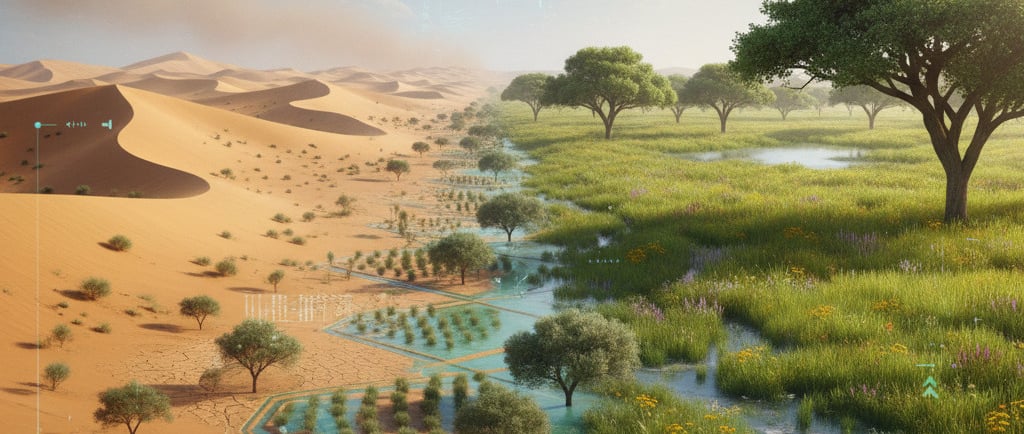
Introduction: The Unintended Consequence of a Green Sahara
Welcome. In our comprehensive design for a terraformed Sahara, we have consistently focused on the intended, positive outcomes: a stable climate, productive agriculture, and restored biodiversity within North Africa. However, a geo-engineering project of this magnitude does not have the luxury of existing in a vacuum. The Earth system is a deeply interconnected network of "teleconnections," where a major change in one region can have profound and often unforeseen consequences thousands of kilometers away.
Today, we confront perhaps the most significant and challenging of these unintended consequences. The Sahara, in its current desert state, is not a void; it is a globally significant actor. It is the planet's single largest source of atmospheric mineral dust, a vast plume of which travels across the Atlantic each year. This is not mere dirt; it is an aerial subsidy of life-giving micronutrients.
This lecture will provide a deep analysis of the global ecological impact of "shutting off" this dust supply, a necessary and inevitable consequence of vegetating the Saharan landscape. We will explore how the cessation of this dust flux threatens the productivity of two of the planet's most vital ecosystems: the Amazon rainforest and the tropical Atlantic Ocean. We will then transition from problem analysis to solution engineering, exploring the complex and controversial mitigation strategies required to consciously replace this accidental, yet critical, planetary function.
The Saharan Air Layer: A Global Nutrient Pump
Each year, an estimated 180 million tons of dust are carried out of the Sahara by the trade winds, forming a massive, elevated layer of warm, dry, and mineral-rich air known as the Saharan Air Layer (SAL). This dust originates from specific geological hotspots within the desert, most notably the Bodélé Depression in Chad, an ancient lakebed composed of diatomite—the fossilized, silica-rich remains of diatoms.
The biogeochemical significance of this dust lies in its composition. It is a cocktail of minerals, but two are of paramount importance to distant ecosystems:
Iron (Fe): Derived from iron oxide minerals (hematite, goethite) that coat the dust particles, giving them their characteristic reddish hue. Iron is an essential, yet often scarce, micronutrient for nearly all forms of life.
Phosphorus (P): Contained within apatite and other mineral fragments within the dust. Phosphorus is a fundamental macronutrient, a core component of DNA, ATP, and cell membranes.
The Sahara, therefore, acts as a giant, wind-powered pump, excavating these nutrients from North Africa's ancient geology and distributing them on a global scale. Our project, by stabilizing the soil with a carpet of vegetation, will effectively turn this pump off.
Impact I: The Starvation of the Atlantic - Iron Limitation
Vast stretches of the open ocean, including the tropical Atlantic directly in the path of the SAL, are known as High-Nutrient, Low-Chlorophyll (HNLC) zones. In these regions, the growth of phytoplankton—the microscopic algae that form the base of the entire marine food web—is not limited by major nutrients like nitrates, but by the extreme scarcity of bioavailable iron.
The Iron Fertilization Effect: When iron-rich Saharan dust settles on the ocean surface, a fraction of its iron dissolves, becoming bioavailable. This injection of a limiting nutrient triggers a massive fertilization event, leading to explosive blooms of phytoplankton, particularly nitrogen-fixing cyanobacteria like Trichodesmium.
Trophic and Biogeochemical Consequences: These blooms have two profound effects:
Supporting the Food Web: They form the foundational trophic level, feeding zooplankton, which in turn support the entire pelagic ecosystem, including commercially vital fisheries for species like tuna.
The Biological Carbon Pump: During photosynthesis, the phytoplankton draw enormous quantities of CO2 from the atmosphere. A portion of this carbon sinks to the deep ocean when the phytoplankton die, sequestering it for centuries. The Saharan dust subsidy is a major, natural driver of this oceanic carbon pump.
The Impact of Cessation: Shutting off the dust supply would place the tropical Atlantic on a severe "iron diet." The predicted consequences are a dramatic reduction in primary productivity, a potential collapse of major offshore fisheries, and a significant weakening of the ocean's ability to act as a carbon sink. This last effect would create a negative feedback loop, partially offsetting the carbon sequestration gains from our new Saharan forests.
Impact II: The Withering of the Amazon - Phosphorus Limitation
The teleconnection between the Sahara and the Amazon rainforest is one of the most stunning examples of planetary interconnectedness. The soils of the Amazon basin are ancient, highly weathered oxisols, from which millennia of heavy rainfall have leached away most soluble nutrients, especially phosphorus.
The Phosphorus Subsidy: The Amazonian ecosystem is maintained in a state of extreme phosphorus limitation. It survives by being incredibly efficient at recycling the phosphorus it already has. The only significant external source of new phosphorus is the deposition of Saharan dust. It is estimated that tens of thousands of tons of phosphorus are delivered to the Amazon basin from the Sahara each year. This aerial fertilization is critical for replenishing the phosphorus lost to river runoff and maintaining the long-term productivity of the rainforest.
The Impact of Cessation: The consequences of cutting off this vital nutrient supply would be slow, insidious, but immense. Over decades and centuries, the phosphorus deficit would accumulate. This would likely lead to a gradual but widespread decline in the Net Primary Productivity of the Amazon, stunting forest growth, altering tree species competition, and potentially reducing the rainforest's overall resilience to other stresses like climate change-induced drought.
Mitigation Strategies: Engineering a New Nutrient Cycle
The Sahara Reforestation Project cannot, in good conscience, proceed without a proactive and credible plan to mitigate these severe, far-reaching negative externalities. We cannot green one continent at the expense of another. This requires us to engineer artificial replacements for the natural function of the dust.
Mitigation A: Oceanic Micronutrient Application
This strategy involves replacing the function of iron-rich dust with a deliberate, large-scale, and continuous ocean fertilization program.
The Technology: A fleet of autonomous, solar-powered vessels or buoys would be deployed throughout the target HNLC zones of the tropical Atlantic. These platforms would be equipped to release a carefully formulated, slow-dissolving solution of iron sulfate (FeSO4) into the sunlit surface layer (the euphotic zone).
Management and Monitoring: This is not a "dump and forget" operation. The application would be managed by the project's AI core, guided by real-time satellite ocean-color imagery (to identify areas of low chlorophyll) and data from a network of robotic oceanographic profilers (Argo floats). The goal is to stimulate productivity without triggering harmful side effects, such as anoxia (oxygen depletion) in deeper waters as the massive blooms decay.
Governance and Ethics: This is an act of large-scale geo-engineering, subject to international law (the London Convention/Protocol). The program would have to be managed with extreme transparency under the authority of the project's International Oversight Council, with the full participation of all nations bordering the affected Atlantic regions.
Mitigation B: Re-establishing the Eolian Corridor (The "Great Filter" Concept)
An alternative, or complementary, strategy is more radical. Instead of replacing the function of the dust, could we replace the dust itself?
The Concept: This involves designing the reforested Sahara to include one or more vast, strategically located, and carefully managed "eolian corridors." These would be multi-kilometer-wide belts of land, aligned with the dominant trade winds, that are deliberately kept in a desert-like state.
The "Great Filter": These corridors would be managed as a "dust filter."
Sourcing Material: The surface of these corridors would not be sterile quartz sand. It would be continuously supplied with a specifically formulated mineral mixture. This "designer dust" would be manufactured from crushed rock (e.g., iron-rich olivine) and phosphatic minerals (apatite), optimized for its nutrient content.
Controlled Emission: The vegetation at the edges of the corridor would be managed to regulate wind flow. The system would be designed to allow the strong seasonal winds to lift a controlled, predictable quantity of this nutrient-rich designer dust into the atmosphere, creating an artificial but functional Saharan Air Layer.
Advantages and Challenges: This approach is more "naturalistic" in its delivery mechanism but presents enormous engineering and ecological challenges. It requires the perpetual operation of a massive mineral grinding and distribution industry and the difficult task of maintaining a stable but emissive desert landscape directly adjacent to a thriving forest.
Conclusion: The Responsibility of a Creator
The teleconnection between Saharan dust and the health of the Atlantic and Amazon ecosystems is a humbling reminder of the intricate, often invisible, threads that bind our planetary systems. The act of greening the Sahara is an act of severing one of these critical threads. Our analysis demonstrates that we cannot do so without accepting the profound responsibility to weave a new one in its place.
The choice of mitigation strategy—be it oceanic nutrient application, the creation of engineered eolian corridors, or a hybrid of both—is a geo-engineering challenge on par with the Sahara project itself. It requires a new level of scientific understanding, technological capability, and, above all, international governance.
This "great filter" of dust serves as a final, critical lesson in the humility required for planetary stewardship. It proves that no single ecosystem can be "fixed" in isolation. Any intentional, large-scale intervention in the Earth system must be undertaken with a holistic perspective, acknowledging and actively managing the complex web of consequences that will inevitably ripple across the globe.
Our next lectures will continue to explore the societal, cultural, and ethical frameworks required to manage a world where humanity has accepted such an awesome and intricate responsibility. Thank you.