Add your promotional text...
Lecture 47: The City as an Ecosystem: Arcologies in the Sahara
Series: The Sahara Reforestation Project: From Dune Sea to Green Valley Part V: Mature Ecosystems and Global Interconnections
6/15/20266 min read
Introduction: The Next Stage of Urban Evolution
Welcome. In Lecture 18, we laid the groundwork for human settlement in the new Sahara, proposing the "Oasis City" model. This model, based on passive desert architecture and integrated greenbelts, was designed for the initial phase of colonization—a sustainable but fundamentally extensive, or spread-out, form of urbanism. However, as the Saharan population grows over centuries and our understanding of ecosystem management deepens, this model will evolve. The drive for ever-greater resource efficiency and a more profound integration of human life with the biosphere will lead to a new urban paradigm.
This lecture will explore that next stage of urban evolution: the development of Saharan Arcologies. The term "arcology," coined by architect Paolo Soleri, combines "architecture" and "ecology" to describe vast, three-dimensional, self-contained structures that are themselves complete ecosystems. An arcology is not just a city in nature; it is a city conceived as nature—a living, breathing organism with a hyper-efficient, circular metabolism.
We will move beyond the initial Oasis City to detail the principles of arcological design as applied to the mature Saharan landscape. Our focus will be on the fusion of dense, vertical living spaces, integrated vertical farming, and closed-loop resource systems, all designed to maximize human well-being while minimizing the city's physical and ecological footprint on the surrounding savanna.
The Rationale for Arcological Development: Why Build Up?
As the new Saharan savanna and woodlands mature into valuable, biodiverse, and ecologically sensitive landscapes, the imperative to conserve this "new nature" will grow. The sprawling model of even the most sustainable low-rise cities becomes a liability. The transition to arcologies is driven by several key factors:
Land Conservation: Arcologies are fundamentally about radical densification. By building vertically and integrating functions within a single, massive structure, a city designed to house a million people might occupy a footprint of just a few square kilometers, compared to the hundreds of square kilometers required for a conventional city. This preserves the vast majority of the terraformed landscape for agriculture, wilderness, and ecological corridors.
Hyper-Efficient Resource Management: The concentration of all urban functions—residential, commercial, agricultural, and industrial—within a single, enclosed system allows for unprecedented efficiencies in water, energy, and nutrient recycling. The physical distances over which resources must be transported are reduced from kilometers to mere meters (vertically).
Total Climate Control: An arcology is a fully enclosed environment. This allows for the creation of an ideal internal climate, completely decoupled from the external Saharan seasons, with optimized temperature, humidity, and air quality. This provides perfect living conditions and allows for year-round, high-yield indoor agriculture.
Ecological Decoupling: By containing the city's entire metabolism, the arcology prevents urban outputs (pollutants, runoff, waste heat) from negatively impacting the sensitive surrounding ecosystem. It creates a clear, sharp boundary between the built and the natural environment.
Architectural Design: The Living Megastructure
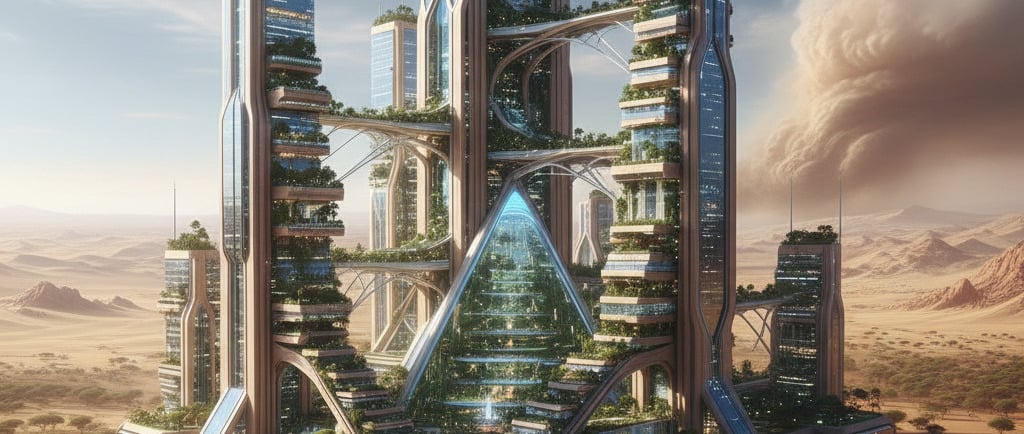
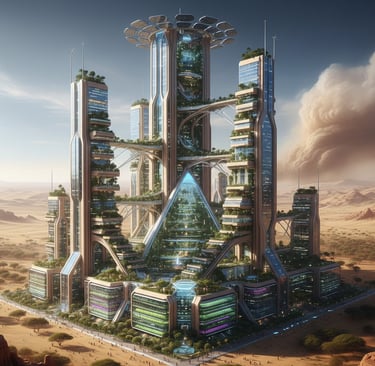
The Saharan arcologies would be monumental feats of engineering and ecological design, likely taking the form of massive conical, pyramidal, or domed megastructures, potentially rising over a kilometer into the sky.
Structural Principles: The structures would be built from locally sourced and manufactured materials, including advanced concrete made with regolith aggregate, steel recycled from project machinery, and massive timber from the sustainable forestry sector. The design would be biomimetic, drawing inspiration from natural structures like termite mounds for passive ventilation, or the radial structure of a flower for residential layout.
The Vertical Transect: The interior of the arcology would be organized along a vertical axis, creating different ecological and functional zones at different altitudes within the structure.
The "Ground" Level (Industrial/Geothermal): The base of the arcology would be its industrial heart and its connection to the Earth. This level would house heavy industry, the primary water and waste recycling plants, and geothermal heat exchange systems that use the stable temperature of the deep earth to cool the entire structure.
The "Commercial" Levels: Above the industrial base would be the city's commercial and civic core, with public plazas, markets, and cultural institutions, all bathed in light from a massive central atrium.
The "Agricultural" Levels (Vertical Farms): A significant portion of the structure's volume would be dedicated to vertical farming. These are multi-story hydroponic and aeroponic facilities, using tailored LED lighting and robotic systems to grow a wide variety of crops, from leafy greens to grains and fruits.
The "Residential" Levels: Habitation zones would be located on the outer skin of the structure, providing residents with external views of the Saharan landscape and access to natural light. Apartments would feature private balconies or "sky gardens."
The "Park" Levels (The Lungs): Vast, multi-story botanical gardens and parklands would be integrated throughout the structure. These are not just for recreation; they are the functional "lungs" of the arcology, playing a key role in air purification, oxygenation, and humidity control.
The Central Atrium and Light Funneling: A massive open space would run through the center of the arcology, from the top to the commercial levels. The roof of the structure would be a vast, transparent dome (ETFE or similar) equipped with a system of heliostats (computer-controlled mirrors) that track the sun, directing natural sunlight down through the atrium to illuminate the interior parks and public spaces.
The Arcology's Metabolism: A Hyper-Efficient Circular Economy
The true innovation of the arcology is its closed-loop metabolic system.
The Water Cycle: Every drop of water is recycled in an endless loop.
Atmospheric water generators and water from the Saharan grid provide the initial supply.
Water is used for domestic, agricultural, and industrial purposes.
Greywater from residences is treated in localized "living machines" and immediately reused for vertical farming.
Blackwater is sent to a biogas digester.
The vast transpiration from the internal parks and vertical farms is recaptured by the building's climate control system through condensation, producing pure, distilled water that is returned to the potable supply. Water loss is near zero.
The Air Cycle: The arcology breathes.
The internal parks and vertical farms are the primary oxygen generators, absorbing the CO2 respired by the population.
Air quality is managed by a sophisticated system of bio-filters (passing air through the root zones of specific plants) and mechanical filters.
The air pressure inside the arcology might be kept slightly higher than outside to prevent the infiltration of dust.
The Food Cycle: The city feeds itself.
The vertical farms are designed to produce more than enough food for the entire population, from staple grains to exotic fruits. Aquaculture (fish farming) would be integrated with the hydroponic systems (aquaponics).
Organic waste from kitchens and farms is immediately routed to onsite anaerobic digesters or composting facilities.
The Nutrient/Waste Cycle: There is no "waste."
The anaerobic digesters process organic waste into biogas (for energy) and nutrient-rich digestate (a liquid fertilizer for the vertical farms).
Composting facilities process solid organic matter into soil for the interior parks.
Non-organic materials (metals, plastics, glass) are recycled with extreme efficiency within the industrial base level.
Life Inside the Arcology: A New Urban Experience
Transportation: Internal transportation would be entirely automated and electric—a network of vertical and horizontal lifts (elevators and "skypods") that eliminate the need for personal vehicles.
Living with Nature: Despite its high-tech, high-density nature, life in the arcology would be characterized by a constant proximity to nature. All residences would be a short walk from a local park level. The sound of running water and the presence of abundant plant life would be ubiquitous.
Connection to the Outside: While self-contained, the arcology is not a prison. Large ground-level portals and high-speed transit lines would connect the city to the surrounding savanna, allowing residents to easily access the wider natural landscape for recreation, research, and travel to other cities.
Conclusion: The City as a Mature Organism
The Saharan arcology represents the logical endpoint of the sustainable design principles we have discussed throughout this series. It is the architectural manifestation of a truly circular economy and a closed-loop ecosystem. Where the initial Oasis Cities were a necessary, extensive adaptation to the new Sahara, the arcologies are an intensive, mature expression of humanity's ability to live in symbiotic harmony with its environment.
By concentrating the human footprint, the arcology liberates the vast majority of the terraformed landscape to be what it is intended to be: a wild, productive, and biodiverse ecosystem. It is a model of regenerative urbanism that achieves a high quality of life for a large population while placing a near-zero negative impact on the planet.
These living megastructures, rising from the greened plains of the Sahara, would be the ultimate symbols of the project's success—beacons of a new, sustainable mode of civilization, not just for the Sahara, but as a potential blueprint for a resource-conscious humanity on Earth and, perhaps one day, on other worlds.
Our next lectures will continue to explore the societal, cultural, and philosophical implications of this new phase of Saharan civilization. Thank you.