Add your promotional text...
Lecture 49: "Neosaharan" Psychology: The Human Mind in a Terraformed World
Series: The Sahara Reforestation Project: From Dune Sea to Green Valley Part V: Mature Ecosystems and Global Interconnections
6/19/20265 min read
Introduction: The Psychology of a Made-World
Welcome. We have spent a great deal of time in this series discussing the external world we are building: the soils, the forests, the climate. We have even explored the new language that might emerge to describe it. Today, we turn our focus inward. We will explore the most subtle, yet perhaps most profound, consequence of the Sahara Rosten project: its impact on the human mind. How does living in a vast, beautiful, but entirely artificial and engineered ecosystem shape human psychology, perception, and consciousness across generations?
For all of human history, "nature" has been the baseline—the pre-existing, untamed, and often indifferent reality from which civilization was carved. On a terraformed Sahara, this fundamental relationship is inverted. Nature is not the baseline; it is the project. The environment is not a given; it is a creation.
This lecture will enter the speculative but academically grounded field of environmental psychology and psycho-geography to explore the potential emergence of a unique "Neosaharan" psychology. We will analyze how the specific characteristics of this new world—its known history, its managed cycles, its vast open spaces, and its inherent fragility—might forge a new human consciousness, distinct from any that has existed on Earth before.
Pillar I: The Consciousness of Creation - Living in a Designed World
The most fundamental psychological shift for a Neosaharan would be the constant, background awareness that their world is a construct. Unlike a native of the Amazon or the Alps, who experiences their environment as an ancient, given reality, a Saharan citizen would grow up knowing the precise history of their local river, the genetic lineage of the trees in their forest, and the engineering principles behind the clouds in their sky.
The Loss of the "Primordial" Wild: The concept of a truly primordial, untamed wilderness—a nature that exists entirely separate from humanity—would be absent. Every part of their "natural" world is, at some level, an artifact. This could lead to:
A Diminished Sense of Awe? One might argue that the awe inspired by a natural wonder is diminished if you know it was designed by a committee and built by robots. The sublime terror of a truly indifferent nature is replaced by the manageable complexity of an engineered system.
Or, a New Kind of Awe? Conversely, this knowledge could foster a new and profound form of awe, directed not at the chaotic power of nature, but at the incredible ingenuity, foresight, and multi-generational dedication of the human project that created it. The "Cathedral Groves" we planned would be objects of reverence not just for their natural beauty, but as living monuments to human achievement.
The Burden of Knowledge: Every citizen would be, in a sense, a de facto ecologist. They would understand the fragility of the system in a way that people living in more robust, natural biomes do not. A prolonged dry spell is not just "bad weather"; it is a potential failure of the biotic pump. A strange discoloration in a lake is not a curiosity; it is a potential sign of catastrophic algal bloom. This could foster a pervasive sense of stewardship and responsibility, but also a low-level, persistent ecological anxiety.
Pillar II: The Psychology of Space and Scale
The physical environment of the new Sahara will be unique, blending vast, open horizons with deliberately created, intimate spaces.
Agoraphilia: The Love of Open Space: Unlike the often claustrophobic density of many 21st-century megacities, the Saharan settlements are designed as compact oases within an immense, open savanna. Generations raised in this environment—with its vast skies, distant horizons, and the profound silence of the open landscape—may develop a form of "agoraphilia," a psychological comfort with and preference for vast, open spaces. This could shape everything from their art (favoring expansive landscapes) to their social norms (valuing personal space and autonomy).
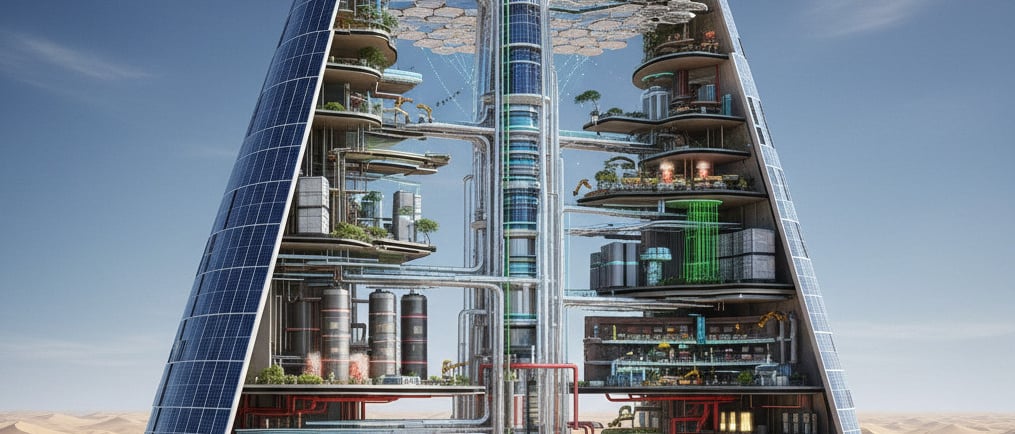
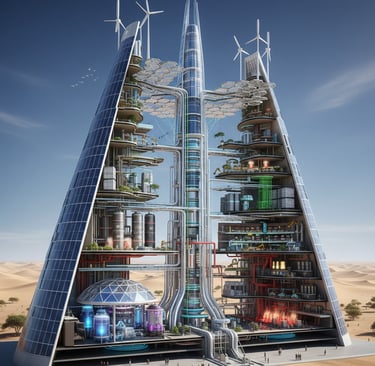
The "Arcology" Counterpoint: In contrast, the citizens of the hyper-dense, self-contained arcologies will have a completely different psychological experience. Their world is vertical, contained, and perfectly managed. This could foster a more communal, interdependent mindset, but also a potential disconnect from the external, "wilder" (though still managed) landscape. The psychological relationship between the citizens of the open Oasis Cities and the enclosed Arcologies would be a fascinating area of social study.
Perception of Distance and Time: In a landscape where one can see for a hundred kilometers and where the dominant narrative is a project spanning millennia, the human perception of time and space may be altered. A multi-day journey across the savanna to another city might be a common experience, fostering a different sense of scale. The awareness of living within a multi-generational project could also foster a longer-term perspective, a cultural patience that is absent in short-termist societies.
Pillar III: The Narrative and the "Great Work"
Human psychology is shaped by the stories we tell ourselves. The defining narrative of the Neosaharan civilization would be the Terraforming Project itself—the "Great Work."
A Purpose-Driven Society: The entire society would be organized around a single, unifying, and profoundly optimistic purpose: the creation and stewardship of a new world. This shared narrative could be a powerful antidote to the anomie and existential drift that characterized many late industrial societies. It provides a clear answer to the question, "Why are we here?"
The "Terraforming Guild" as a Cultural Ideal: The scientists, ecologists, and engineers who manage the biosphere—the "Keepers of the Planet" we've theorized—would likely hold a position of immense cultural prestige. They would be the heroes of the societal narrative. This could foster a culture that deeply values science, ecological literacy, long-term thinking, and a sense of duty.
Ancestor Veneration: The early pioneers of the project—the first engineers who laid the pipelines, the first biologists who planted the seeds—would become legendary, almost mythical figures. Their stories would be taught to every child. This form of "ancestor veneration" would reinforce the sense of being part of a continuous, multi-generational project.
Pillar IV: The Relationship with Technology and Nature
In the Neosaharan mind, the distinction between "technology" and "nature" would be almost meaningless.
Nature as Technology: The rivers, forests, and weather are, in a fundamental sense, technologies. They are systems designed and built to perform specific functions. A Neosaharan might view a river with the same mix of appreciation and analytical understanding that we might view a complex machine.
Technology as Nature: Conversely, the technology that sustains them—the AI Core, the sensor networks, the genetic code of their crops—is so deeply integrated into their living world that it would be perceived as a natural, organic part of it. The AI that manages the water grid would be seen less as a computer and more as the "mind" of the river.
The Loss of the "Naturalistic Fallacy": The belief that "natural" is inherently "good" and "artificial" is inherently "bad" would be absent. In their world, the most beautiful and life-sustaining things are the result of deliberate, artificial intervention. This could lead to a highly pragmatic and unsentimental, yet deeply appreciative, relationship with both biology and engineering.
Conclusion: The Emergence of Homo Arenaeus (Sandy Man)
The human mind is plastic, shaped by the environment it inhabits and the stories it tells. The unique conditions of the terraformed Sahara—a consciously created world, a shared sense of purpose, a landscape of immense scale, and the fusion of technology and nature—would likely, over generations, forge a new psychological archetype.
We can speculate that the "Neosaharan" citizen would be characterized by:
A deep-seated sense of ecological responsibility and a constant awareness of their dependence on a fragile, managed system.
A long-term temporal perspective, accustomed to thinking in terms of decades and centuries.
A pragmatic worldview that sees no inherent conflict between the artificial and the natural.
A profound connection to place, born from the knowledge that their world was built for them, and is now theirs to protect.
This is, of course, a speculative exercise in psycho-geography. But it is a necessary one. The Sahara Rosten Project is not just about changing the land; it is about creating a new context for human existence. The ultimate success of the project will not be measured by the biomass of its forests, but by the resilience, wisdom, and well-being of the human minds that will call this new world home.
Our next lectures will continue to explore the societal and ethical frameworks that will shape this new civilization. Thank you.