Add your promotional text...
Lecture 5: Soil Creation I: The Microbial Beachhead
Series: The Sahara Reforestation Project: From Dune Sea to Green Valley Part I: The Foundation - Analysis and Initial Interventions
3/9/20266 min read
Introduction: The Pedological Void
Welcome. In our previous lectures, we have solved, in principle, the great hydrological challenge of the Sahara. We have designed a system to generate and transport a continental-scale supply of freshwater to the desert interior. We now face a challenge that is not one of brute-force engineering, but of intricate, patient biology. The water from our grid will initially fall upon a substrate that is geologically and biologically inert. Saharan sand, primarily composed of quartz (silicon dioxide), is not soil. It is a mineral skeleton, devoid of the organic matter, nutrient cycles, and microbial life that define a living pedosphere. To pour water onto this sand without a biological intervention would be to create little more than a temporary, sterile mudflat.
This lecture marks the first truly biological step in our terraforming endeavor. We will detail the process of pedogenesis—the creation of soil—initiated not by plows and fertilizers, but by the most ancient and resilient life forms on our planet: microbes. We will outline the strategy for deploying a carefully selected consortium of extremophilic microorganisms to establish a "microbial beachhead" on the irrigated sand. Our focus will be on two key functional groups: nitrogen-fixing cyanobacteria, which will form the foundational biocrusts, and silicate-weathering bacteria, which will begin the slow process of liberating essential minerals from the sand itself. This is the genesis of a living soil.
The Starting Material: Characterizing Irrigated Sand
Before inoculation, we must understand the substrate we are working with. The irrigated Saharan sand is primarily composed of crystalline quartz grains, which are chemically very stable and nutrient-poor. The pore space between these coarse grains allows for rapid water infiltration and drainage, but provides very little water-holding capacity. Crucially, it lacks three essential components of a fertile soil:
Organic Matter: There is no humus to provide structure, retain water, and store nutrients.
Nitrogen: The atmosphere is ~78% dinitrogen (N2), but this form is inert and unavailable to plants. The sand contains virtually no fixed nitrogen (e.g., ammonia, nitrate).
Available Phosphorus and Micronutrients: While the mineral matrix contains elements like phosphorus, potassium, iron, and magnesium, they are locked within the crystalline structure of silicate minerals, making them biologically unavailable.
Our microbial consortium is designed to address these three deficiencies simultaneously. It is a multi-pronged biological assault on the sterility of the desert sand.
The First Wave: Nitrogen-Fixing Cyanobacteria and Biocrust Formation
The first and most critical limiting nutrient in this new system is nitrogen. The most efficient way to introduce it is to harness the ancient biological process of nitrogen fixation. For this, we turn to cyanobacteria.
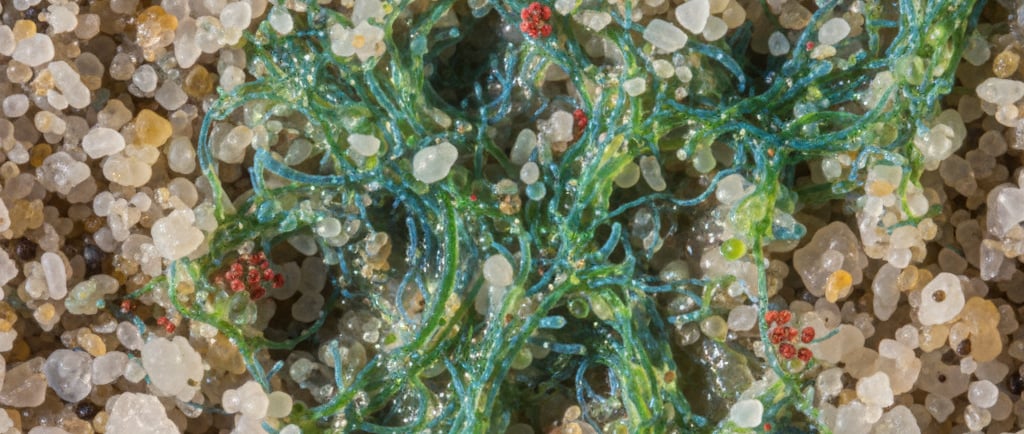
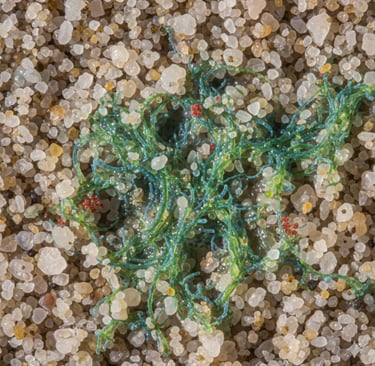
Organism Selection: The chosen species must be extremophiles, capable of tolerating intense UV radiation, high temperatures, and desiccation. Leading candidates include species from the genera Nostoc and Anabaena. These are filamentous cyanobacteria, known for their ability to form colonial mats and for their specialized cells, called heterocysts, where the oxygen-sensitive process of nitrogen fixation occurs. They are pioneers that colonize barren landscapes across Earth.
The Process of Nitrogen Fixation: Within the heterocysts, the enzyme nitrogenase catalyzes the reduction of atmospheric dinitrogen (N2) into ammonia (NH3), a biologically usable form of nitrogen. This is an energetically expensive process, fueled by photosynthesis occurring in the adjacent vegetative cells. The chemical reaction is: N2 + 8 H+ + 8 e− + 16 ATP → 2 NH3 + H2 + 16 ADP + 16 Pi.
Inoculation and Biocrust Formation: The inoculation strategy would involve the aerial spraying of a slurry containing cultured cyanobacterial cells and a hydrogel binder onto the pre-moistened sand. The hydrogel provides a temporary moist, protective microenvironment for the bacteria to establish themselves. As the cyanobacteria photosynthesize and multiply, their filamentous structures intertwine with sand grains, and they excrete copious amounts of Extracellular Polymeric Substances (EPS). This sticky matrix of polysaccharides binds the sand particles together, initiating the formation of a biological soil crust, or "biocrust."
Functions of the Biocrust: This nascent biocrust is the cornerstone of the new ecosystem. It performs several critical functions:
Soil Stabilization: It physically binds the sand, dramatically reducing wind and water erosion—a critical step in preventing the new landscape from simply blowing away.
Nitrogen Input: As the cyanobacteria fix nitrogen and eventually die and decompose, they release fixed nitrogen into the substrate, providing the first essential nutrient for other organisms.
Carbon Input: Through photosynthesis, they are the primary producers in this early system, converting atmospheric CO2 into organic carbon, which is the foundational source of energy for the entire soil food web.
Moisture Retention: The EPS in the crust can absorb and hold many times its own weight in water, creating a thin, moist layer at the surface and significantly reducing evaporative water loss from the sand below.
The establishment of a stable, functioning biocrust across the first designated greening zones is the single most important milestone of this initial biological phase, transforming a shifting, sterile surface into a stabilized, nutrient-enriching proto-soil.
The Second Wave: Silicate-Weathering Bacteria (SWB)
While the cyanobacteria provide the essential nitrogen and carbon, the rest of the plant mineral nutrient profile remains locked within the sand grains. To unlock these elements, we introduce a functional group of microbes known as silicate-weathering bacteria.
Organism Selection: The consortium would include species known for their potent mineral-solubilizing capabilities, such as those from the genera Bacillus, Pseudomonas, and Burkholderia. These bacteria are ubiquitous in terrestrial soils and have evolved sophisticated mechanisms for extracting elements from rock.
Mechanisms of Bioweathering: SWB do not physically grind the rock; they dissolve it through biochemistry. Their primary mechanisms include:
Production of Organic Acids: As part of their metabolism, these bacteria secrete a variety of low molecular weight organic acids (e.g., citric, oxalic, gluconic acid). These acids create a highly acidic microenvironment on the surface of mineral grains.
Protonation and Chelation: The protons (H+) from these acids attack the mineral lattice, displacing essential metal cations like potassium (K+), calcium (Ca2+), magnesium (Mg2+), and iron (Fe2+/Fe3+). The organic acid anions then act as chelating agents, binding to these metal ions and keeping them in a soluble, biologically available form.
Phosphate Solubilization: Phosphorus is often present in insoluble mineral forms like apatite. Many SWB are also potent phosphate solubilizers, producing phosphatases (enzymes that cleave phosphate from organic molecules) and acids that dissolve mineral phosphates, releasing soluble phosphate (PO43−) into the soil solution.
Synergy with Biocrusts: The SWB would be introduced alongside or shortly after the cyanobacteria. They would thrive within the moist, carbon-rich environment of the biocrust. The organic carbon exuded by the cyanobacteria serves as the energy source for the SWB, which, in turn, release the mineral nutrients that the cyanobacteria (and future plants) need. This creates a synergistic, self-reinforcing loop: the biocrust feeds the weathering bacteria, and the weathering bacteria feed the biocrust.
The Pace of Transformation: It is crucial to understand that this is a slow process. The rate of mineral weathering is measured on geological, not agricultural, timescales. However, at the microbial scale, the creation of a nutrient-rich biofilm on the surface of individual sand grains can occur over a matter of months to years. While we are not transforming the bulk mineralogy of the desert, we are "etching" the surfaces of the sand grains, liberating a continuous, slow-release supply of essential nutrients into the nascent soil ecosystem.
The Third Wave: Heterotrophic Decomposers
The final component of our initial microbial consortium is a diverse group of heterotrophic bacteria and fungi. Their role is decomposition and nutrient cycling.
Function: While the cyanobacteria are the primary producers, their fixed carbon and nitrogen are only made available to the wider ecosystem when they die. Decomposers are responsible for breaking down the dead microbial biomass (necromass) and other organic matter.
Nutrient Mineralization: Through this process, they mineralize organic nitrogen and phosphorus back into inorganic forms (ammonia, nitrate, phosphate) that can be taken up by living microbes and, eventually, plants. This closes the nutrient loop and prevents the essential elements from being locked away in dead organic matter.
Humus Formation: Over time, the decomposition of complex organic polymers (like the polysaccharides in EPS) contributes to the formation of humus—a stable, complex organic matter that is the hallmark of fertile soil. Humus is critical for creating soil structure (aggregation), improving water retention, and enhancing cation exchange capacity (the soil's ability to hold onto nutrients).
Deployment and Monitoring
The deployment of this three-part microbial consortium would be a continuous process, following the expansion of the water grid. Aerial inoculation would be the primary method, with the composition of the microbial slurry being constantly refined based on environmental feedback.
Monitoring the success of this microbial beachhead would be a high-tech endeavor. A combination of satellite remote sensing (to track the spectral signature of developing biocrusts) and in-situ analysis by autonomous rovers would be employed. These rovers would take soil samples, perform on-site DNA sequencing to analyze the microbial community structure (metagenomics), and use chemical sensors to measure key soil parameters like organic carbon content, nitrogen levels, and the concentration of available phosphorus.
Conclusion: The Birth of a Technosol
This lecture has outlined the first, and arguably most foundational, biological intervention in the greening of the Sahara. We have moved beyond the sterile physics of sand and water and have introduced the catalysts of life. The establishment of a microbial beachhead, led by nitrogen-fixing cyanobacteria and silicate-weathering bacteria, does not create a mature soil overnight. It creates what pedologists call a "technosol"—a soil whose properties are dominated by its technical, human-made origin.
This microbial--driven process transforms the inert desert sand in three fundamental ways: it stabilizes the surface against erosion, it initiates the biogeochemical cycling of carbon and nitrogen, and it begins the slow liberation of mineral nutrients. We are, in essence, recapitulating the first billion years of planetary evolution—when microbes alone prepared the Earth's barren lands for the eventual arrival of plants—but we are attempting to do so on a hyper-accelerated, engineered timescale.
With this living, breathing crust now established, the substrate is finally prepared for the next trophic level. Our next lecture, "Soil Creation II: Mass Production of Biochar and Compost," will discuss the large-scale industrial processes required to rapidly inject bulk organic matter into this system, dramatically accelerating the transition from a thin microbial skin to a deep, fertile soil capable of supporting complex plant life. Thank you.