Add your promotional text...
Lecture 50: The Keepers of the Planet: The Role of the "Terraforming Guild"
Series: The Sahara Reforestation Project: From Dune Sea to Green Valley Part V: Mature Ecosystems and Global Interconnections
6/22/20266 min read
Introduction: The Challenge of Deep Time
Welcome. We have spent the majority of this series detailing the scientific and engineering feats required to initiate the greening of the Sahara. We have also explored the legal, political, and economic frameworks necessary to govern it. However, all these systems share a common vulnerability: they are subject to the fluctuating winds of short-term human interests—political cycles, market forces, and shifting public opinion. The Sahara Rosten Project is not a four-year plan or a quarterly report; it is a multi-millennial endeavor. Its timescale transcends that of any government, corporation, or ideology.
How, then, can we ensure the continuity of purpose and the integrity of the project's foundational principles across dozens of human generations? A conventional bureaucracy or a democratic government, by its very nature, is ill-equipped for such deep-time stewardship. The project requires a new kind of institution, one designed for permanence, dedicated to a singular purpose, and insulated from the transient passions of the society it serves.
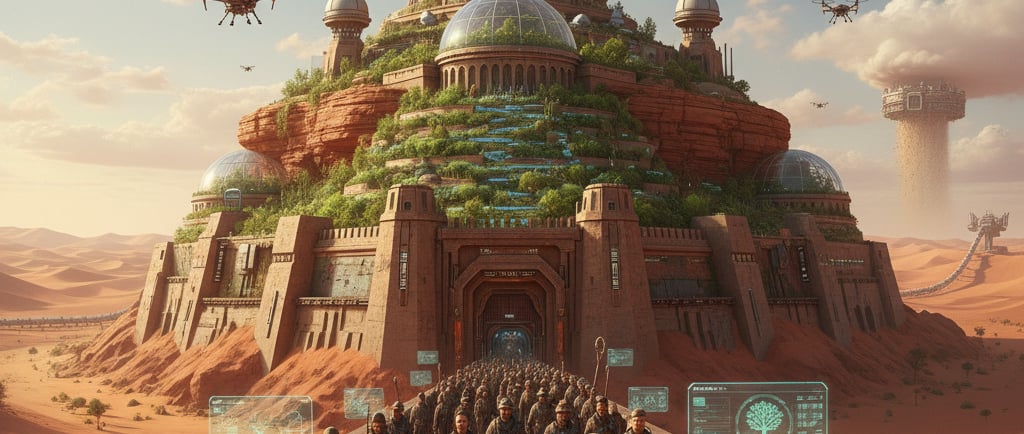
This lecture will explore a speculative but logical solution to this challenge: the creation of a specialized, semi-autonomous, and culturally revered organization we will call the "Terraforming Guild." We will posit that to manage a project on a geological timescale, a new social structure must evolve—one that blends the rigorous discipline of a scientific academy, the long-term perspective of a monastic order, and the practical authority of an engineering corps. This Guild would be the living memory and the steady hand of the terraforming project, the multi-generational stewards tasked with the sacred duty of managing the Saharan biosphere.
The Rationale for a Specialized Order: Why Conventional Governance Fails
The need for a Guild-like structure arises from the inherent limitations of traditional institutions in managing a project of this nature:
The Problem of Political Timescales: Democratic and autocratic governments alike operate on timescales of years to decades. They are driven by election cycles, five-year plans, and immediate crises. They are structurally incapable of consistently executing a 1,000-year strategy, which would require them to make sacrifices for a future they will never see.
The Problem of Market Myopia: Corporate and market-based entities are driven by profit motives, which demand returns on investment on a quarterly or annual basis. They cannot be entrusted with decisions that might require sacrificing short-term economic gain for long-term ecological stability (e.g., reducing agricultural output for a decade to allow a soil ecosystem to recover).
The Problem of Knowledge Dilution: The operational knowledge required to manage the Saharan biosphere is extraordinarily complex and interdisciplinary. In a conventional society, this expertise is fragmented across universities, government agencies, and private companies. There is a high risk of this critical, holistic knowledge being diluted, lost, or misinterpreted over generations.
The Problem of Populist Pressure: A future Saharan society might, for a variety of reasons, demand changes that are detrimental to the long-term health of the ecosystem (e.g., demanding the draining of a vital wetland for new housing, or the cessation of the unpopular but necessary prescribed burning program). A governing body must have the authority and the cultural legitimacy to resist such short-sighted pressures.
The Terraforming Guild is conceived as a solution to these problems—an institution designed for the specific and unique challenge of deep-time, planetary-scale management.
The Structure and Mandate of the Guild
The Guild would not be a secret society, but a public, formal, and integral part of the Saharan Authority's governance structure, albeit with a unique and protected status.
The Prime Directive: The Guild's actions would be governed by a foundational charter, a constitution containing the "Prime Directives" of the terraforming project. These directives would be a set of inviolable, scientifically-grounded ecological principles (e.g., "The preservation of biodiversity is paramount," "The integrity of the water cycle shall not be compromised," "The long-term sequestration of carbon must be maintained"). The Guild's primary function is to interpret and enact these principles.
A Technocratic Theocracy? No, a Scientific Stewardship: The Guild's authority would not be political in the conventional sense. It would not govern the daily lives of citizens, make laws about commerce, or conduct foreign policy. Its authority would be strictly limited to the management of the biosphere. It would have ultimate operational control over the water grid, the atmospheric management systems, the fire and wildlife ecology programs, and the genetic archives. In this domain, its authority, granted by the international treaties that founded the project, would be near-absolute.
Recruitment and Training: Membership in the Guild would not be hereditary. It would be a meritocracy of the highest order.
Induction: Promising young students from the Saharan Agricultural University and other global institutions would be identified and invited to enter a rigorous apprenticeship.
Interdisciplinary Education: The training would be intensely interdisciplinary. An apprentice would not just become a hydrologist; they would have to master ecology, climatology, genetics, systems theory, and even ethics and history. The goal is to create holistic "systems thinkers."
A Lifetime Commitment: Entry into the Guild would likely be a lifetime commitment, fostering a deep sense of institutional memory and dedication. Members would live and work within the research centers and operational hubs of the project.
The Vow of Stewardship: Upon becoming a full member, an individual might take a formal vow—a secular oath—pledging their life to the "Great Work," to the health of the biosphere, and to the well-being of future generations, above any personal, corporate, or national interest. This cultural ritual would reinforce the Guild's unique, almost sacred, role in society.
The Guild in Practice: The Mind of the Planet
In its daily function, the Guild would be the human interface for the AI Core.
AI as the Nervous System, Guild as the Brain: The AI management system (as discussed in Lecture 17) is the planet's nervous system, collecting data and performing real-time optimizations. The Guild is the executive brain. Its members would be the ones setting the strategic goals for the AI, interpreting its complex outputs, making the high-level judgment calls that are beyond the scope of the algorithm, and intervening in novel situations that the AI has not been trained for.
The Council of Disciplines: The Guild's leadership would likely be a council composed of the masters of each key discipline (the Master Hydrologist, the Master Ecologist, the Master Geneticist, etc.). This council would be responsible for making the most critical, multi-decade strategic decisions, such as initiating the next major phase of afforestation or approving the reintroduction of a new apex predator.
The Keepers of the Archive: A central role of the Guild would be to maintain the "Great Archive"—the complete physical and digital record of the entire project, including all the scientific data, engineering blueprints, ecological models, and a historical record of all decisions made and their consequences. This archive is the institution's memory, ensuring that the lessons of the past are never forgotten.
The Relationship with Saharan Society: Reverence and Tension
The relationship between the Guild and the wider, dynamic, and "messy" civilian society of the new Sahara would be complex and fascinating.
A Source of Reverence: The Guild would likely be held in high esteem, viewed as the selfless guardians of the world's well-being. The "Great Work" would be the central narrative of their culture, and the Guild members would be its high priests.
A Source of Tension: At the same time, the Guild's absolute authority over the environment would inevitably create tension. Its decisions, based on a 500-year ecological model, might conflict with the immediate economic desires of the population. A decision to decommission a farming area to allow a wetland to recover, or to restrict urban expansion to protect a wildlife corridor, would be unpopular. The Guild's ability to enforce these decisions would depend entirely on the deep cultural legitimacy and the robust legal authority granted to it by the project's founding charter.
The "Long Now" Perspective: The Guild would be the cultural embodiment of the "Long Now" philosophy—the practice of thinking and planning on multi-generational and multi-millennial timescales. It would serve as a constant, living reminder to the rest of society of their deep-time responsibilities.
Conclusion: An Institution for a New Kind of Task
The Terraforming Guild is a speculative concept, but it is born of a logical necessity. The task of managing a planetary biosphere over millennia is a new kind of task for humanity, and it demands a new kind of institution. A structure based on short-term politics or profit is guaranteed to fail.
The Guild represents a potential solution: a permanent, meritocratic, and highly specialized order, culturally and legally empowered to act as the long-term stewards of the planet. It is an institution that seeks to combine the scientific rigor of an academy, the long-term perspective of a monastery, and the practical responsibility of an engineering corps.
Its existence would be a profound statement about the maturity of our civilization—an admission that some tasks are so important, and their timescales so vast, that they must be entrusted to a dedicated and protected class of guardians who are empowered to act on behalf of the deep future. The health of the new Sahara, and the legacy of all who built it, would rest in their hands.
Our final lectures will explore the ultimate philosophical and evolutionary implications of this new world we have created. Thank you.