Add your promotional text...
Lecture 52: The New Saharan Culture: A Synthesis of Past and Future
Series: The Sahara Reforestation Project: From Dune Sea to Green Valley Part VI: The Anthropocene Redefined - A Thousand-Year Perspective
6/26/20266 min read
Introduction: The Human Imprint on a New Land
Welcome. We have spent many lectures detailing the physical and biological transformation of the Sahara, and the complex legal and governance structures required to manage it. We have built the "hardware" of a new world. Today, we turn to its "software"—the emergent, dynamic, and profoundly human system of culture. A landscape, no matter how verdant, is merely a space until it is imbued with meaning, memory, and ritual. It is culture that transforms a space into a place, a settlement into a home.
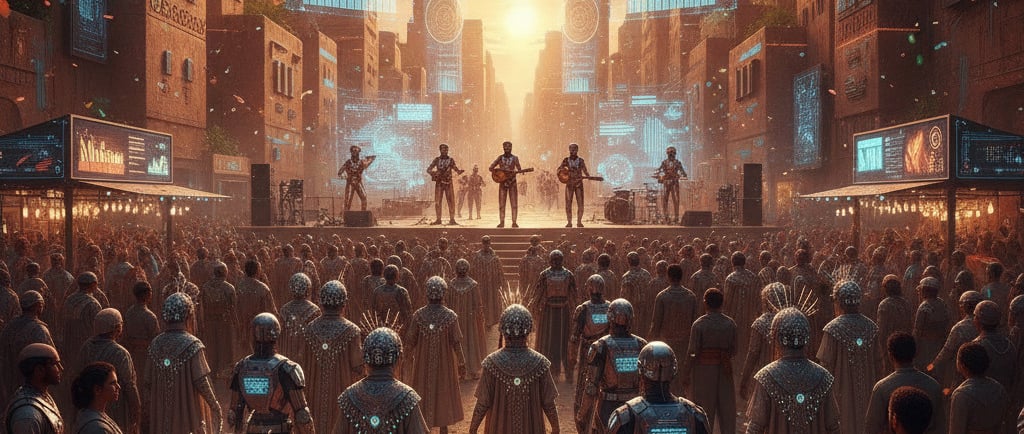
This lecture will embark on a sociological and anthropological exploration of the potential development of a unique "Neosaharan" culture. This new culture will not be a simple transplant from elsewhere, nor will it be a mere preservation of the past. It will be a dynamic synthesis, a creolization of the ancient, resilient traditions of the Sahara's indigenous nomadic peoples with the high-tech, data-driven, and multicultural society of the new settlers—the scientists, engineers, and farmers drawn from across the globe.
We will examine how this fusion will likely manifest in the new society's social structures, its art and music, its traditions and festivals, and its fundamental worldview, creating a culture as unique and as hybrid as the agroforestry ecosystems its people inhabit.
The Founding Populations: A Confluence of Worlds
The character of any new culture is shaped by its founding populations. The Neosaharan culture will be born from the confluence of two primary groups:
The Indigenous Peoples of the Sahara: Groups such as the Tuareg, the Sahrawi, the Tubu, and various Berber and Arab communities. They bring millennia of deep, place-based knowledge, a rich oral history, strong kinship structures, a profound spiritual connection to the landscape, and a cultural aesthetic forged in the crucible of aridity and mobility.
The Settler-Scientists and International Migrants: A highly educated, multicultural, and technologically adept population drawn from around the world. They bring the scientific rationalism of the project, a data-driven worldview, diverse cultural traditions from their home nations, and the shared identity of being "terra-formers."
The interaction, tension, and eventual fusion between the deep-rooted, traditional knowledge of the first group and the forward-looking, technological mindset of the second will be the primary engine of cultural evolution.
Social Structures: From Clan to Cooperative
The new social fabric will likely weave together elements of traditional kinship with new, function-based associations.
The Persistence of Kinship: The clan and extended family structures of the indigenous Saharan peoples will likely remain a central pillar of social identity, particularly in the more dispersed rural communities. These networks provide a deep sense of belonging and mutual support that a purely technocratic society cannot replicate.
The Rise of the Cooperative: The dominant economic unit in the new agricultural zones will be the cooperative, as established by the Saharan Authority's legal framework. These cooperatives, organized around the management of an agroforestry block or a water resource, will create a new, non-kin-based form of community identity, built on shared economic interest and ecological stewardship.
A Hybrid Model: Over time, these structures will likely merge. We might see cooperatives that are largely composed of, and managed by, specific clans or extended family groups. Leadership roles within the community might be a hybrid of traditional elder-based authority and meritocratic, elected positions within the cooperative's governance structure.
The Terraforming Guild: As discussed in Lecture 50, the Guild will exist as a distinct, semi-separate social class. Their prestige and unique, long-term role will set them apart, creating a dynamic of reverence, and perhaps a degree of social distance, between them and the wider civilian population.
Art and Aesthetics: A Fusion of Sand and Circuitry
The artistic expression of the Neosaharan culture will reflect its hybrid environment.
Visual Arts:
The Palette: The visual palette will be a striking combination of the earthy tones of the desert—the ochres, reds, and deep blues of the ancient landscape and sky—with the vibrant greens of the new biosphere and the metallic, functional aesthetic of the high-tech infrastructure.
Themes: We can anticipate a fusion of traditional geometric patterns found in Tuareg metalwork and textiles with the data-driven patterns generated by the project's scientific models. Imagine tapestries whose patterns are not just decorative, but are actually visualizations of a year's rainfall data, or sculptures whose forms are derived from the molecular structure of a key gene-edited plant.
Land Art: As discussed in Lecture 39, the landscape itself will be the grandest canvas, with art integrated into the very fabric of the ecosystem.
Music and Oral Tradition:
The rich oral history and poetic traditions of the Saharan peoples will be the foundation. The ancient songs of the desert, of salt caravans and stars, will persist.
These will be augmented by new epics and ballads—the "Songs of the Terra-formers"—that tell the story of the Great Work. There will be songs about the laying of the first pipeline, the blooming of the first genetically resurrected flower, the return of the Oryx, and the reawakening of the Tamanrasset River.
Musically, we might see a fusion of traditional instruments like the imzad (a single-stringed fiddle) and the tinde drum with electronic music and data sonification, where streams of real-time environmental data are converted into an ambient soundscape.
Rituals and Festivals: A New Sacred Calendar
A culture is defined by its shared rituals. The Neosaharan society will develop a new calendar of festivals that mark the key moments of their unique world.
The Day of First Flow: A major holiday commemorating the day the first desalinated water flowed into the interior, celebrated at the great reservoirs and along the riverbanks.
The Festival of the Monsoon ("Greenfall"): The most important annual festival, marking the arrival of the first biotic-pump-driven rains of the wet season. This would be a multi-day celebration of life, water, and renewal.
Harvest Festivals: Tied to the cycles of the agroforestry systems, celebrating the bounty of the new land.
The Remembrance of the Sand: A more solemn, reflective holiday, perhaps observed during the hottest, driest part of the year. This would be a time for cultural memory, for retelling the stories of the old desert and the ancestors who survived in it, ensuring that the origins of their green world are never forgotten. This ritual would be a vital psychological anchor, preventing a complete disconnect from the region's deep past.
Worldview and Philosophy: The Stewardship Ethos
Living in a consciously created and managed world will forge a unique philosophical outlook.
The Fusion of Science and Spirit: Unlike in many older cultures where science and spirituality were often seen as being in conflict, in the Neosaharan mind, they would be deeply intertwined. The scientific principles that govern the ecosystem—the water cycle, the carbon cycle, the genetic code—would be the subject of both intellectual study and spiritual reverence. The AI Core might be viewed not just as a machine, but as the embodiment of the system's holistic intelligence, an object of deep respect.
The Stewardship Ethos as Civic Religion: The "Stewardship Obligation"—the legal and moral duty to care for one's piece of the ecosystem—would become the central tenet of Neosaharan civic life. It would be the primary virtue taught to children. A person's social standing might be measured less by their material wealth and more by the demonstrable health and productivity of the land and water under their care.
A Non-Antagonistic View of Nature: The Western philosophical tradition often frames humanity in opposition to, or as a master of, a separate "Nature." For a Neosaharan, this distinction is meaningless. Nature is a human construct, and humanity is a fully integrated component of the ecosystem. This leads to a profoundly symbiotic worldview, where the health of the individual and the health of the planet are understood to be one and the same.
Conclusion: The Birth of a New Identity
The Neosaharan culture will not emerge overnight. It will be the product of centuries of interaction, adaptation, and creative synthesis. But its foundational characteristics are predictable, arising from the unique circumstances of its birth.
It will be a culture that is deeply rooted in a sense of place, yet global in its origins. It will be technologically advanced, yet grounded in a profound respect for the ecological principles that sustain it. It will honor the deep past of the desert while being oriented towards the deep future of the Great Work.
This new culture is perhaps the most important "product" of the Sahara Rosten Project. The ultimate success of the endeavor is not just in creating a new ecosystem, but in fostering a new model for human society—one that is sustainable, equitable, and has a unifying, positive purpose. The Neosaharan culture, born from the fusion of the oldest human wisdom and the most advanced human technology, could serve as a powerful and hopeful blueprint for the future of civilization on a planet where humanity must now consciously manage its own nest.
Our next lectures will continue to explore the long-term, global implications of this new civilization. Thank you.