Add your promotional text...
Lecture 53: The Geopolitical Shift: A North African Breadbasket
Series: The Sahara Reforestation Project: From Dune Sea to Green Valley Part VI: The Anthropocene Redefined - A Thousand-Year Perspective
6/29/20266 min read
Introduction: Reshaping the Global Map
Welcome. For much of modern history, North Africa and the Sahel have been characterized in the global political economy as regions of resource scarcity, climate vulnerability, and geopolitical instability. Their economies have been heavily reliant on the export of finite hydrocarbons or defined by the challenges of subsistence agriculture on the margins of an expanding desert. The Sahara Rosten Project, as we have explored, is designed to fundamentally invert this ecological reality. In doing so, it will inevitably and profoundly reshape the geopolitical landscape.
This lecture will transition our focus from the internal dynamics of the new Sahara to its external role on the world stage. We will employ the methodologies of political economy and international relations to model the long-term geopolitical consequences of North Africa's transformation into a global "breadbasket"—a major, self-sufficient, and export-oriented powerhouse of food, renewable energy, and carbon credits.
We will analyze how this shift will alter global trade routes, reconfigure regional power dynamics between Africa, Europe, and the Middle East, and create a new center of economic and political gravity. The emergence of a green and prosperous Sahara is not merely a regional event; it is a global geopolitical shift of the first order.
From Hydrocarbon Exporter to Sustainable Superpower: The New Economic Foundation
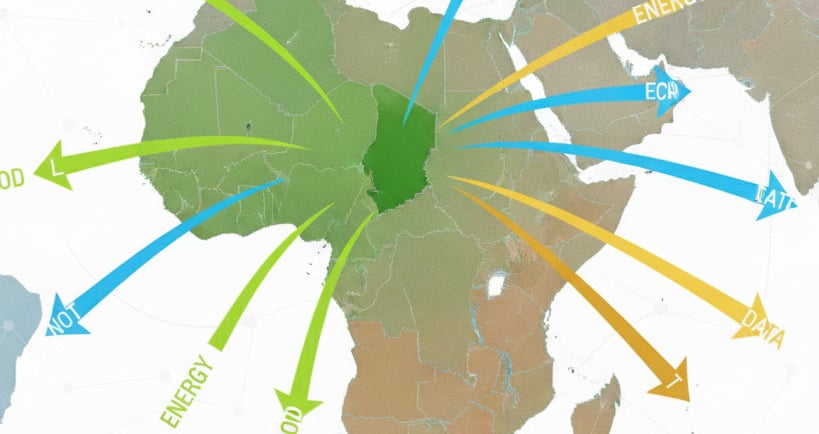
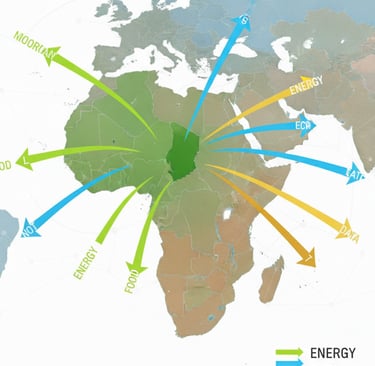
The geopolitical influence of a region is inextricably linked to its economic output and its control over critical global resources. The mature Neosaharan economy, as designed, will be built on three export pillars that are perfectly aligned with the primary challenges of the 21st and 22nd centuries: food security, energy transition, and climate mitigation.
Pillar I: The Agricultural Breadbasket (Food Power):
The Output: With millions of square kilometers of newly fertile, sustainably irrigated land, the Sahara will become one of the world's largest food-producing regions. It will achieve not only regional self-sufficiency but will become a massive net exporter of grains (sorghum, millet, wheat), proteins (from livestock and aquaculture), fruits, and high-value horticultural products.
Geopolitical Impact: In a world facing a growing population and increasing agricultural disruption from climate change in traditional breadbaskets (e.g., due to drought in North America, flooding in South Asia), the Sahara's stable, climate-controlled output will be a critical component of global food security. The Saharan Authority will wield significant "food power," influencing global commodity markets and holding immense leverage in diplomatic relations, particularly with food-importing nations in the Middle East and sub-Saharan Africa.
Pillar II: The Solar Powerhouse (Energy Power):
The Output: The vast solar energy infrastructure built to power the project will generate an enormous surplus of clean electricity. This will be exported via a network of High-Voltage Direct Current (HVDC) sub-sea and terrestrial cables.
Geopolitical Impact: The primary market for this energy will be Europe, which will be seeking to fully decarbonize its economy. By becoming a primary, non-intermittent (due to CSP with storage) source of renewable energy for Europe, the Sahara fundamentally alters the EU's energy security calculus. It reduces European dependence on politically volatile gas suppliers (like Russia) and creates a deep, symbiotic economic interdependence between the two continents. This "Africa-Europe Supergrid" becomes a major axis of global energy politics.
Pillar III: The Carbon Sink (Climate Power):
The Output: As established in Lecture 24, the project will sequester gigatons of CO2 annually, generating a massive supply of high-quality, verifiable carbon removal credits.
Geopolitical Impact: In a global economy governed by stringent carbon pricing and net-zero commitments, these credits will be a mandatory purchase for nations and corporations that are unable to fully decarbonize their own operations. The Saharan Authority will become the "central bank" of the global carbon market, controlling the supply of one of the world's most valuable commodities. This gives it unparalleled influence in international climate negotiations and the ability to finance its own operations and development in perpetuity.
Reconfiguring Regional Power Dynamics
The emergence of this new economic superpower in North Africa will radically reconfigure the existing geopolitical landscape.
The Rise of a Unified North Africa: The Saharan Authority, as the transnational body governing the project, will necessarily become the most powerful political and economic entity in North Africa. The shared interest in the project's success will likely foster unprecedented economic and political integration among the host nations (Morocco, Algeria, Tunisia, Libya, Egypt, etc.), potentially leading to the formation of a powerful new regional bloc, a "Saharan Union." This union, backed by its immense economic output, would become a major new pole in a multipolar world.
The Africa-Europe Relationship: The relationship will shift from one of post-colonial aid and resource extraction to one of strategic interdependence. Europe will depend on the Sahara for energy, food, and climate stability. The Sahara will depend on Europe for technology, investment, and as a primary export market. This creates a more balanced and co-dependent partnership, fundamentally altering the dynamics of Mediterranean politics.
The Middle East and the Gulf States: The traditional hydro-political tensions of the Middle East will be reshaped. The Sahara's ability to export vast quantities of food and potentially even bulk freshwater (via supertankers) could alleviate some of the region's most acute resource scarcities. The Gulf hydrocarbon economies, facing a post-oil future, might become major investors in the Saharan project, seeking to transfer their wealth from fossil fuels to the new sustainable economy.
The Sahelian Transformation: The nations of the Sahel, directly south of the Sahara, will be transformed from being on the front lines of desertification to being the immediate neighbors of a burgeoning economic and ecological powerhouse. The revived monsoon will stabilize their own agriculture, and the Saharan economy will provide a massive new market and source of employment, likely reversing historical migration patterns.
Altering Global Trade and Infrastructure
The sheer scale of the Sahara's new economy will physically alter the globe's logistical and trade infrastructure.
New Trans-Saharan Trade Routes: The project will necessitate the construction of new high-speed rail lines and transport corridors across the Sahara, connecting the Mediterranean coast with the Sahel and sub-Saharan Africa. This will resurrect the ancient trans-Saharan trade routes in a modern form, creating the most direct land-based trade route between Europe and Central/West Africa.
Port Development: The North African coast will see the development of massive new "eco-ports," designed for the export of agricultural goods and the import of materials for the project. These ports will be integrated with the solar energy grid and the desalination plants.
Shifts in Global Commodity Flows: Global markets for grain, renewable energy, and carbon will be fundamentally altered. The Sahara's massive, stable output will likely act as a price stabilizer in what are currently volatile markets.
Geopolitical Risks and Strategic Vulnerabilities
This new concentration of power and resources also creates new strategic vulnerabilities.
The "Water Grid" as a Target: The continental water grid, with its thousands of kilometers of pipelines, is the project's Achilles' heel. It would be a high-value target for state or non-state actors seeking to destabilize the region. Securing this infrastructure would be a primary strategic concern for the Saharan Authority and its international partners.
Economic Dependency: While creating interdependence, the energy and food links also create vulnerabilities. Europe's reliance on Saharan energy could become a point of political leverage, just as its reliance on other energy sources has in the past.
Internal Stability: The distribution of the immense wealth generated by the project among the populations of the host nations will be a critical challenge. Failure to ensure equitable benefit-sharing could lead to internal social and political instability, threatening the entire project.
Conclusion: A New Center of Gravity
The greening of the Sahara is a project that begins with ecology but ends with a fundamental reordering of the global political and economic landscape. By transforming a region of scarcity into a global hub of sustainable production, the project creates a new center of gravity in the world system.
The emergence of a unified, prosperous, and powerful Saharan bloc, built on the exports of food, clean energy, and climate security, will shift the balance of power between continents. It will redefine the relationship between Africa and Europe, creating a new axis of co-dependence. It will provide a powerful new model for large-scale, post-fossil fuel economic development.
The geopolitical consequences, both positive and negative, will be immense. The management of these new power dynamics, the equitable distribution of the new wealth, and the security of the new infrastructure will be the defining challenges of international relations in the 22nd century. The Sahara Rosten Project does not just create a new ecosystem; it creates a new world order.
Our next lectures will continue to explore the long-term, philosophical, and evolutionary implications of this new human epoch. Thank you.